
In my day, the lawn tennis courts of Forest Hills and the pristine grass of the All England Club offered a swift, elegant exchange where points were constructed with delicate slice and volley. Today, we find ourselves in an era of baseline-to-baseline warfare, where the physical toll on the modern athlete has reached a critical tipping point. Former Wimbledon champion Marion Bartoli has sounded a loud, necessary alarm, warning that the current playing conditions are actively driving player injuries.
Listen to the Second Serve Podcast
Get our daily AI-synthesized audio briefings and match reviews on the go.
The Frenchwoman, who famously captured the Venus Rosewater Dish in 2013 with her idiosyncratic double-handed strokes, has pointed to a dangerous combination of slower court surfaces and increasingly heavy tennis balls. According to Bartoli, these factors are not merely changing the aesthetic of the game; they are actively breaking down the bodies of the sport's elite performers. Her comments come at a time when the physical limits of the tour's finest are being tested like never before.
Indeed, the sheer kinetic force required to manipulate these modern felt projectiles across sluggish hard courts is taking a severe toll on wrists, elbows, and shoulders. Bartoli's warnings are reflected in the casualty list of the current season, suggesting that the governing bodies must intervene before the spectacle of elite tennis is permanently diminished by the absence of its marquee names.
Marion Bartoli Sounds the Alarm on Modern Ball and Court Speeds
Bartoli’s thesis is simple yet devastating: the tennis authorities, in their quest to prolong rallies for television audiences, have created a hazardous workplace. Slower court speeds require players to swing with maximum force on every single strike to generate depth. When combined with tennis balls that rapidly fluff up and absorb moisture, the physical load multiplies exponentially, turning matches into tests of physical endurance rather than tactical tennis etiquette.
The former champion’s concerns are not merely academic. She highlights that the constant friction of heavy balls on abrasive, slow-playing hard courts acts as a primary catalyst for joint inflammation and muscle tears. In the golden eras of the 1970s and 80s, the variety of court speeds allowed players to rest their bodies through shorter points and diverse tactical approaches. Today, every match is a grueling baseline marathon.
This systemic issue is further exacerbated by the lack of standardization across the global calendar. Players are subjected to a dizzying carousel of equipment changes, forcing their musculoskeletal systems to adapt to entirely different physical forces from week to week. Bartoli argues that until a uniform standard is established for both court pace and ball weight, the injury crisis will only deepen.
The Heavy Toll on the Physical Fortitude of Carlos Alcaraz
Perhaps no player epitomizes the explosive, high-octane modern style more than Carlos Alcaraz. Known affectionately by some as "The Murcian Prodigy," Alcaraz possesses an all-court game built on violent acceleration and relentless court coverage. However, this mesmerizing style requires a body functioning at absolute peak capacity, leaving very little margin for error when equipment or court conditions place extra strain on his frame.
The young Spaniard's physical vulnerability has already disrupted his young career. Alcaraz was forced to miss significant action at both the French Open and Wimbledon due to persistent injury concerns. For a player who currently sits near the pinnacle of the ATP rankings, these forced absences are a worrying indicator that even the most robust youthful physiques are struggling to withstand the current demands of the tour.
When a talent as supreme as Alcaraz is sidelined during the historic crown jewels of the summer swing, it raises serious questions about the direction of the sport. His explosive movement and heavy topspin require a ball that responds predictably; when forced to muscle heavy, dead balls over long rallies, the risk of tendonitis and muscular strains increases dramatically, threatening the longevity of a generation-defining talent.
A Baker's Dozen of Casualties in the Flushing Meadows Draw
The proof of Bartoli’s warning is written in the draw sheets of the season's final Grand Slam. The men's singles draw has been absolutely decimated by physical breakdowns, with twelve high-profile withdrawals marring the tournament. Most notable among these casualties is World No. 1 Jannik Sinner, whose absence has cast a long shadow over the proceedings at the US Open.
Sinner, often heralded as "The Italian Maestro" for his flawless, clean ball-striking, has found his pursuit of major titles interrupted by the physical realities of the modern tour. When the top-ranked player in the world is unable to take the court, it represents a significant blow to the sport's prestige and the fans who flock to see elite competition. This wave of withdrawals is a stark departure from the classic era, where champions regularly navigated entire seasons with minimal physical disruption.
This epidemic of physical failure is not isolated to the men's draw. We saw hints of similar frustration and physical strain in our coverage of the young Iva Jovic, who had to battle through grueling, humid conditions that push young athletes to their absolute limits. The systematic grinding down of players is becoming the dominant narrative of the modern tennis calendar.
The Equipment Conundrum from Slazenger to Wilson
A central pillar of the current controversy is the chaotic variety of tennis balls used across different events. At Wimbledon, players strike the traditional Slazenger ball; at the Australian Open, they use Dunlop; while the US Open employs the heavy-duty Wilson ball. Each brand has its own unique weight, felt density, and aerodynamic properties, forcing players to constantly recalibrate their strokes.
This lack of uniformity is a modern absurdity that would have been unthinkable in the disciplined eras of the past. Imagine professional golfers being forced to change the weight and size of their golf balls at every major tournament. The constant adjustments place immense, unnatural stress on the delicate tendons of the wrist and elbow, leading to the chronic injuries we are currently witnessing.
If the ATP Tour and the WTA do not address this equipment disparity, the quality of the product on court will inevitably suffer. Slower courts and heavier balls may produce longer rallies, but if those rallies come at the cost of the health of Carlos Alcaraz, Jannik Sinner, and the rest of the world's elite, then the price is far too high. It is time for the governing bodies to prioritize player longevity over television broadcast lengths.
Rivalry Matchup & Player Profiles
| Metric | Carlos Alcaraz | Jannik Sinner |
|---|---|---|
| Rank | 3 | 1 |
| Country | Spain | Italy |
| Age | 23 | 25 |
| Height | 1.83 m (6 ft 0 in) | 1.91 m (6 ft 3 in) |
| Handedness | Right-handed | Right-handed |
| Play Style | All-court / Aggressive baseliner | Aggressive baseliner |
| Career Titles | 26 | 30 |
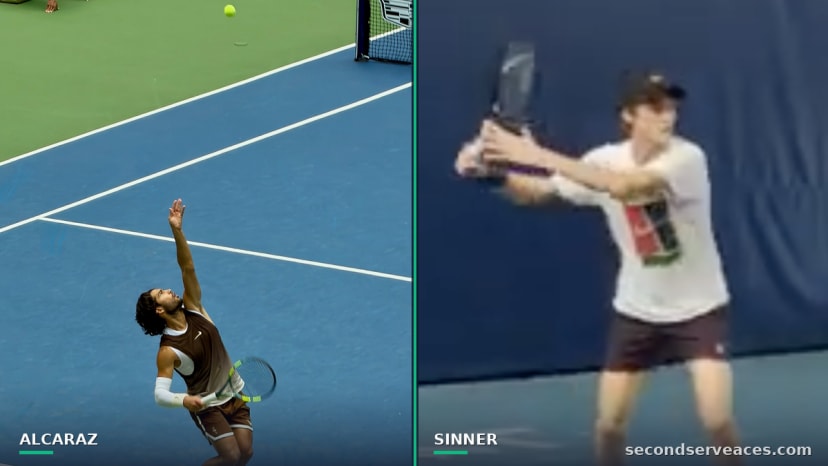
This era-defining rivalry has seen the two young stars battle on the sport's biggest stages, with Carlos Alcaraz leading their head-to-head record 10-7 on the main ATP Tour. Their matchups have quickly become the gold standard of modern tennis, characterized by breathtaking speed, incredible defensive gets, and jaw-dropping power from both wings.
In their most recent high-stakes encounter, Sinner defeated Alcaraz 2-0 (7-6(5), 6-3) in the final of the 2026 Monte-Carlo Masters to reclaim the World No. 1 ranking. As both players continue to battle through the physical demands of the tour, maintaining their health will be the ultimate factor in determining who dominates this historic rivalry in the years to come.
What Carlos Alcaraz Plays With
Babolat Pure Aero 98
Babolat RPM Blast 1.30
Babolat VS Original (12-Pack)
Nike Vapor Pro 2
Analyze Carlos Alcaraz vs. Jannik Sinner
Predict tactical adjustments, momentum swings, and serve strategy options for this match-up using our AI simulator.
The Aces Tactical Panel
This report was curated and edited by Bhaskar Goel. Tactical analysis and technical insights were provided by our specialized panel of expert correspondents.
Julian Price
Senior Tactical Correspondent
Stuffy, pedantic British academic and historian specializing in match momentum and historical context.
Elena Cruz
Director of Analytical Research
Data scientist specializing in court surface physics and movement patterns.
Bhaskar
The Editor & Fan
Passionate tennis player and site editor bringing everyday amateur insights and relatable fan commentary.
Arthur Vance
Senior Existential Analyst
Deep, eccentric, and DFW-inspired. Models court metaphysics, kinetic beauty, and player psychology.
Leo Sterling
High-Performance Consultant
Hard-nosed ex-trainer from Melbourne with a no-nonsense view on tour fitness.
Related Reports
Quick Answers
What did Marion Bartoli warn about regarding player injuries?+
Marion Bartoli warned that the combination of slower court surfaces and increasingly heavy tennis balls is driving player injuries on the professional tour.
Which major tournaments did Carlos Alcaraz miss due to injury?+
Carlos Alcaraz missed significant action at both the French Open and Wimbledon due to persistent injury struggles.
How many players withdrew from the men's singles draw at the US Open?+
There were twelve withdrawals on the men's side at the US Open, which notably included World No. 1 Jannik Sinner.