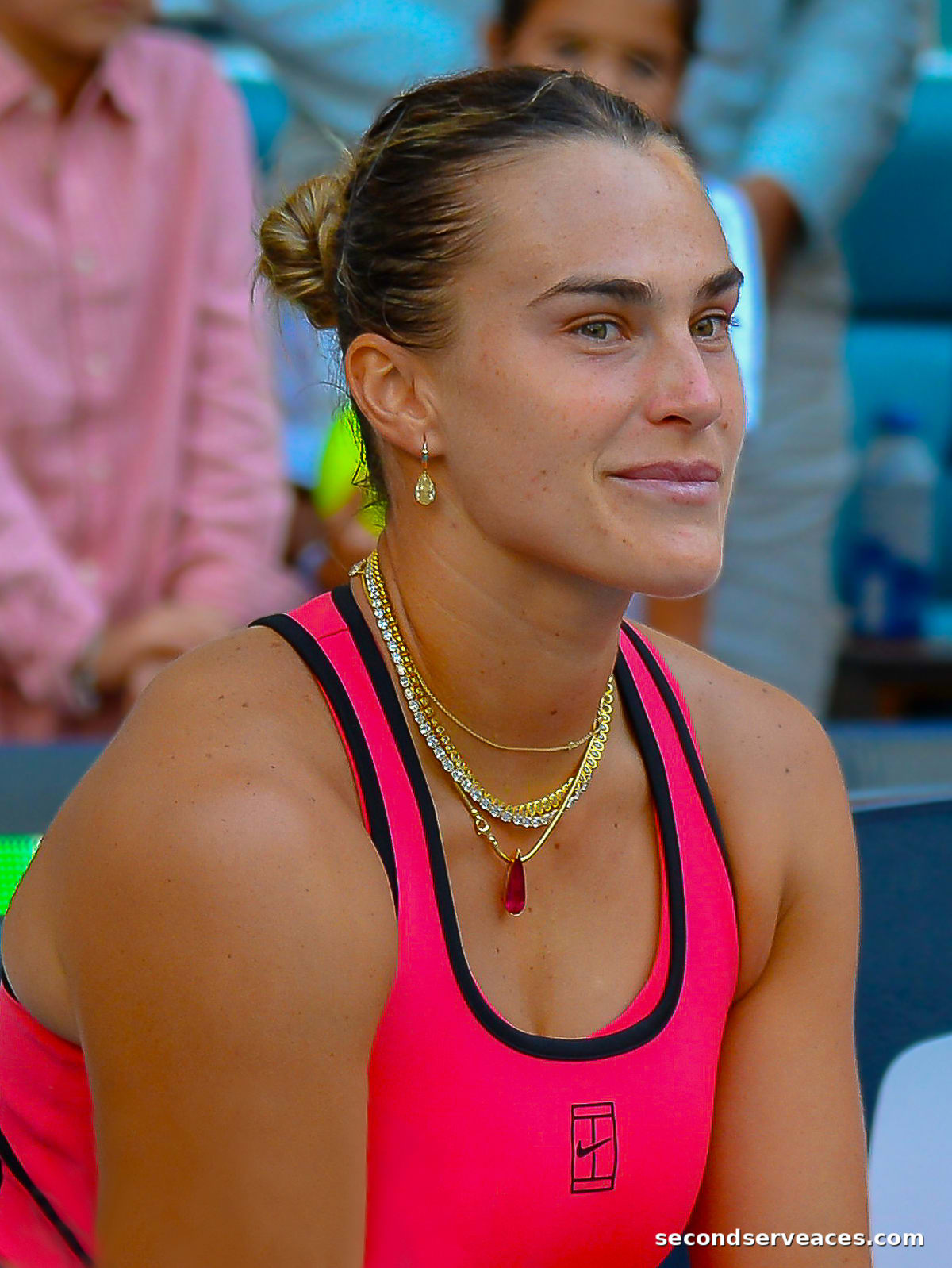
In professional tennis, elite performance requires absolute technical calibration, especially when environmental variables threaten mechanical execution. Following her defeat in the 2025 Roland-Garros final against Coco Gauff, world No. 2 Aryna Sabalenka drew sharp criticism for her post-match assessment. Rather than analyzing her technical margins, Sabalenka lamented that she played her worst tennis in months, citing terrible clay-court conditions as the primary catalyst for her defeat.
Listen to the Second Serve Podcast
Get our daily AI-synthesized audio briefings and match reviews on the go.
While players often struggle to control their topspin under heavy wind, Sabalenka's public complaints did not sit well with tennis royalty. Eighteen-time Grand Slam champion Chris Evert expressed immediate shock at the Belarusian's remarks. Evert pointed out that adapting to shifting winds and clay-court dampness is a fundamental requirement of championship tennis, not an excuse for erratic baseline errors. While peers occasionally offer support, as we explored in our coverage of locker-room dynamics, Evert's critique highlights the high standards expected at the sport's pinnacle.
Wind, Clay, and the Limits of Power Baseline Play
From a technical perspective, Sabalenka's heavy, flat groundstrokes require precise timing. When high winds disrupt the ball's flight path, players who rely on extreme power must increase their physical margins by targeting larger areas of the court. Instead, Sabalenka’s high-risk style faltered under pressure, leading to a high unforced error count that ultimately handed the advantage to Gauff's elite defensive tracking.
Evert's critique cuts to the heart of tactical durability. On clay, the ball's bounce is inherently unpredictable, meaning players must rely on footwork adjustments and shorter backswings to maintain control. Sabalenka's refusal to adapt her swing mechanics in the wind exposed a vulnerability that her opponents will undoubtedly seek to exploit in future clay-court campaigns.
Hard Court Hardships and the Search for Technical Calibration
This struggle to close out major finals has not been isolated to the Parisian clay. Sabalenka's high-octane game also faced severe tests on hard courts, most notably during her run to the US Open final. While the faster surface at Flushing Meadows generally rewards her aggressive baseline play, it also demands immense mental discipline when rallies extend past the five-shot threshold.
In New York, Sabalenka was pushed to the limit in a grueling three-set final by Elena Rybakina, who eventually wore down the Belarusian's defenses. To track her standing among the game's elite, fans can consult the official WTA Tour Home. For a closer look at her hard-court performance, you can read our analysis of her US Open final performance, which details how minor mechanical deviations can derail her baseline consistency.
Rivalry Matchup & Player Profiles
| Metric | Aryna Sabalenka | Elena Rybakina |
|---|---|---|
| Rank | No. 2 | No. 1 |
| Country | Belarus | Kazakhstan |
| Age | 28 | 27 |
| Height | 1.82 m (6'0") | 1.84 m (6'0") |
| Handedness | Right-handed | Right-handed |
| Play Style | Aggressive baseliner | Aggressive baseliner |
| Career Titles | 24 | 14 |
Aryna Sabalenka holds a narrow 10-8 lead in her overall head-to-head matchup against Elena Rybakina. Both players employ an ultra-aggressive baseline style, relying on massive first serves and flat groundstrokes to dictate play from the very first ball. This technical similarity often results in highly volatile, high-margin contests where small shifts in momentum decide the outcome.
However, Rybakina claimed the upper hand in their most high-stakes recent meeting, securing a 6-4, 5-7, 6-2 victory in the 2026 US Open final. That win not only secured the title for the Kazakhstani star but also propelled her to the world No. 1 ranking, proving that Rybakina's ability to maintain her technical discipline under pressure remains a major hurdle for Sabalenka's ambitions.
What Aryna Sabalenka Plays With
Wilson Blade 98 v9 (16x19)
Luxilon ALU Power 125
Analyze Aryna Sabalenka vs. Elena Rybakina
Predict tactical adjustments, momentum swings, and serve strategy options for this match-up using our AI simulator.
The Aces Tactical Panel
This report was curated and edited by Bhaskar Goel. Tactical analysis and technical insights were provided by our specialized panel of expert correspondents.
Julian Price
Senior Tactical Correspondent
Stuffy, pedantic British academic and historian specializing in match momentum and historical context.
Elena Cruz
Director of Analytical Research
Data scientist specializing in court surface physics and movement patterns.
Bhaskar
The Editor & Fan
Passionate tennis player and site editor bringing everyday amateur insights and relatable fan commentary.
Arthur Vance
Senior Existential Analyst
Deep, eccentric, and DFW-inspired. Models court metaphysics, kinetic beauty, and player psychology.
Leo Sterling
High-Performance Consultant
Hard-nosed ex-trainer from Melbourne with a no-nonsense view on tour fitness.
Related Reports
Quick Answers
Why did Chris Evert criticize Aryna Sabalenka after the 2025 Roland Garros final?+
Chris Evert expressed shock at Sabalenka's post-match comments, emphasizing that elite players must learn to adjust their tactics to windy conditions rather than blaming the environment.
Who did Aryna Sabalenka lose to in the 2025 Roland Garros final?+
Aryna Sabalenka lost the 2025 Roland Garros final to American Coco Gauff.
How did Aryna Sabalenka perform against Elena Rybakina at the US Open?+
Sabalenka reached the US Open final but was defeated by Rybakina in a tight three-set match.