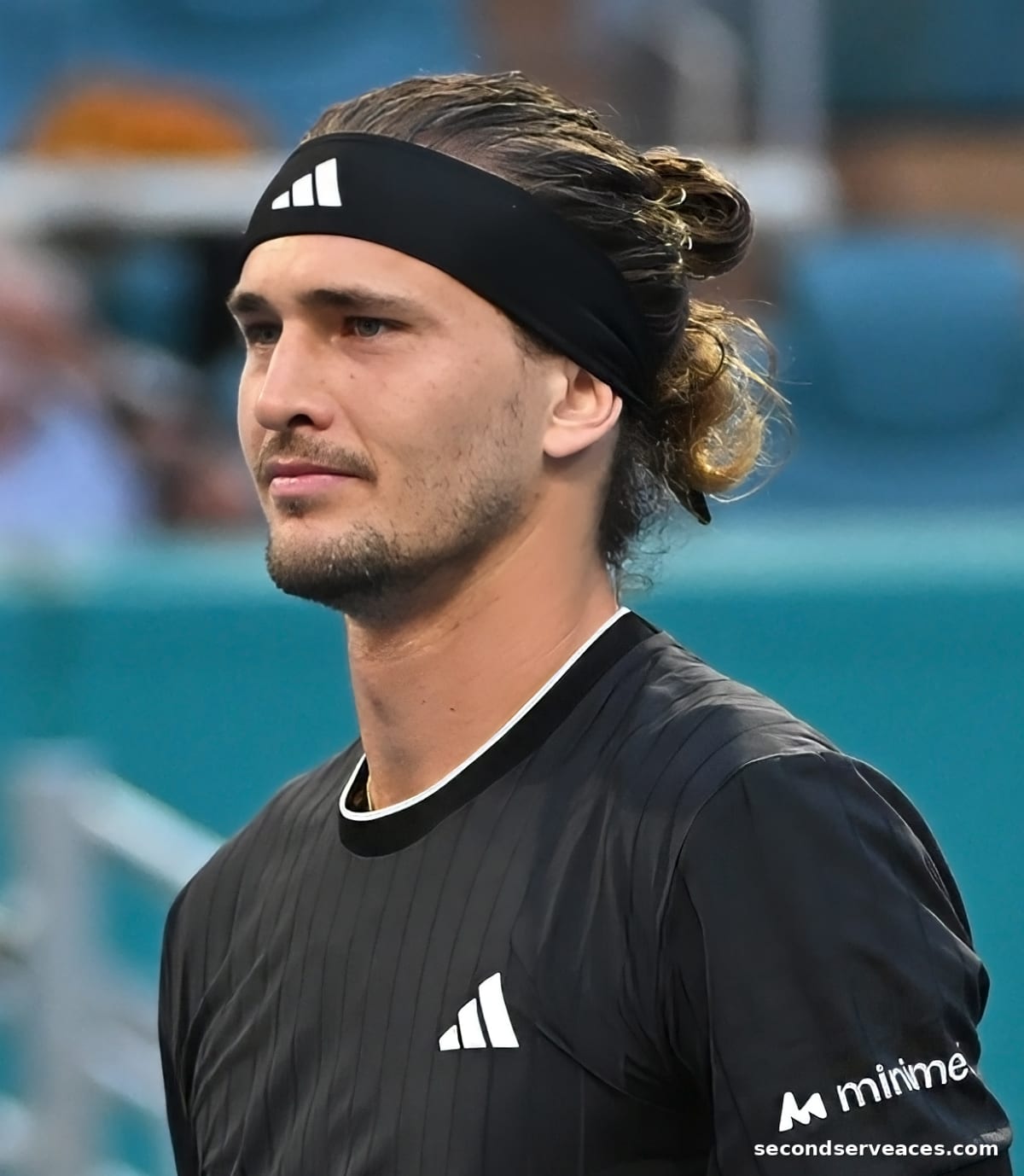
The transition from the grueling, slide-heavy clay of Paris to the slick, low-bouncing lawns of Westphalia is always a jarring exercise in kinetic recalibration. For Alexander Zverev, fresh off a grueling clay campaign, his opening match at the Terra Wortmann Open in Halle against qualifier Vit Kopriva was a stark reminder of how unforgiving grass can be to those who stand 6'6" and prefer to dictate play from the deep baseline. Zverev ultimately secured a 6-3, 4-6, 6-2 victory on Tuesday, but the match itself was quickly overshadowed by the German's post-match excursions into tennis historiography.
Listen to the Second Serve Podcast
Get our daily AI-synthesized audio briefings and match reviews on the go.
The Grass Transition and the Kinetic Math of Kopriva’s Resistance
During the opening set, Zverev looked reasonably comfortable, utilizing his massive first serve to dictate play and keeping his unforced error count low. Kopriva, a player accustomed to the lower rungs of the professional tour, initially struggled with the sheer velocity of Zverev's delivery. However, the second set saw a dramatic shift in match momentum. Kopriva began taking the ball earlier, exploiting Zverev’s deep return positioning by executing short-angled groundstrokes that forced the top seed into awkward, lunging movements.
Zverev’s return points won on first serve plummeted in that second set, as he struggled to find his footing on the lush green surface. The physical toll of the clay season seemed to linger in his lateral movements, leading to a series of mistimed backhands. Kopriva seized his opportunity, breaking Zverev’s serve late in the set to level the match and send a wave of tension through the crowd in Halle.
The decider, however, saw Zverev reassert his authority. He increased his first-serve percentage and began attacking the net with greater frequency, winning 80% of his first-serve points in the final set. The final scoreline of 6-3, 4-6, 6-2 was a testament to Zverev's resilience, but it was his subsequent press conference that truly set the tennis world ablaze.
The Retroactive Mythmaking of the 2016 Halle Semifinal
In his post-match press conference, Zverev was asked about his comfort levels on grass, a surface that has historically been his most challenging. In an attempt to bolster his grass-court credentials, Zverev pointed back to his 2016 victory over Roger Federer in the Halle semifinals (7-6(4), 5-7, 6-3). Zverev asserted that beating Federer at that specific tournament, when the Swiss legend was allegedly at his "peak," gave him the ultimate confidence that his game translates perfectly to grass.
This assertion immediately drew sharp criticism and backlash from fans and historians alike. To suggest that Roger Federer was at his "peak" in 2016 is to engage in a highly creative, if not entirely solipsistic, rewriting of tennis history. The year 2016 was, by almost any objective metric, one of the most physically compromised and difficult seasons of Federer's illustrious career.
Elite athletes often construct personal myths to survive the psychological demands of the tour, but Zverev’s retroactive elevation of his 2016 opponent felt, to many, like an attempt to inflate his own grass-court pedigree. The fan reaction online was swift, pointing out the vast discrepancy between Zverev's memory and the actual historical record of that season.
The Statistical Reality of a Knee-Hobbled Swiss Icon
Let us look at the cold, hard data. In February of 2016, Federer underwent arthroscopic knee surgery to repair a torn meniscus—an injury sustained not on a tennis court, but while preparing a bath for his twin daughters. This surgery forced him to miss the French Open, snapping his historic streak of 65 consecutive Grand Slam appearances. He arrived in Halle with very little match play and his movement visibly compromised.
According to the official records on the ATP Tour Home, Federer's 2016 season was cut short immediately after Wimbledon so he could focus on recovering from his knee injury. He did not win a single title that year, making it his first title-less season since 2000. To frame this version of Federer as "peak" is an insult to the vintage that dominated the mid-2000s or even the resurgent version that won multiple majors in 2017 and 2018.
For Zverev, whose career achievements and statistics are detailed extensively on Wikipedia, this victory remains a cornerstone of his grass-court identity. However, the tennis public has a long memory, and attempting to rewrite the physical state of a beloved icon to boost one's own self-belief is a tactical error in public relations.
The Tactical Horizon: Facing Hanfmann and the Search for Validity
The debate over historical peaks must now yield to immediate tactical realities. Zverev's next test in Halle comes against compatriot Yannick Hanfmann, a player who possesses a flat, heavy ball strike that can penetrate the grass court with alarming speed. Hanfmann will not offer the same rhythm as Kopriva, and Zverev's deep return position will be severely tested on the slick German lawns.
As we analyzed in our Zverev vs. Hanfmann Halle Preview, Zverev's tendency to drop far behind the baseline can be fatal on grass. On this surface, giving up court positioning allows an aggressive opponent to dictate play with first-strike tennis, rendering Zverev's defensive skills far less effective than they are on clay.
To progress deep in Halle and build genuine momentum, Zverev must rely less on the myths of 2016 and more on the mechanical adjustments of 2024. He must improve his low-volley transition, shorten his backswings, and maintain a high first-serve percentage to avoid being dragged into another grueling three-set battle against Hanfmann.
What Alexander Zverev Plays With
Head Gravity Pro
Head Hawk Touch 1.25
Analyze Alexander Zverev vs. Vit Kopriva
Predict tactical adjustments, momentum swings, and serve strategy options for this match-up using our AI simulator.
The Aces Tactical Panel
This report was curated and edited by Bhaskar Goel. Tactical analysis and technical insights were provided by our specialized panel of expert correspondents.
Julian Price
Senior Tactical Correspondent
Stuffy, pedantic British academic and historian specializing in match momentum and historical context.
Elena Cruz
Director of Analytical Research
Data scientist specializing in court surface physics and movement patterns.
Bhaskar
The Editor & Fan
Passionate tennis player and site editor bringing everyday amateur insights and relatable fan commentary.
Arthur Vance
Senior Existential Analyst
Deep, eccentric, and DFW-inspired. Models court metaphysics, kinetic beauty, and player psychology.
Leo Sterling
High-Performance Consultant
Hard-nosed ex-trainer from Melbourne with a no-nonsense view on tour fitness.
Related Reports
Quick Answers
What was the score of Alexander Zverev's first-round match in Halle?+
Alexander Zverev defeated Vit Kopriva 6-3, 4-6, 6-2 in the first round of the Terra Wortmann Open.
Why did Alexander Zverev's comments about Roger Federer cause backlash?+
Zverev claimed his 2016 victory over Federer in Halle was against Federer at his 'peak,' but fans pointed out that Federer was actually recovering from knee surgery and missed most of the 2016 season.
Who will Alexander Zverev play in the second round in Halle?+
Alexander Zverev is scheduled to face fellow German Yannick Hanfmann in the second round.