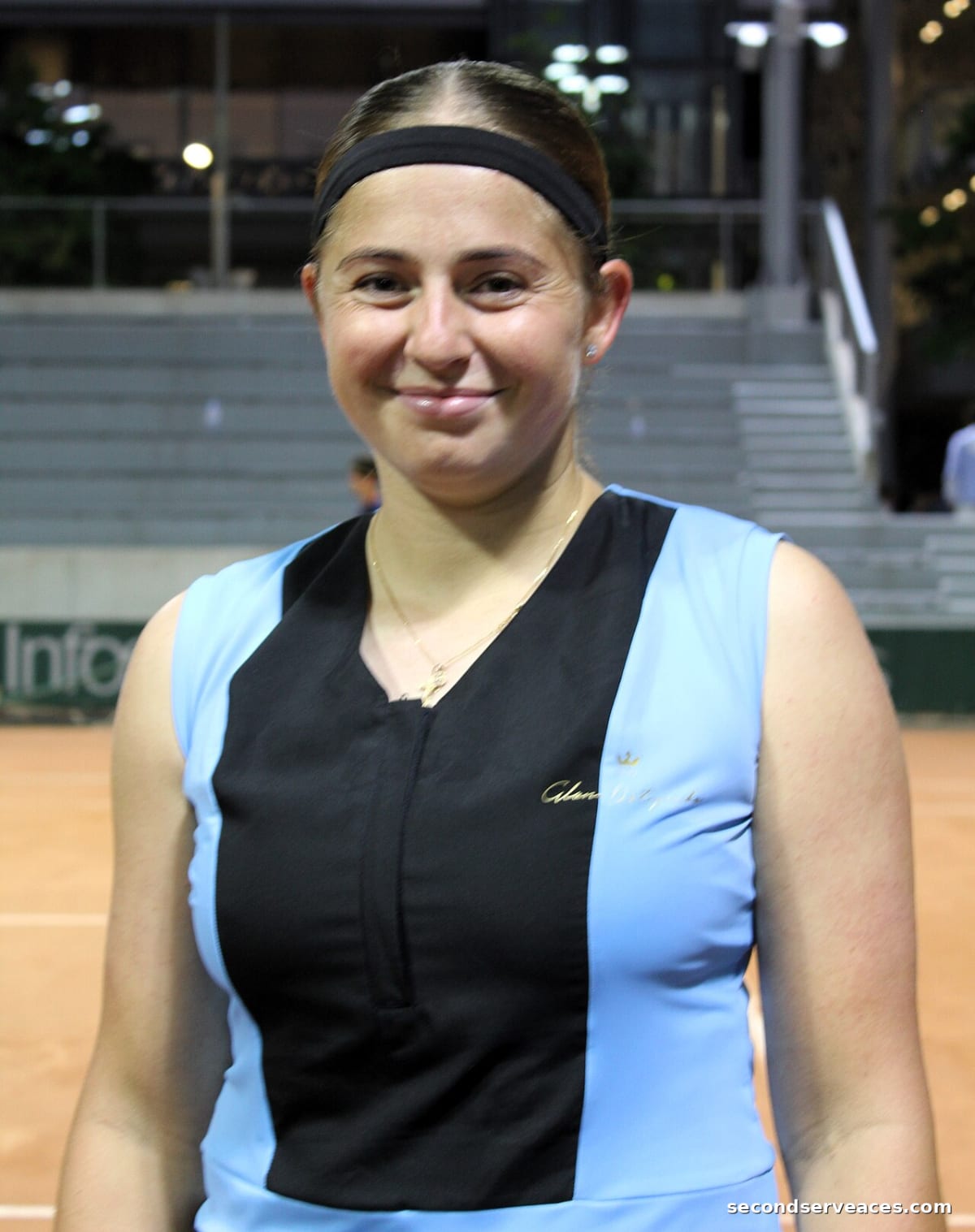
Low-Bounce Adjustments and Flat Firepower: Ostapenko's Kinetic Efficiency
To succeed on the slick, low-bouncing surfaces of Eastbourne, a player must adjust their strike zone. Unlike clay, where players can wait for the ball to rise and drop, grass-court efficiency demands that you meet the ball early, often with a shortened backswing to handle the erratic, skidding bounce. Former champion Jelena Ostapenko put on an absolute clinic in kinetic efficiency during her opening match of the grass season. The third seed dropped a mere four games and remained completely unbroken, showcasing a highly calibrated flat-hitting masterclass that gave her opponent zero time to organize a defensive response.
Listen to the Second Serve Podcast
Get our daily AI-synthesized audio briefings and match reviews on the go.
Ostapenko’s racket of choice allows her to generate immense plow-through without sacrificing stability on off-center hits. By maintaining a highly aggressive court position, she effectively robs her opponents of reaction time. In her upcoming Day 3 matchup against Panna Udvardy, this flat-firepower formula will be the defining tactical metric. Udvardy, who prefers the high-looping ball trajectories of clay courts, will face immediate structural pressure on her service games. On the rapid grass courts of the WTA Tour, players who rely on heavy topspin often find their shots sitting up right in the hitting zone of aggressive returners like Ostapenko.
Our tactical prediction points to a highly one-sided affair if Ostapenko maintains her first-serve percentage. By remaining unbroken in her previous outing, she demonstrated that her high-risk, high-reward delivery is finding the corners of the service box with pinpoint precision. Udvardy will need to utilize extreme low-slice variations to disrupt Ostapenko's rhythm, but the raw pace and depth of the Latvian's return will likely prevent Udvardy from executing those delicate defensive adjustments. Expect Ostapenko to dictate the terms of almost every baseline exchange.
From Qualifying Grinds to Main Draw Upsets: Birrell's Grass-Court Calibration
Kimberly Birrell has quietly emerged as one of the most dangerous floaters in the draw, largely due to her extensive match-play preparation on this specific surface. Fresh off a monumental upset over Barbora Krejcikova in the first round, Birrell is reaping the high-performance dividends of her grueling qualifying run. We previously highlighted Birrell's tactical adaptability and grit in our Stearns vs. Birrell Eastbourne Preview, and her performance against Krejcikova proved that her flat, low-to-the-ground groundstrokes are perfectly suited for these quick courts.
What makes Birrell so lethal on grass is her ability to redirect pace with a compact takeback. Against Krejcikova, Birrell constantly targeted the ad-court corner, forcing her opponent into awkward, lunging positions where she could not generate sufficient topspin. This low-bounce adjustment is a critical metric for grass-court success; by keeping the ball low and skidding, Birrell neutralizes the heavy, looping groundstrokes of traditional clay-court specialists. Her defensive slice utilization has also improved, allowing her to reset the point when pushed wide.
Heading into her Day 3 encounter against Petra Marcinko, Birrell holds a massive advantage in match sharpness. Having already navigated the qualifying rounds and secured a high-profile main draw victory, her comfort level on the Eastbourne turf is at an all-time high. Birrell's ability to maintain a high first-serve percentage while keeping her unforced error count low makes her a highly reliable pick for bettors looking for premium bang-for-buck value on the Day 3 card.
The Three-and-a-Half-Hour Toll: Marcinko's Physical Deficit Ahead of Day 3
While Petra Marcinko showed incredible mental fortitude to defeat Antonia Ruzic in her opening match, the physical toll of that encounter cannot be overstated. The battle lasted over three and a half hours, demanding an extraordinary amount of physical exertion from the young Croatian. On grass, the physical strain on the lower body is doubled due to the constant knee flexion required to dig out low-skidding balls. This extreme physical load often leads to rapid muscular fatigue in subsequent rounds, particularly when facing a highly active opponent who thrives on extended rallies.
Marcinko's recovery protocols will be put to the ultimate test before she steps on court to face Birrell. From a sports science perspective, recovering from a three-and-a-half-hour match on grass in under 48 hours is a monumental task. The constant lateral shifting and explosive lunges on a slippery surface place immense strain on the adductors and lower back. If Marcinko's movement is even slightly compromised, Birrell's flat, deep groundstrokes will quickly exploit any defensive gaps.
Tactically, Birrell's team will likely instruct her to test Marcinko's lateral movement early in the match. By utilizing short angles and drop shots, Birrell can force Marcinko into forward-sprinting patterns that test her recovery limits. Given the stark contrast in physical freshness between the two players, Birrell's odds of advancing are highly favorable, making this a matchup where physical durability and match endurance take center stage.
Underdog Resurgence: How Sonmez and Arango Rewrote the Grass-Court Manual
The early rounds of the Eastbourne Open have been defined by remarkable underdog stories, none more compelling than Zeynep Sonmez's dramatic comeback against Harriet Dart. Sonmez was a set and a break down, facing seemingly insurmountable odds against the home favorite. However, a tactical shift toward high-frequency slice utilization and aggressive baseline positioning allowed her to turn the match momentum entirely. This victory marked Sonmez's first-ever win at the Eastbourne Open, proving that tactical discipline can overcome a massive deficit in surface experience.
Similarly, Emiliana Arango secured her first tour-level victory on grass by defeating the highly touted Maya Joint. Arango's success was anchored in her serve-and-volley frequency, a high-performance tactic that we previously earmarked as a critical differentiator in our Eastbourne WTA Preview. By attacking the net and forcing Joint to hit passing shots from low, uncomfortable positions, Arango completely disrupted her opponent's rhythm and proved that traditional grass-court tactics still hold immense value in the modern game.
These results underscore a broader trend on the WTA Tour: the gap between established grass-court specialists and adaptive underdogs is shrinking. Players who are willing to adjust their string tensions, shorten their swings, and embrace forward-moving court positioning are finding immense success. As we head deeper into the tournament, keeping a close eye on these technical adaptations will be key to identifying high-value opportunities on the betting board.
Essential Matchday Add-Ons
Tournament-tested accessories and high-frequency consumables every competitive player keeps in their bag.
Tourna Grip Original Dry Feel Overgrip (10-Pack)
4.8 ★ (12,000+ reviews)
The gold standard for sweaty hands. Proprietary dry feel absorbs moisture better as play intensifies.
Luxilon ALU Power 125 Silver String Set
4.9 ★ (3,500+ reviews)
Unrivaled control and spin potential used by over 50% of the ATP Top 100 players.
Babolat Custom Damp Vibration Dampener (2-Pack)
4.7 ★ (4,200+ reviews)
Customizable dampening with removable central O-ring for fine-tuning court feedback and sound.
Penn Championship Extra Duty Tennis Balls (4-Can Pack)
4.7 ★ (8,900+ reviews)
Official ball of USTA League Tennis with extra-duty felt designed for abrasive hard courts.
Analyze Jelena Ostapenko vs. Panna Udvardy
Predict tactical adjustments, momentum swings, and serve strategy options for this match-up using our AI simulator.
The Aces Tactical Panel
This report was curated and edited by Bhaskar Goel. Tactical analysis and technical insights were provided by our specialized panel of expert correspondents.
Julian Price
Senior Tactical Correspondent
Stuffy, pedantic British academic and historian specializing in match momentum and historical context.
Elena Cruz
Director of Analytical Research
Data scientist specializing in court surface physics and movement patterns.
Bhaskar
The Editor & Fan
Passionate tennis player and site editor bringing everyday amateur insights and relatable fan commentary.
Arthur Vance
Senior Existential Analyst
Deep, eccentric, and DFW-inspired. Models court metaphysics, kinetic beauty, and player psychology.
Leo Sterling
High-Performance Consultant
Hard-nosed ex-trainer from Melbourne with a no-nonsense view on tour fitness.
Related Reports
Quick Answers
How did Jelena Ostapenko perform in her first grass-court match of the season?+
Jelena Ostapenko won her opening grass-court match of the season in dominant fashion, losing only four games and remaining completely unbroken.
What was the duration of Petra Marcinko's first-round match at Eastbourne?+
Petra Marcinko's grueling first-round victory over Antonia Ruzic lasted over three and a half hours, presenting a major physical recovery challenge ahead of Day 3.
Which player did Kimberly Birrell upset in the first round at Eastbourne?+
Kimberly Birrell secured a major first-round upset by defeating Barbora Krejcikova after successfully navigating the qualifying rounds.