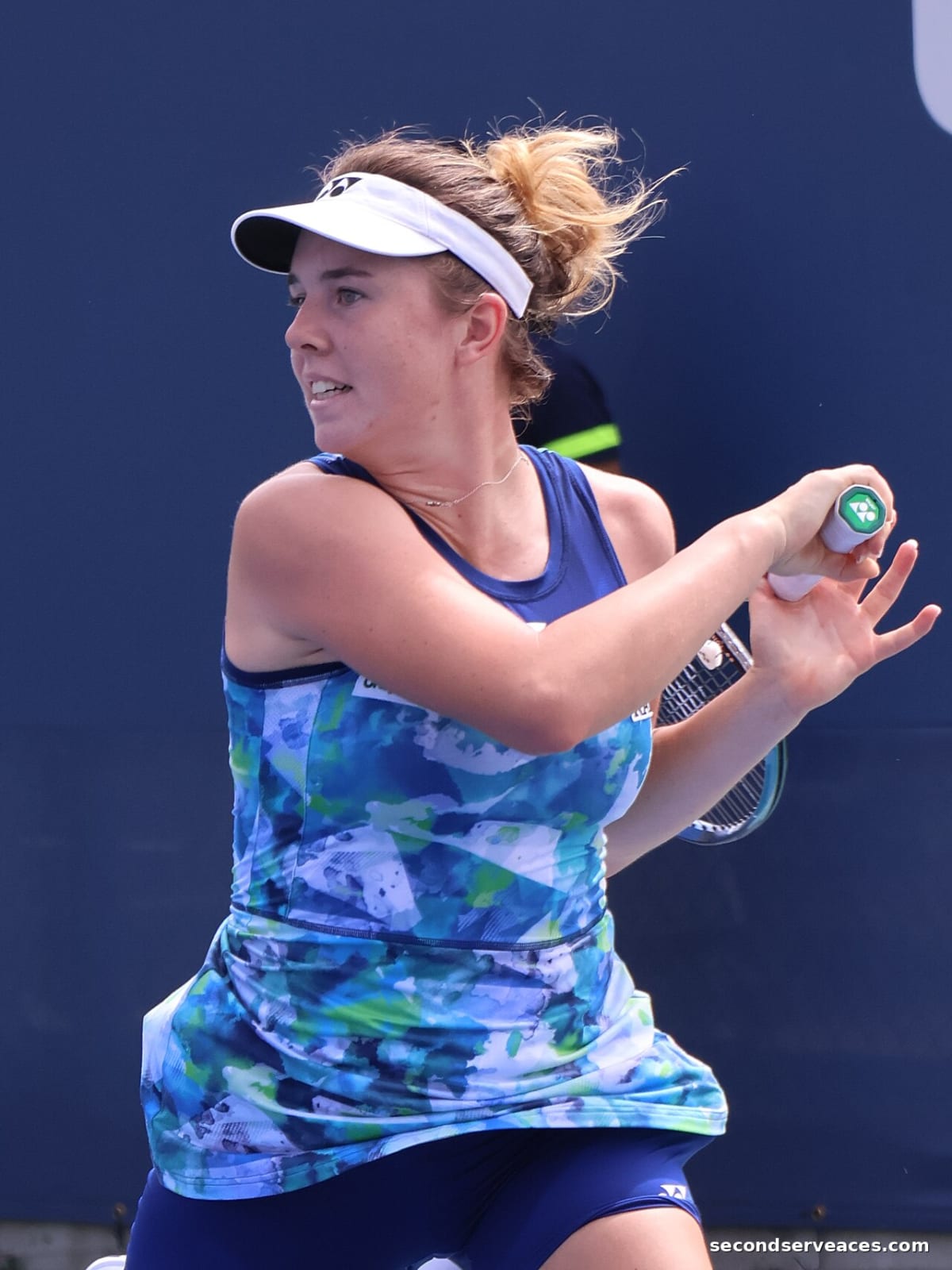
To watch tennis on grass is to witness a brief, frantic negotiation with gravity. The ball does not bounce so much as it skids, a green blur slicing through the humid air of Berlin, forcing players into deep, quad-burning knee bends that feel less like athletic posture and more like existential penance. On these low-bouncing lawns, matches are decided not by epic baseline marathons, but by microscopic windows of reaction time and the cold, unyielding physics of the serve.
Listen to the Second Serve Podcast
Get our daily AI-synthesized audio briefings and match reviews on the go.
The Ninety Percent Threshold on First-Serve Delivery
Linda Noskova’s opening-round performance against Renata Zarazua was not merely a victory; it was a masterclass in geometric efficiency. Serving nine aces, Noskova established an almost dictatorial control over the service line, winning an astonishing 90% of her first-serve points. On grass, such numbers are not just dominant—they are mathematically suffocating. It reduces the opponent's return game to a sequence of desperate, off-balance lunges, transforming the return of serve into an exercise in futility.
Zarazua, a competitor of immense grit, was left to contemplate the sheer kinetic finality of a ball sliding off the turf. When a server is winning nine out of every ten first-serve deliveries, the returner is forced to take absurd risks on the second serve, leading to a cascade of unforced errors. Noskova’s ability to find the lines with such consistency suggests she has cracked the code of grass-court acceleration, making her one of the most intriguing dark horses in the draw.
Four Games Conceded and the Geometry of Low-Bounce Efficiency
Karolina Muchova’s dismantling of Zhang Shuai was less a match and more a clinical demonstration of court positioning. Muchova conceded a mere four games, a number that suggests an absolute mastery of transition play and slice variations on the low-bouncing Berlin lawns. This performance highlights her readiness to challenge the upper elite of the WTA Tour, proving that her multi-layered game remains highly effective on slicker surfaces.
Muchova’s game thrives when she can disrupt rhythm, using the slice to drag opponents forward before exploiting the open court with delicate volleys. In contrast to the baseline slugging that dominates modern hard courts, grass demands this sort of delicate, almost painterly touch. It is a style we previously admired in our coverage of the Berlin draw's early rounds, where court craft and variety reigned supreme over raw, unthinking power.
The One-Zero Leverage and Grass-Court Transition Dynamics
Then there is the upcoming encounter between Elena Rybakina and Alexandra Eala. Rybakina holds a 1-0 head-to-head advantage, a slender margin but one loaded with psychological weight. Eala enters this second-round fixture fresh off a notable upset of Donna Vekic, a result that proves her transition game can flourish under pressure. Eala's ability to redirect pace will be tested to its absolute limit against Rybakina's flat, penetrating groundstrokes.
To pull off another upset, Eala must navigate one of the most formidable serves in women's tennis, a weapon well-documented on the lawns of Wimbledon. Meanwhile, Elina Svitolina advances under stranger circumstances, her first-round opponent Anna Kalinskaya retiring in the second set due to illness. This leaves Svitolina rested but perhaps lacking the match rhythm required for the deep end of the tournament, where every unforced error is magnified.
| Player | Key Tournament Metric | Next Opponent / Status |
|---|---|---|
| Linda Noskova | 90% First-Serve Points Won (9 Aces) | Advanced to Round 2 |
| Karolina Muchova | Only 4 Games Lost vs. Zhang Shuai | Advanced to Round 2 |
| Alexandra Eala | Defeated Donna Vekic (R1) | vs. Elena Rybakina (H2H: 0-1) |
| Elina Svitolina | Opponent Retired (Illness) | Advanced to Round 2 |
Analyze Linda Noskova vs. Diane Parry
Predict tactical adjustments, momentum swings, and serve strategy options for this match-up using our AI simulator.
The Aces Tactical Panel
This report was curated and edited by Bhaskar Goel. Tactical analysis and technical insights were provided by our specialized panel of expert correspondents.
Julian Price
Senior Tactical Correspondent
Stuffy, pedantic British academic and historian specializing in match momentum and historical context.
Elena Cruz
Director of Analytical Research
Data scientist specializing in court surface physics and movement patterns.
Bhaskar
The Editor & Fan
Passionate tennis player and site editor bringing everyday amateur insights and relatable fan commentary.
Arthur Vance
Senior Existential Analyst
Deep, eccentric, and DFW-inspired. Models court metaphysics, kinetic beauty, and player psychology.
Leo Sterling
High-Performance Consultant
Hard-nosed ex-trainer from Melbourne with a no-nonsense view on tour fitness.
Related Reports
Quick Answers
Who did Alexandra Eala defeat in the first round of the WTA Berlin Open?+
Alexandra Eala defeated Donna Vekic in the first round of the tournament.
What is the head-to-head record between Elena Rybakina and Alexandra Eala?+
Elena Rybakina leads the head-to-head record against Alexandra Eala 1-0 entering their second-round match.
Why did Anna Kalinskaya retire from her match against Elina Svitolina?+
Anna Kalinskaya retired in the second set of their first-round match due to illness.