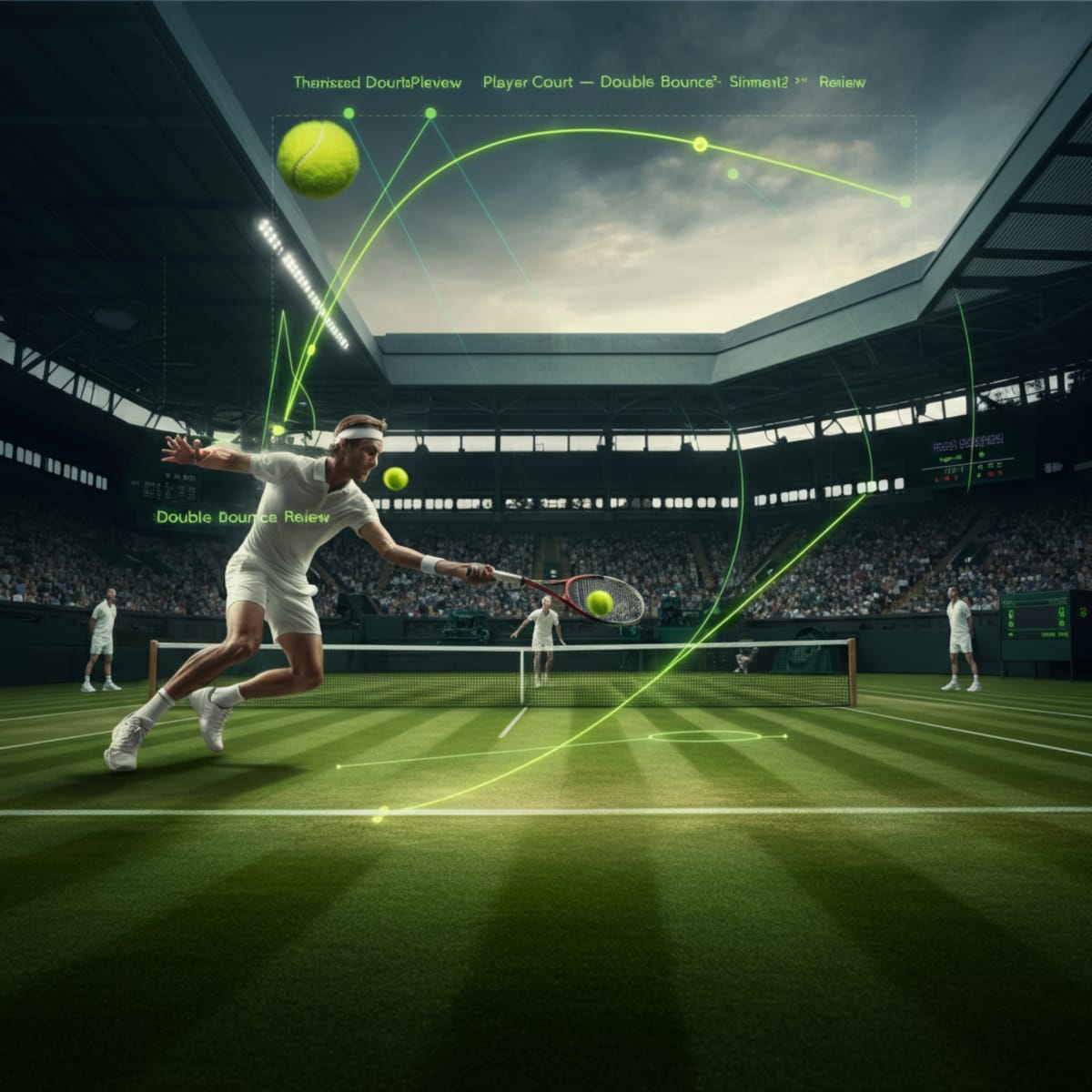
The immaculate lawns of SW19 are getting a high-tech upgrade. Announced by the All England Club on Saturday, Wimbledon will utilize video review technology for the first time at this year's tournament. While the grounds may still mandate all-white attire and serve up traditional strawberries and cream, the operational mechanics of the sport’s oldest major are firmly stepping into the modern era.
Listen to the Second Serve Podcast
Get our daily AI-synthesized audio briefings and match reviews on the go.
Deployed across six total courts—most notably Centre Court and No. 1 Court—this system targets the chaotic, split-second officiating gray areas that have historically plagued human umpires. Grass-court tennis presents a uniquely difficult environment for line judges and chair umpires alike, largely due to the sheer speed of the surface and the low, skidding nature of the bounce.
For purists, the increasing automation of tennis might feel sterile, but for the athletes grinding out a living between the baselines, it is a necessary evolution. Every point at a Grand Slam carries massive financial and ranking implications. Removing human error from the equation isn't just about fairness; it fundamentally alters the psychological rhythm of the match.
Umpiring in the Trenches: The Grass Court Dilemma
Officiating on grass requires exceptional visual acuity. The ball reacts differently here than on any other surface, frequently slipping through the turf rather than gripping and popping up. This low trajectory forces players into desperate, lunging gets near the net, creating a breeding ground for controversial calls.
With video review now active on the major show courts, the chair umpire will have definitive authority over the following infractions:
- Double Bounces: The most contentious call in tennis. When a player sprints forward to dig out a heavy topspin dropshot, the margin between a clean frame and a trapped ball is microscopic.
- Foul Hits and Double Touches: Rackets moving at high velocity can easily strike the ball twice in a single, fluid motion, a phenomenon incredibly difficult to spot in real time.
- Net Touches: In the heat of a kinetic volley exchange, a player's shoe or clothing grazing the mesh can completely upend the result of a critical point.
- Through the Net: Balls that punch through tiny gaps in the net fabric rather than passing cleanly over the cord.
The End of the Umpire Argument
Remember the days of John McEnroe berating the chair, or more recently, players demanding the supervisor over a suspected double-bounce? Those prolonged, theatrical disputes are facing extinction. By centralizing the visual evidence, the All England Club is effectively eliminating the debate, forcing players to accept the empirical data and immediately reset their focus for the next point.
The Tactical Breakdown
Any disruption in play is a tactical weapon. As an analyst, I look constantly at match momentum. Tennis is a game of intense psychological momentum, where a single break point can dictate the emotional trajectory of an entire set. The introduction of video review adds a completely new variable to how players manage that pressure.
Historically, when a player faces a critical juncture—say, 30-40 on their own serve—their primary focus is on their serve placement patterns and maintaining a steady heart rate. If the returner hits a lunging slice backhand approach and the umpire calls it a clean get, the server now has the option to stop play and demand a video review. This is not merely a quest for truth; it is a sanctioned timeout.
The mechanics of the review process take time. The umpire must consult the screen, evaluate the angles, and render a final verdict. During that 60-to-90-second delay, the server is left standing at the baseline, forced to internalize the tension of the break point. It freezes the server's rhythm. Conversely, if a server feels the match slipping away in a flurry of baseline rallies, initiating a marginal review can effectively ice a red-hot opponent. We have seen players use standard Hawk-Eye line challenges for this exact pacing purpose; video review provides another avenue to manipulate court geometry and timing to their advantage.
Furthermore, knowing that every net scramble is subject to high-definition scrutiny, players might subtly adjust their rally tolerance. The risk-reward calculation of sprinting for a dying dropshot changes when you know you cannot bluff a double-bounce past the umpire's naked eye. The requirement for absolute technical precision on the stretch will be higher than ever.
The Bigger Picture
This development does not exist in a vacuum. Video review previously made its Grand Slam debut at the 2023 U.S. Open, setting a precedent that the rest of the major tournaments were inevitably going to follow. The fact that Wimbledon—a tournament deeply protective of its aesthetic and historical prestige—has adopted this technology so quickly speaks volumes about the pressure from player councils and tour executives to standardize match conditions.
The transition highlights a broader narrative in professional tennis: the gradual, inevitable phasing out of subjective human officiating. We are moving toward a future where the geometry of the court is entirely governed by algorithms, cameras, and sensors. The six courts equipped with this technology at SW19 this summer represent a testing ground. If the implementation is smooth, it is highly likely we will see a rapid expansion to the outer courts in the coming years.
For the athletes stepping onto Centre Court this July, the rules of engagement have fundamentally shifted. The pristine grass remains the same, but the omniscient eye of the camera means there is nowhere to hide. You either make the shot cleanly, or the screen exposes you. In a sport defined by inches, the All England Club has finally decided to measure them exactly.
Run Match-Point Simulations
Simulate high-pressure scenarios, score leverage points, and tactical responses for ATP and WTA players.
The Aces Tactical Panel
This report was curated and edited by Bhaskar Goel. Tactical analysis and technical insights were provided by our specialized panel of expert correspondents.
Julian Price
Senior Tactical Correspondent
Stuffy, pedantic British academic and historian specializing in match momentum and historical context.
Elena Cruz
Director of Analytical Research
Data scientist specializing in court surface physics and movement patterns.
Bhaskar
The Editor & Fan
Passionate tennis player and site editor bringing everyday amateur insights and relatable fan commentary.
Arthur Vance
Senior Existential Analyst
Deep, eccentric, and DFW-inspired. Models court metaphysics, kinetic beauty, and player psychology.
Leo Sterling
High-Performance Consultant
Hard-nosed ex-trainer from Melbourne with a no-nonsense view on tour fitness.