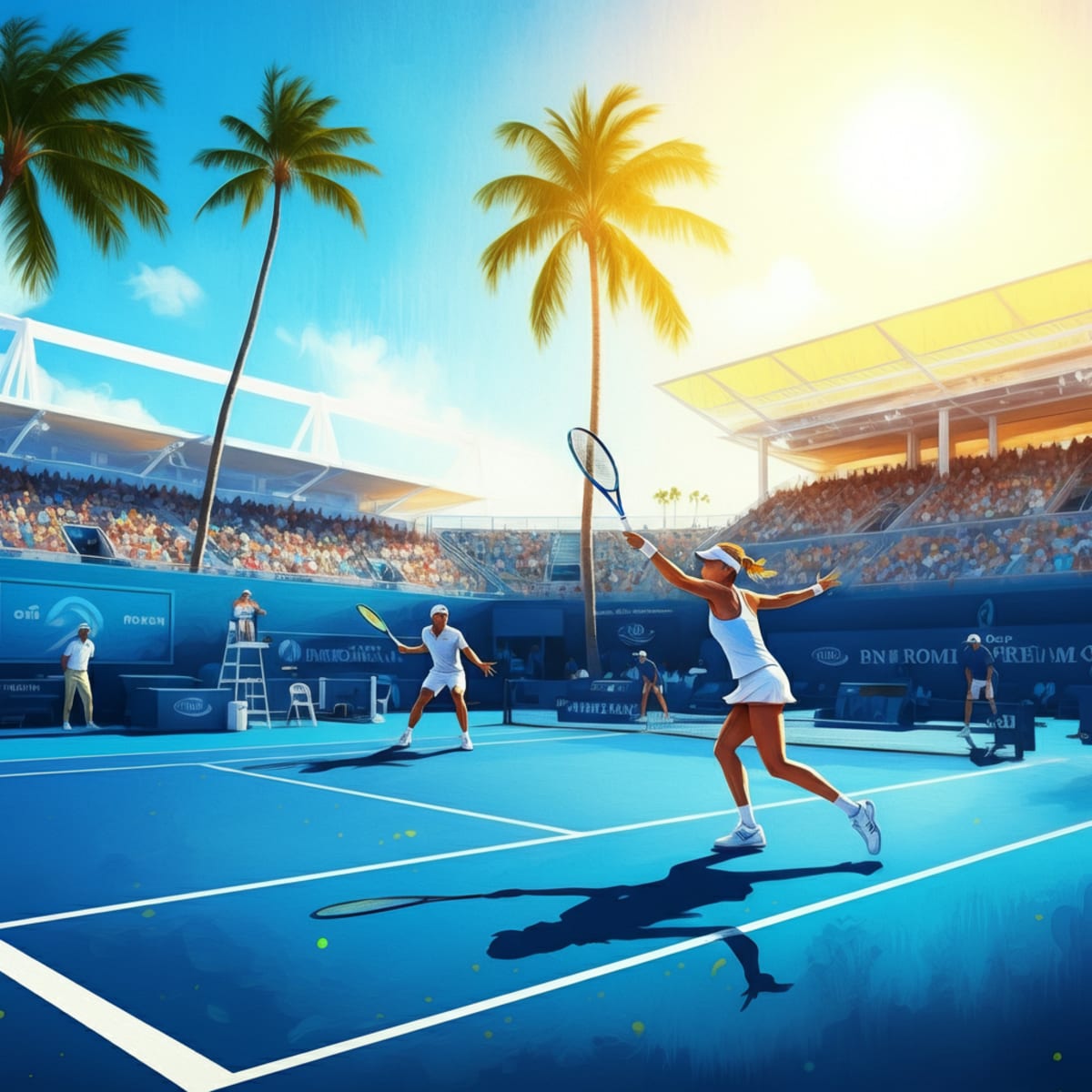
There is a specific, agonizing type of atmospheric tension that crystallizes over a hard court during a final-set tiebreak. It is a moment where the physics of topspin and the geometry of the baseline are suddenly subordinated to sheer, unadulterated neurological endurance. Frances Tiafoe found himself suspended in exactly this crucible at the Miami Open, ultimately defeating Jakub Menšík 7-6(4), 4-6, 7-6(11). This was not merely a tennis match; it was a brutalizing exercise in cognitive survival, punctuated by Tiafoe erasing two match points in a deciding breaker that felt entirely divorced from the normal constraints of time.
Listen to the Second Serve Podcast
Get our daily AI-synthesized audio briefings and match reviews on the go.
Simultaneously, the women's draw offered its own exhibition of geometric brilliance. Hailey Baptiste executed a clinical, breathtakingly disciplined victory over Jelena Ostapenko, triumphing 6-3, 6-4. The victory propels Baptiste into her first career WTA 1000 quarterfinal, fundamentally altering the trajectory of her season on the blistering Miami concrete. In a tournament already defined by seismic shifts—highlighted profoundly by Sebastian Korda defeating Carlos Alcaraz—the heavy, humid coastal air continues to reward those who can synthesize aggressive ball-striking with supreme emotional regulation.
The Tactical Breakdown
To understand the architecture of Baptiste's straight-sets victory, one must first confront the reality of Jelena Ostapenko's game. Ostapenko operates on a foundational philosophy that involves trying to hit a fuzzy yellow sphere directly through the sternum of her opponent. She is an apex predator of the flat, first-strike baseline exchange. Baptiste, rather than attempting to match this unhinged kinetic violence, utilized brilliant spatial awareness. By absorbing pace, varying the height of her topspin, and continuously altering the strike zone, Baptiste forced Ostapenko to hit from awkward, non-linear postures. This disruption of rhythm is the quintessential blueprint for dismantling purely aggressive, flat-hitting baseliners.
Conversely, the men's epic required a distinctly different strategic application. Menšík brings an oppressive weight of shot to the court, utilizing a massive serve-plus-one sequence to dictate court positioning. Tiafoe's survival mechanism rested upon his return depth and his willingness to embrace the chaotic, lateral scrambles. In the dying moments of that 7-6(11) tiebreak, facing the abyss of match points, Tiafoe’s shot selection shifted from baseline aggression to a hyper-focused, margin-heavy placement strategy. He leveraged the humid conditions, generating heavier topspin to buy fractions of a second in recovery time, forcing the younger Menšík to string together three or four high-risk shots to win a single point. It was a victory forged in rally tolerance rather than outright winners.
The Bigger Picture
Stepping back from the immediate adrenaline of these results reveals a fascinating crossroads for both victors. Baptiste’s reward for navigating the chaotic pace of Ostapenko is a Wednesday clash against defending champion Aryna Sabalenka. This represents a staggering leap in competitive weight class. Sabalenka possesses an offensive arsenal that rivals, and arguably supersedes, Ostapenko's, but with a more refined defensive foundation. For Baptiste, this upcoming match is the ultimate litmus test of her newly showcased tactical maturity on the WTA Tour's biggest stages.
For Tiafoe, surviving an opponent like Menšík is the kind of gut-check that can unilaterally ignite a player's hard-court swing. The American will next face 24-year-old French player Térence Atmane, a matchup that shifts Tiafoe from the role of embattled survivor to the heavy favorite with immense crowd backing. The Miami Open, with its unique blend of slow hard courts and heavy air, historically favors those who combine immense physical conditioning with the capacity to generate their own pace. As evidenced by Korda's earlier triumph over Alcaraz, reputation alone does not win matches on this surface. It requires the precise, grueling execution of physics, point after agonizing point.
What Taylor Fritz Plays With
Head Radical MP 2024
Yonex Poly Tour Strike
Analyze Frances Tiafoe vs. Hailey Baptiste
Predict tactical adjustments, momentum swings, and serve strategy options for this match-up using our AI simulator.
The Aces Tactical Panel
This report was curated and edited by Bhaskar Goel. Tactical analysis and technical insights were provided by our specialized panel of expert correspondents.
Julian Price
Senior Tactical Correspondent
Stuffy, pedantic British academic and historian specializing in match momentum and historical context.
Elena Cruz
Director of Analytical Research
Data scientist specializing in court surface physics and movement patterns.
Bhaskar
The Editor & Fan
Passionate tennis player and site editor bringing everyday amateur insights and relatable fan commentary.
Arthur Vance
Senior Existential Analyst
Deep, eccentric, and DFW-inspired. Models court metaphysics, kinetic beauty, and player psychology.
Leo Sterling
High-Performance Consultant
Hard-nosed ex-trainer from Melbourne with a no-nonsense view on tour fitness.