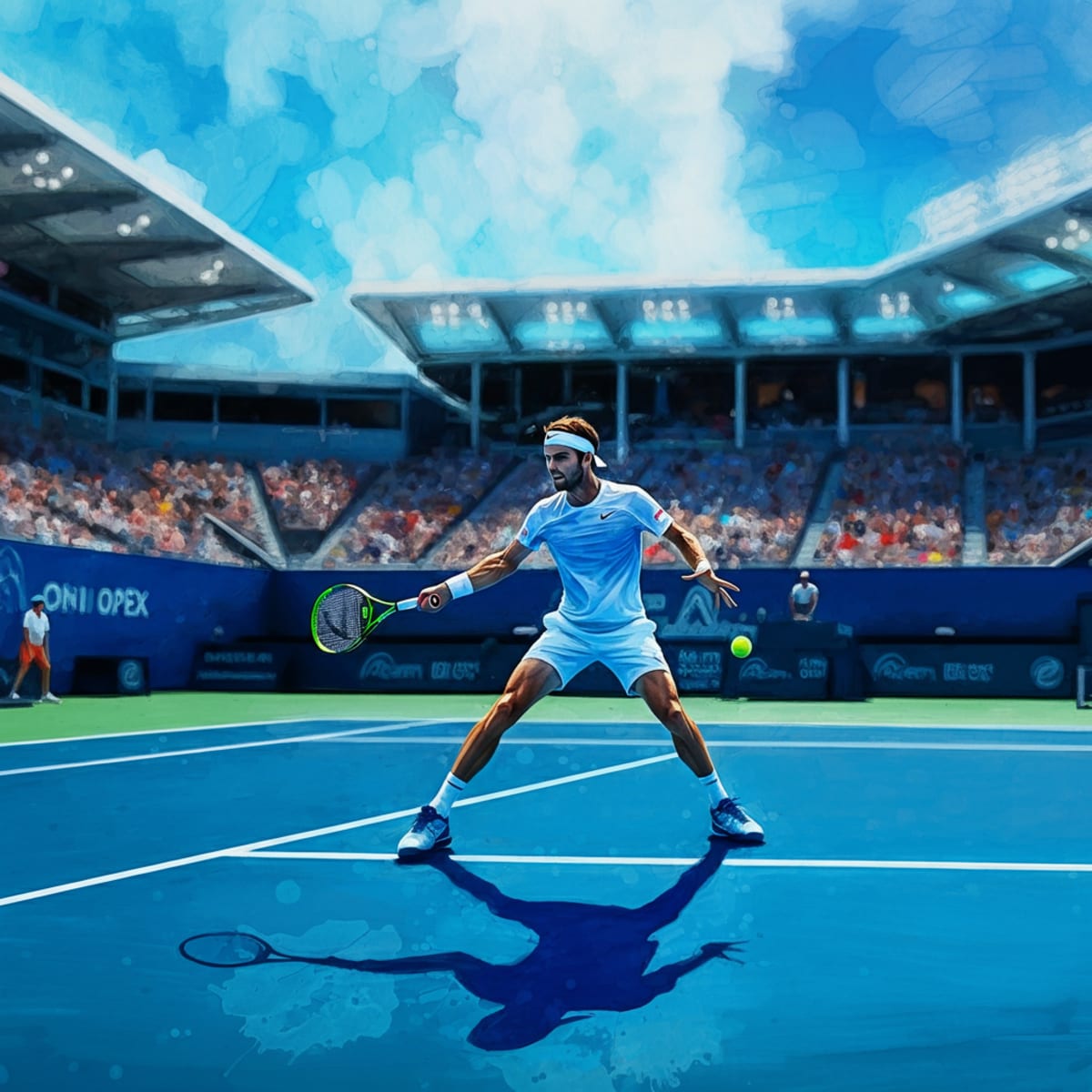
The air in South Florida possesses a specific, gelatinous weight. Moving a tennis racket through it requires a recalibration of intent, a sudden understanding that the atmosphere itself is acting as an invisible opponent. For one hour and forty-one minutes on a sun-baked hard court, Jannik Sinner negotiated this meteorological friction, dispatching Alex Michelsen 7-5, 7-6 (7/4) to secure his passage into the Miami Open quarter-finals. The Italian did not simply overpower his opponent; rather, he solved him mathematically.
Listen to the Second Serve Podcast
Get our daily AI-synthesized audio briefings and match reviews on the go.
To understand the day's events requires zooming out from Sinner’s solitary triumph. The ATP draw in Miami is currently functioning as a brutal sorting mechanism, separating the meticulously prepared from the merely talented. The surrounding courts offered their own frantic narratives, revealing a tour simmering with volatility.
The Day's Definitive Reversals and Advancements
- The Qualifiers' Uprising: Martin Landaluce, an 18-year-old Spanish qualifier ranked 151st globally, authored a startling reversal against 32nd seed Sebastian Korda, surviving a second-set crucible to win 2-6, 7-6 (8/6), 6-4.
- The Next Assignment: Frances Tiafoe survived an oscillatory encounter with Terence Atmane, prevailing 6-4, 1-6, 6-4, booking a quarter-final collision with Sinner.
- The Baseline Attrition: Jiri Lehecka methodically dismantled the defensive architecture of sixth seed Taylor Fritz, advancing 6-4, 6-7 (4/7), 6-2 across two hours and twenty-five minutes of heavy hitting.
The Tactical Breakdown
Sinner’s game is traditionally understood through the prism of his groundstrokes—the effortless, terrifying acceleration of his forehand, the whip-crack flat trajectory of the two-hander. Yet, the architecture of this particular victory was constructed firmly on the service line. The intelligence data is stark: Sinner hit 15 aces compared to Michelsen's meager three.
Generating fifteen unreturnable deliveries in just two sets requires more than mere pace; it demands acute geometric awareness. Michelsen is a tall, capable returner with a wide wingspan, yet he was repeatedly caught leaning the wrong way. Tactically, players who amass this sort of ace disparity against proficient returners are usually expertly masking their ball toss. Sinner likely utilized identical kinetic chains for his wide slice and his flat heater up the T, introducing a fraction of a second of hesitation into Michelsen's split-step. In professional tennis, a hesitation of a tenth of a second is the difference between a clean return and watching a yellow blur paint the center line.
Conversely, Michelsen’s inability to penetrate Sinner's return positioning allowed the Italian to dictate rally tempo. When the serve is not earning free points, the server is immediately dragged into a baseline physiological tax. Michelsen paid that tax heavily, while Sinner insulated himself behind those 15 aces, effectively shortening his time on court.
The Bigger Picture
Remaining on course for the elusive "Sunshine Double"—claiming both Indian Wells and Miami in the same month—is historically one of the sport's most punishing endeavors. It requires winning back-to-back Masters 1000 titles in wildly disparate environments. The transition from the arid, ball-flying desert of California to the heavy, sea-level humidity of Florida demands physical and mechanical adjustments that routinely break top-tier athletes.
Sinner's ability to maintain his trajectory speaks to a newly solidified bedrock in his game. He will need every ounce of that stability in the quarter-finals against Tiafoe. Historically, an encounter between Sinner and Tiafoe presents a fascinating stylistic dichotomy: the Italian’s Euclidean precision versus the American’s improvisational jazz. Tiafoe thrives on the kinetic energy of the crowd, turning matches into theatrical productions, while Sinner prefers a silent, clinical dismantling.
Meanwhile, the sheer depth of the tour was laid bare by the supporting cast. Landaluce’s upset over Korda is a stark reminder of the ATP’s vicious undertow. When a 151st-ranked qualifier unseats an established 32nd seed in a deciding set, it underscores the narrowing margin between the elite tier and the ascendant youth. As the Miami sun sets and the quarter-finals loom, the geometry of the courts remains fixed, but the hierarchy of the men traversing them feels entirely fluid.
What Jannik Sinner Plays With
Head Speed MP 2024
Head Hawk Touch 1.25
Nike GP Challenge 1
Analyze Jannik Sinner vs. Alex Michelsen
Predict tactical adjustments, momentum swings, and serve strategy options for this match-up using our AI simulator.
The Aces Tactical Panel
This report was curated and edited by Bhaskar Goel. Tactical analysis and technical insights were provided by our specialized panel of expert correspondents.
Julian Price
Senior Tactical Correspondent
Stuffy, pedantic British academic and historian specializing in match momentum and historical context.
Elena Cruz
Director of Analytical Research
Data scientist specializing in court surface physics and movement patterns.
Bhaskar
The Editor & Fan
Passionate tennis player and site editor bringing everyday amateur insights and relatable fan commentary.
Arthur Vance
Senior Existential Analyst
Deep, eccentric, and DFW-inspired. Models court metaphysics, kinetic beauty, and player psychology.
Leo Sterling
High-Performance Consultant
Hard-nosed ex-trainer from Melbourne with a no-nonsense view on tour fitness.