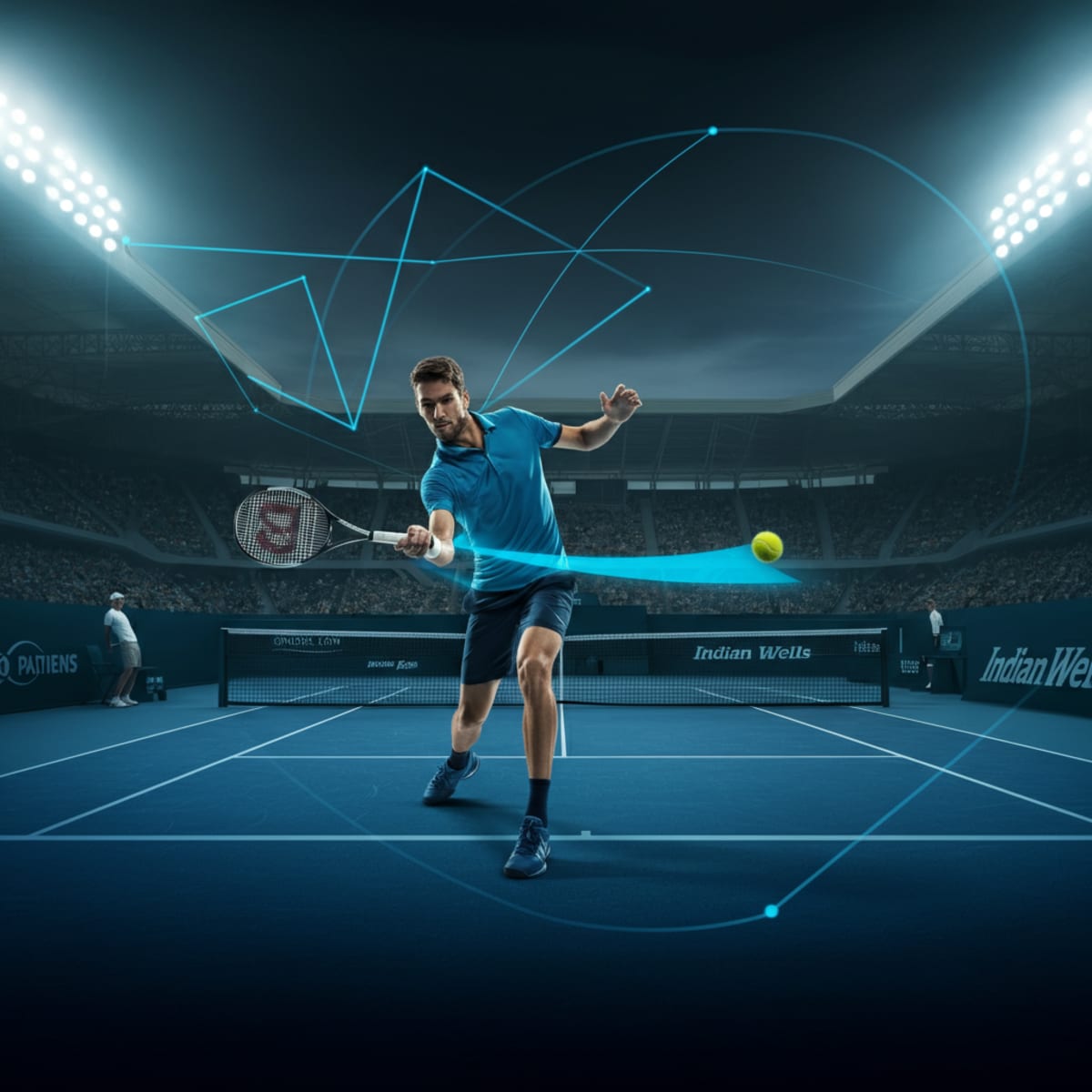
When you step onto the gritty Plexipave of Stadium 1 in the California desert, you aren't just playing your opponent; you are playing the geometry of the court and the heavy, slow-bouncing conditions. In a pristine display of tactical execution, World No. 2 Jannik Sinner delivered a masterclass performance to defeat Alexander Zverev 6-2, 6-4, advancing to his first-ever Indian Wells final.
Listen to the Second Serve Podcast
Get our daily AI-synthesized audio briefings and match reviews on the go.
For the uninitiated, a 6-2, 6-4 scoreline might just look like a comfortable straight-sets win. But for those of us tracking the footwork patterns and the battle for the baseline, it was a clinic in spatial suffocation. Sinner didn't just beat Zverev; he systematically dismantled the German's operational airspace, refusing to relinquish control of the match momentum from the first ball to the last.
The Tactical Breakdown
Let's get under the hood of this matchup. Hard courts like Indian Wells are notoriously unique. The dry desert air allows the ball to fly, but the highly abrasive surface grips the ball upon the bounce, rewarding heavy topspin and heavily penalizing passive, deep court positioning. This surface dynamic is exactly where this match was won and lost.
The Geometry of Time
Alexander Zverev is a formidable athlete with immense leverage, but his historical tendency—especially under pressure—is to retreat deep behind the baseline. Against a player with moderate pace, this buys Zverev the time he needs to uncoil his massive groundstrokes. Against Jannik Sinner, it's a tactical death sentence.
Sinner's game is built on a foundational principle: taking the ball early. By hugging the baseline and striking the ball on the rise, Sinner fundamentally altered the geometry of the rallies. He wasn't necessarily hitting the ball harder than Zverev; he was hitting it sooner. This robbed Zverev of the crucial fractions of a second needed to set his feet for his forehand—historically his more vulnerable wing when rushed.
- Baseline Proximity: While Zverev drifted toward the stadium backstop, Sinner held his ground inside or firmly on the baseline, effectively shrinking the court for Zverev.
- Targeting the Wingspan: Zverev's long levers require time to organize. Sinner consistently drove the ball flat and deep into the Zverev forehand corner, denying the German the time to generate defensive topspin.
- Return Position: Sinner neutralized Zverev's lethal first serve by reading the toss early and leaning into the return, rather than chipping and retreating.
Exploiting the Break Point
Tennis matches often hinge on a handful of high-leverage points, and court positioning dictates who dictates those terms. When a break point opportunity arises, the tension naturally tightens the muscles. Zverev's natural inclination when tight is to roll the ball in and rely on his elite rally tolerance to outlast the opponent.
Sinner, however, flipped the script. On crucial points, Sinner stepped in. He recognized that Zverev's second serve in tight moments lacked the usual bite, allowing Sinner to take massive cuts on the return, immediately putting Zverev on his back foot. Once Sinner secures the center of the court, his ability to distribute the ball from side to side makes it nearly impossible for a deeper-positioned player to recover. Sinner's clinical conversion rate in this 6-2, 6-4 victory was a direct result of dictating terms when it mattered most.
The Bigger Picture
This victory secures Jannik Sinner's first appearance in an Indian Wells final, an achievement that feels both inevitable and profoundly significant. The hard courts of Tennis Paradise have historically been a litmus test for the absolute elite of the ATP tour. It requires a blend of power, patience, and supreme physical conditioning.
Cementing the Number Two Spot
As the World No. 2, Sinner is no longer the hunter; he is the hunted. Validating that ranking requires consistently putting away top-tier opponents like Zverev in straight sets at Masters 1000 events. This performance sends a chilling message to the rest of the locker room: Sinner is not just relying on hot streaks; he has developed a repeatable, tactically bulletproof baseline game.
Historically, the transition from "top five contender" to "dominant force" requires mastering the subtle arts of point construction. We've seen it with Novak Djokovic and Rafael Nadal—eventually, raw shot-making evolves into tactical inevitability. Sinner is exhibiting that exact evolution. He didn't need to play out of his mind to win 6-2, 6-4; he simply needed to execute his game plan with relentless discipline.
Looking Ahead
For Zverev, the loss highlights a glaring ceiling against the game's ultimate early-ball strikers. If he wants to consistently challenge players like Sinner for the biggest titles on tour, he must find a way to establish better baseline proximity and increase his aggressive intent on neutral balls.
For Sinner, the maiden Indian Wells final awaits. He has proven he has the tactical acumen to dismantle a towering server and exceptional defender. As he prepares for the final, his team won't need to overhaul the strategy. The blueprint is clear: hug the baseline, compress the opponent's time, and let the geometry do the heavy lifting. If he executes as he did today, the World Number Two might just be leaving the desert with another massive piece of hardware.
What Jannik Sinner Plays With
Head Speed MP 2024
Head Hawk Touch 1.25
Nike GP Challenge 1
Analyze Jannik Sinner vs. Alexander Zverev
Predict tactical adjustments, momentum swings, and serve strategy options for this match-up using our AI simulator.
The Aces Tactical Panel
This report was curated and edited by Bhaskar Goel. Tactical analysis and technical insights were provided by our specialized panel of expert correspondents.
Julian Price
Senior Tactical Correspondent
Stuffy, pedantic British academic and historian specializing in match momentum and historical context.
Elena Cruz
Director of Analytical Research
Data scientist specializing in court surface physics and movement patterns.
Bhaskar
The Editor & Fan
Passionate tennis player and site editor bringing everyday amateur insights and relatable fan commentary.
Arthur Vance
Senior Existential Analyst
Deep, eccentric, and DFW-inspired. Models court metaphysics, kinetic beauty, and player psychology.
Leo Sterling
High-Performance Consultant
Hard-nosed ex-trainer from Melbourne with a no-nonsense view on tour fitness.