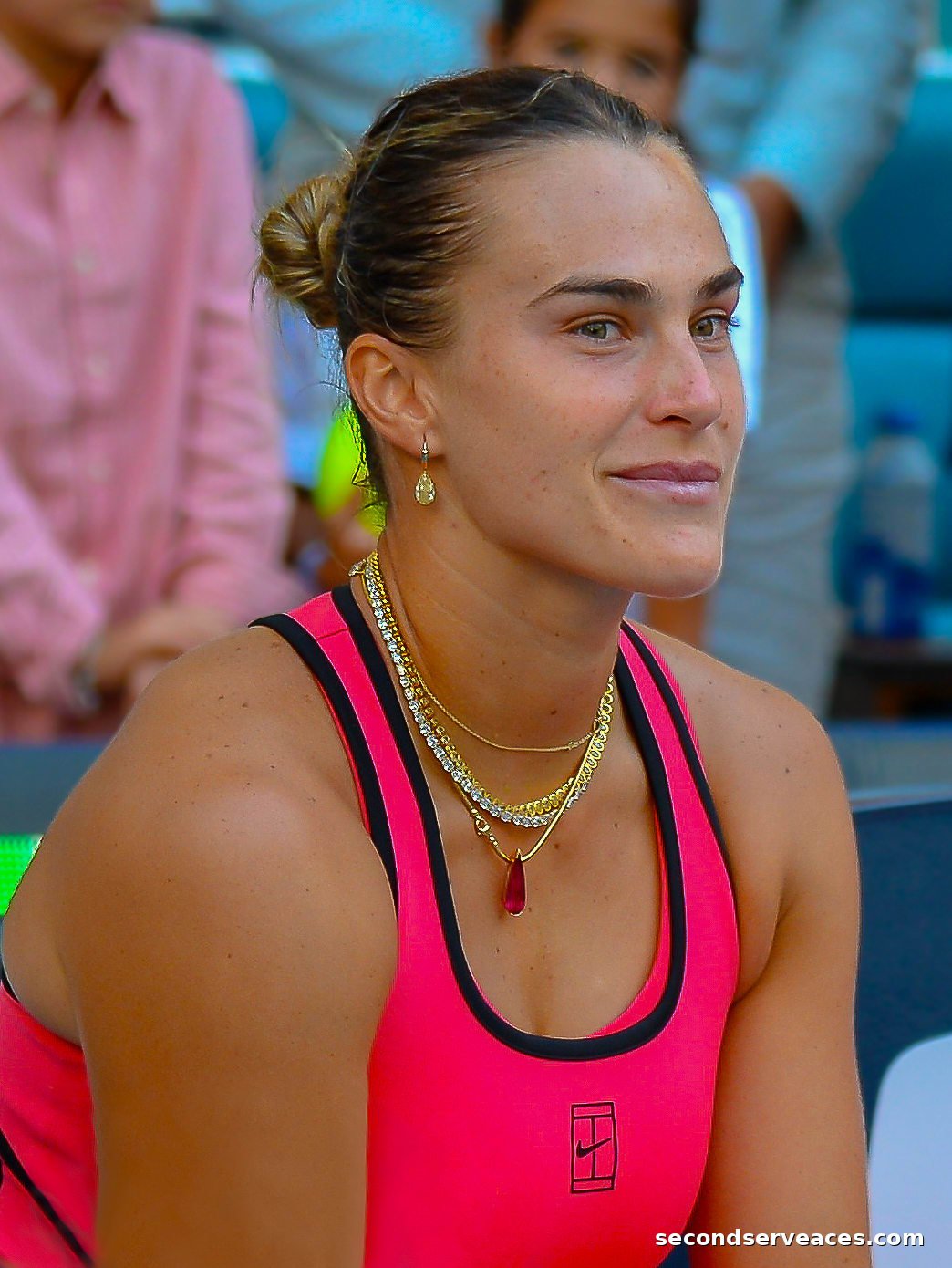
A fast hard court is a merciless truth-teller. At the WTA Tour Masters in Toronto, the Court Pace Index (CPI) hovered at a brisk 42.1, a metric that fundamentally alters baseline physics. While heavy topspin thrives on slower surfaces that allow the ball to jump and sit up in the strike zone, this skidding surface rewards linear, flat ball-strikers who take the ball early. Ekaterina Alexandrova exploited these precise parameters to secure a 7-6 (7/3), 4-6, 6-4 victory over world number one Aryna Sabalenka in a grueling fourth-round encounter that lasted 2 hours and 29 minutes.
Listen to the Second Serve Podcast
Get our daily AI-synthesized audio briefings and match reviews on the go.
Flat Ball Striking Exploits Toronto Court Speed
In fast conditions, preparation time is the ultimate currency. Alexandrova, currently ranked No. 19, operates with remarkably compact takebacks on both wings, allowing her to redirect pace without needing the expansive wind-up that can break down under pressure. By hitting flatter, lower-clearance groundstrokes, she ensured the ball skidded through the court rather than bouncing into Sabalenka's preferred shoulder-height strike zone. This tactical adjustment forced the top seed to constantly bend her knees and hit up on the ball, neutralizing her ability to dictate play from the center of the court.
Sabalenka, despite her immense raw power, struggled to establish her usual baseline depth. The kinetic energy transfer of her forehand requires a fraction of a second more than the Toronto surface allowed. Because Alexandrova stood her ground right on the baseline, Sabalenka was forced to rush her footwork, leading to mistimed strikes that landed short or flew wide. The Belarusian found herself pushed into defensive positions, unable to generate the clean angles that typically define her hard-court dominance.
By taking away Sabalenka's preparation time, Alexandrova exposed the top seed's lateral movement. Rather than sliding comfortably into her shots, Sabalenka was forced into rushed, lunging defensive strokes. Alexandrova's relentless depth kept the Belarusian on the back foot, preventing her from stepping inside the court to punish short balls and control the tempo of the rallies.
Breaking Down the First-Set Tiebreak Mechanics
The opening set was a masterclass in first-strike tennis, with both players holding serve comfortably as they dialed in their target zones. Alexandrova focused her tactical execution on Sabalenka's backhand wing, using a wide slice serve from the deuce court to open up the court before firing a flat forehand into the opposite corner. This pattern kept Sabalenka guessing and prevented her from cheating toward her forehand side to dictate play.
When the set progressed to a tiebreak, Alexandrova's tactical discipline paid immediate dividends. She secured an early mini-break by striking a deep, flat return directly at Sabalenka’s shoelaces. Sabalenka's attempt to scoop the ball on the rise sailed long, handing the Russian a critical advantage. Throughout the tiebreak, Alexandrova refused to yield ground, maintaining her court positioning within a meter of the baseline.
Alexandrova closed out the tiebreak 7-3, showcasing superior tactical execution under pressure. Her ability to take the ball on the rise allowed her to rob Sabalenka of recovery time between shots. By denying the world number one the luxury of resetting her court position, Alexandrova forced the errors that decided the opening set.
Sabalenka Service Inconsistencies Peak on Match Point
Although Sabalenka fought back to claim the second set 6-4 by dropping her return position further back to buy herself extra split-seconds of reaction time, her serve remained a vulnerable liability. The technical biomechanics of her toss began to break down under pressure in the third set, leading to inconsistent contact points. When the toss drifted too far into the court, she was forced to rush her arm speed, resulting in flat misses into the net.
Throughout the final set, Sabalenka struggled to find a reliable rhythm on her second delivery. Alexandrova capitalized on this vulnerability by stepping inside the baseline on second-serve returns, applying immediate pressure and forcing Sabalenka to over-cook her targets. This constant pressure on the return game wore down Sabalenka's physical and mental reserves as the match crossed the two-hour mark.
The ultimate breakdown occurred on match point. Facing a break point that doubled as match point at 4-5 in the third set, Sabalenka committed her sixth and final double fault of the afternoon. It was a anticlimactic end to a highly physical battle, handing Alexandrova a hard-fought victory and demonstrating how tactical pressure can dismantle even the most formidable service weapons in the sport.
Tactical Outlook for Alexandrova in the Quarterfinals
With this victory, Alexandrova advances to the quarterfinals, where she will face either Amanda Anisimova or Elina Svitolina. Svitolina's tactical versatility could present a completely different challenge, as we analyzed in our previous tactical breakdown of Svitolina's spin profile. Svitolina excels at absorbing pace and utilizing heavy topspin to push opponents back, meaning Alexandrova's flat, early-taken strikes will once again be the key to dictating the tempo.
If she faces Svitolina, Alexandrova must maintain her aggressive baseline positioning. Letting Svitolina dictate the depth of the rallies would neutralize Alexandrova's flat ball-striking advantage. Alternatively, a matchup against Anisimova would feature a clean, hard-hitting baseline duel where first-strike efficiency on the return will be paramount.
Regardless of her opponent, Alexandrova's ability to utilize the fast Toronto courts will determine her success as she looks to build on this landmark win. Her performance in this match proves that when she aligns her flat strokes with quick court conditions, she possesses the tactical tools to disrupt anyone on the tour and climb the WTA singles rankings.
Rivalry Matchup & Player Profiles
| Metric | Aryna Sabalenka | Ekaterina Alexandrova |
|---|---|---|
| Rank | No. 1 | No. 19 |
| Country | Belarus | Russia |
| Age | 28 | 31 |
| Height | 6'0" (1.82 m) | 5'9" (1.75 m) |
| Handedness | Right-handed | Right-handed |
| Play Style | Aggressive baseliner | Aggressive baseliner |
| Career Titles | 24 Singles | 5 Singles |
This victory brings the head-to-head record between Aryna Sabalenka and Ekaterina Alexandrova to a balanced 5-5. Their rivalry has always been characterized by tight, high-intensity baseline battles where small margins decide the outcome. Alexandrova's ability to absorb and redirect Sabalenka's pace has consistently made her one of the most difficult matchups for the top seed on quick surfaces.
While Sabalenka currently sits at the pinnacle of the sport as the top-ranked player according to the WTA singles rankings, Alexandrova has repeatedly proven that her flat ball-striking can disrupt the best in the world when conditions align. This balanced head-to-head record underscores the tactical reality that styles make fights in professional tennis, and court speed remains the ultimate equalizer.
What Aryna Sabalenka Plays With
Wilson Blade 98 v9 (16x19)
Luxilon ALU Power 125
Wilson Pro Overgrip (12-Pack)
Analyze Aryna Sabalenka vs. Ekaterina Alexandrova
Predict tactical adjustments, momentum swings, and serve strategy options for this match-up using our AI simulator.
The Aces Tactical Panel
This report was curated and edited by Bhaskar Goel. Tactical analysis and technical insights were provided by our specialized panel of expert correspondents.
Julian Price
Senior Tactical Correspondent
Stuffy, pedantic British academic and historian specializing in match momentum and historical context.
Elena Cruz
Director of Analytical Research
Data scientist specializing in court surface physics and movement patterns.
Bhaskar
The Editor & Fan
Passionate tennis player and site editor bringing everyday amateur insights and relatable fan commentary.
Arthur Vance
Senior Existential Analyst
Deep, eccentric, and DFW-inspired. Models court metaphysics, kinetic beauty, and player psychology.
Leo Sterling
High-Performance Consultant
Hard-nosed ex-trainer from Melbourne with a no-nonsense view on tour fitness.
Related Reports

Quick Answers
What was the final score of the match between Ekaterina Alexandrova and Aryna Sabalenka in Toronto?+
Ekaterina Alexandrova defeated world number one Aryna Sabalenka 7-6 (7/3), 4-6, 6-4 in a fourth-round match lasting 2 hours and 29 minutes.
How did the match end on match point?+
The match concluded when Aryna Sabalenka committed her sixth and final double fault on match point in the tenth game of the third set.
Who will Ekaterina Alexandrova face in the quarterfinals of the WTA Toronto Masters?+
Alexandrova advanced to the quarterfinals to face either Amanda Anisimova or Elina Svitolina.