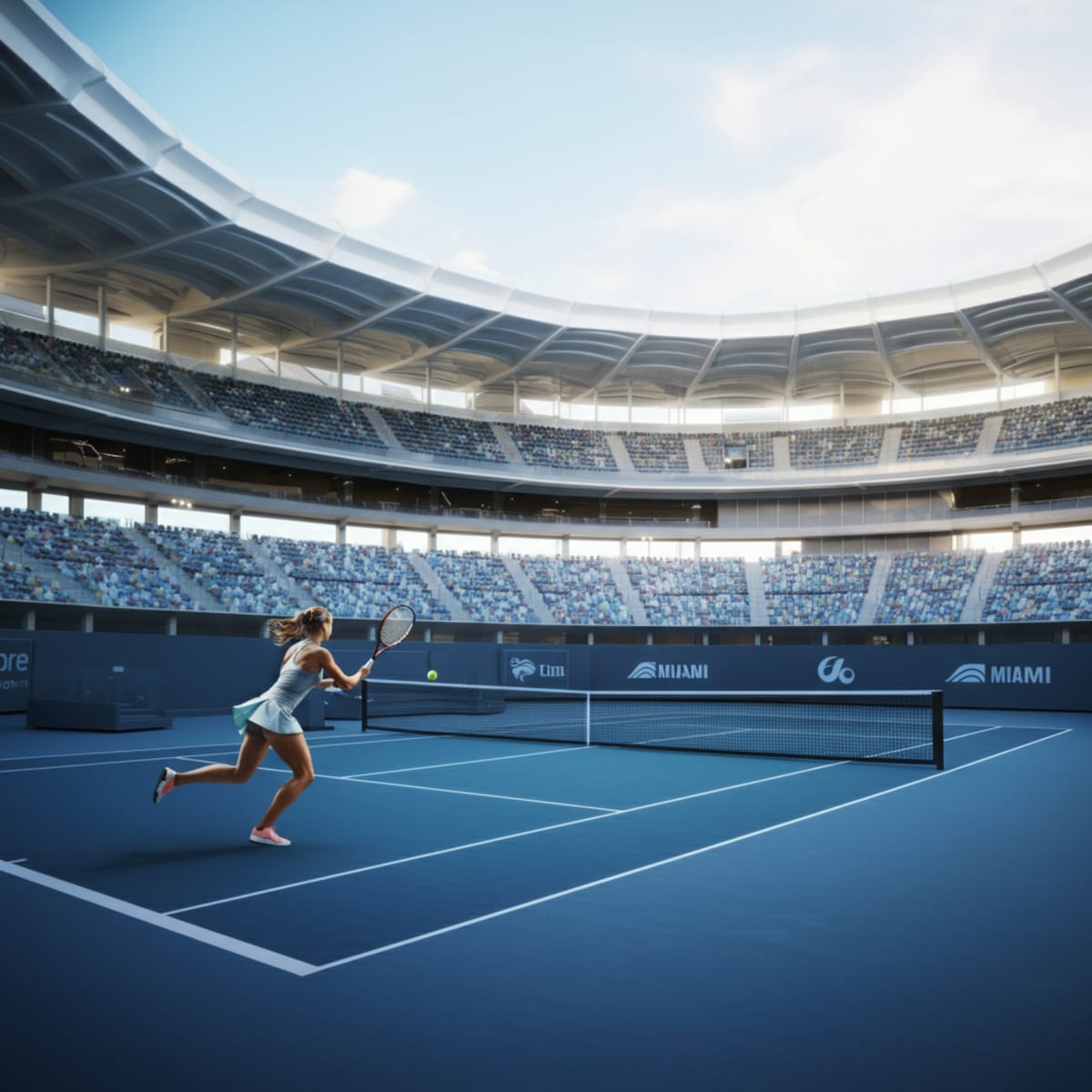
The pristine blue hard courts of Miami provide the ultimate architectural stage for a clash of contrasting baseline philosophies.
The contemporary WTA Tour operates at a brutal cadence, fundamentally unforgiving to those lacking elite physical and mental endurance. Securing simultaneous championships in the dry Californian desert and the humid sprawl of South Florida represents one of the sport's ultimate structural tests. World No. 1 Aryna Sabalenka stands one match away from that rarefied air, bidding to capture the elusive Sunshine Double. Standing in her way on the Miami Open hard courts is Coco Gauff, who surges into her first final at this venue following a dominant fortnight.
To reach the championship round, Sabalenka expertly dismantled World No. 2 Elena Rybakina with a clinical 6-4, 6-3 victory. The Belarusian nullified one of the premier first serves in the women's game through aggressive early-strike positioning and superior topspin generation. On the opposite half of the draw, Gauff advanced by tearing through Karolina Muchova. The American yielded just two games, securing a remarkably efficient 6-1, 6-1 triumph that highlighted her elite court coverage and transitional defense.
Entering this high-stakes final, the competitive ledger sits at a perfectly balanced six wins apiece. This symmetry hints at a foundational stylistic clash, pitting unparalleled kinetic output against suffocating defensive elasticity.
The Tactical Breakdown
The strategic architecture of this rivalry centers entirely on how effectively Gauff can absorb and redirect pace. Sabalenka’s baseline philosophy relies on immense torque, initiating offense simultaneously off both the serve and the return. Against Rybakina, Sabalenka utilized aggressive court positioning to rob her opponent of recovery time. She routinely pinned the Kazakh deep, ensuring that her heavy groundstrokes dictated the match momentum.
Gauff brings an entirely different geometric problem to the hard court. Her victory over Muchova was an exhibition in neutralizing variety. Muchova, typically adept at utilizing slices and net approaches to disrupt rhythm, found herself trapped behind the baseline by Gauff's relentless depth and lateral speed. Gauff does not simply defend; she shrinks the court.
For Sabalenka to dictate terms on Sunday, she will need to navigate Gauff’s exceptional backhand rally tolerance. The World No. 1 must construct points patiently, utilizing sharp cross-court angles to stretch the American beyond her comfort zones on the perimeter, rather than simply attempting to hit through the center of her defense. Sabalenka’s primary tactical risk lies in overhitting when Gauff predictably extends early offensive combinations. Conversely, Gauff must consistently land deep returns, forcing Sabalenka into an uncomfortable transition game and preventing the Belarusian from setting her feet on the serve-plus-one.
The Bigger Picture
The true weight of this final extends far beyond the immediate ranking points or prize money. Should Sabalenka lift the trophy, she will become merely the fifth woman in tennis history to secure both Indian Wells and Miami back-to-back. She aims to join an exclusive, historical pantheon featuring Steffi Graf, Kim Clijsters, Victoria Azarenka, and her contemporary rival, Iga Swiatek.
- Institutional Dominance: Achieving the Sunshine Double would establish Sabalenka not just as the current top-ranked player, but as the defining hard-court force of this specific era.
- The American Resurgence: For Gauff, claiming a top-tier title on home soil against the sport’s apex competitor offers an opportunity to disrupt the established hierarchy at the pinnacle of the WTA.
The sport's structural evolution over the past decade has heavily rewarded first-strike tennis, a reality that heavily favors Sabalenka’s current form. Yet, Gauff’s trajectory suggests a rapid tactical maturation. The American is learning to weaponize her athleticism rather than merely relying on it as a safety net. A victory in Miami would validate her adjustments and signal a readiness to contest for major titles consistently across the calendar.
This final serves as a compelling referendum on the current state of women's tennis. It is a collision of established baseline authority and rising, dynamic counter-punching. Regardless of who raises the trophy, the architectural landscape of the upcoming European clay swing will be significantly shaped by the outcome on these North American hard courts.
The Aces Tactical Panel
This report was curated and edited by Bhaskar Goel. Tactical analysis and technical insights were provided by our specialized panel of expert correspondents.
Julian Price
Senior Tactical Correspondent
Distinguished British academic and historian specializing in match momentum.
Elena Cruz
Director of Analytical Research
Data scientist specializing in court surface physics and movement patterns.
Marcus Thorne
Global Tour Insider
Veteran reporter with deep ties to the global ATP/WTA locker rooms since '98.
Arthur Vance
Technical Equipment Analyst
Former club player obsessed with technical specs, racket tension, and underdog grit.
Leo Sterling
High-Performance Consultant
Hard-nosed ex-trainer from Melbourne with a no-nonsense view on tour fitness.