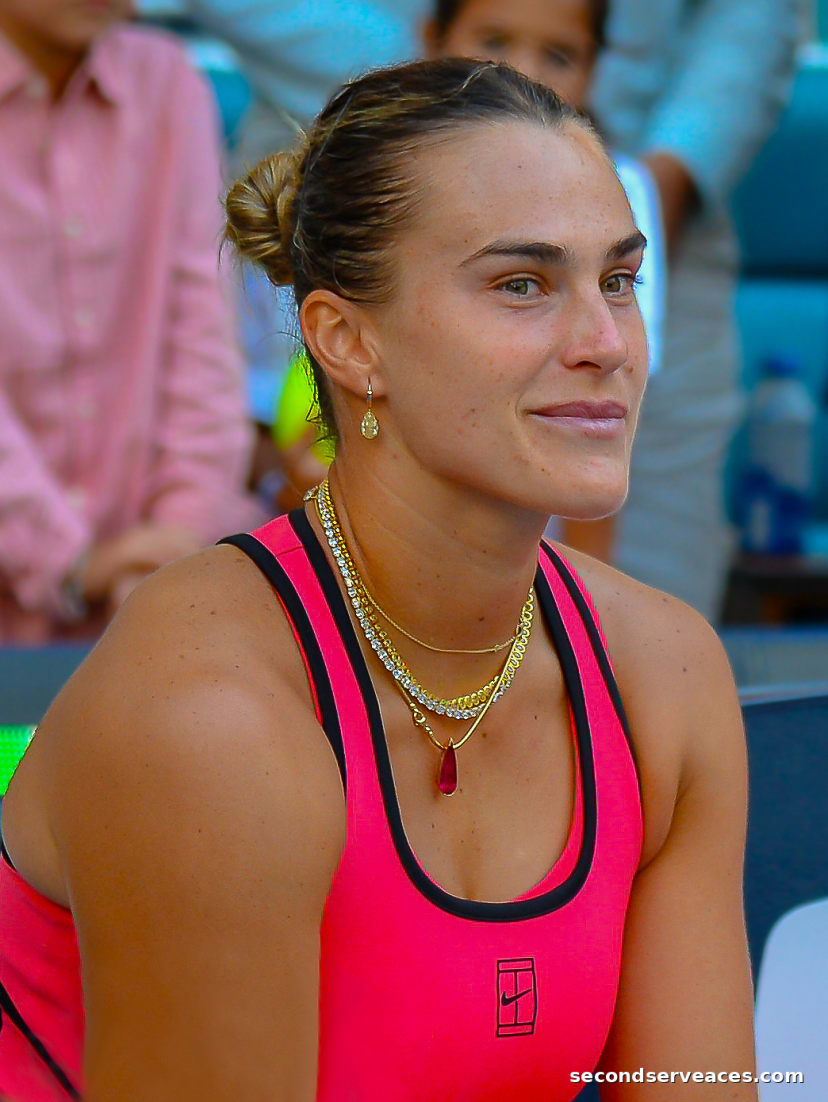
Aryna Sabalenka punched her ticket to the Miami Open quarter-finals with a clinical 6-3, 6-4 dismantling of Zheng Qinwen in a brisk one hour and 25 minutes. While the Belarusian executed a streamlined, aggressive hard-court strategy to advance, the rest of the draw navigated sheer logistical and physical chaos. Down the grounds, Francisco Cerundolo handed Daniil Medvedev an abrupt last-32 exit with a roller-coaster 6-0, 4-6, 7-5 victory, an upset punctuated by a bizarre technical malfunction.
Listen to the Second Serve Podcast
Get our daily AI-synthesized audio briefings and match reviews on the go.
In the women's draw, Coco Gauff also secured a quarter-final berth, battling past Sorana Cirstea 6-3, 4-6, 6-2. For Gauff, the victory was an exercise in biomechanical survival. Having retired from Indian Wells earlier this month due to a nerve problem in her left arm, the American had to recalibrate her mechanics on the fly, fighting through six double faults to close out the match.
The Tactical Breakdown
Deconstructing the Medvedev Defense
You do not drop a 6-0 opening set on Daniil Medvedev without a flawless execution of court geometry. Cerundolo’s massive upset at the last-32 stage was built on exploiting the Russian’s historically deep return position. Medvedev relies on absorbing pace from five meters behind the baseline, daring opponents to overhit. Cerundolo, possessing one of the heaviest forehands on the ATP Tour, refused to play into that trap.
- Short-Angle Exploitation: Instead of hitting through Medvedev, Cerundolo utilized sharp, topspin-heavy crosscourt angles, dragging the Russian out of the center and exposing the alleys.
- Drop Shot Frequency: By forcing Medvedev to cover an immense amount of vertical real estate, Cerundolo disrupted the defensive rhythm that normally makes Medvedev a hard-court nightmare.
- Forehand Dictation: In the decisive third set, Cerundolo consistently found his run-around forehand, dictating play from the ad-court and keeping Medvedev pinned down the line.
Gauff’s Serving Mechanics Under Duress
Coco Gauff’s three-set victory over Cirstea offers a fascinating case study in tactical compensation. A nerve issue in the non-dominant arm is catastrophic for a tennis player's serve. The left arm dictates the toss trajectory, balance, and shoulder turn. When the toss wanders, the kinetic chain breaks down. Gauff’s six double faults indicate a player struggling to find a consistent release point. However, her ability to win 6-3, 4-6, 6-2 highlights her elite rally tolerance. She compensated for a compromised delivery by increasing her first-serve margin, relying heavily on her world-class lateral movement and backhand stability to neutralize Cirstea’s flat baseline strikes.
Sabalenka’s First-Strike Tennis
Conversely, Aryna Sabalenka’s 6-3, 6-4 win over Zheng was a clinic in taking time away. Zheng generates tremendous racket head speed, but she requires a fraction of a second longer to set up her kinetic chain compared to the tour average. Sabalenka stepped inside the baseline on second-serve returns, flattening out her groundstrokes to rob Zheng of that crucial setup time. The 85-minute sprint was decided purely by court positioning.
The Bizarre Spider-Cam Delay
The tactical purity of the Cerundolo-Medvedev clash was briefly derailed by an entirely unprecedented delay. Umpire Mohamed Lahyani found his elevated chair entangled with the aerial 'spider cam', forcing a halt in play. In professional tennis, where match momentum hinges on heart-rate management and neurological focus, sudden external delays can be highly destabilizing. Medvedev, a player heavily reliant on routine and serving rhythm, had to completely reset his mental framework during the logistical sorting of the camera rig.
The Bigger Picture
Francisco Cerundolo’s victory highlights his unique affinity for the Miami hard courts. Historically, South American clay-court specialists have struggled to transition their heavy topspin to faster surfaces, but Miami’s specific gritty surface and humid conditions allow the ball to grip and jump, perfectly suiting Cerundolo’s heavy ball-striking. This upset dramatically opens up his quarter of the draw.
For Coco Gauff, the primary objective over the next 48 hours is strictly physical recovery. Navigating a WTA 1000 event with compromised nerve function in the tossing arm is a monumental task. The rest of the field will undoubtedly take note of her serving struggles and look to attack her second delivery early in the rally. Meanwhile, Sabalenka continues to look incredibly comfortable in the Florida humidity, solidifying her status as the apex predator in the top half of the draw.
What Aryna Sabalenka Plays With
Wilson Blade 98 v9 (16x19)
Luxilon ALU Power 125
Wilson Pro Overgrip (12-Pack)
Analyze Aryna Sabalenka vs. Zheng Qinwen
Predict tactical adjustments, momentum swings, and serve strategy options for this match-up using our AI simulator.
The Aces Tactical Panel
This report was curated and edited by Bhaskar Goel. Tactical analysis and technical insights were provided by our specialized panel of expert correspondents.
Julian Price
Senior Tactical Correspondent
Stuffy, pedantic British academic and historian specializing in match momentum and historical context.
Elena Cruz
Director of Analytical Research
Data scientist specializing in court surface physics and movement patterns.
Bhaskar
The Editor & Fan
Passionate tennis player and site editor bringing everyday amateur insights and relatable fan commentary.
Arthur Vance
Senior Existential Analyst
Deep, eccentric, and DFW-inspired. Models court metaphysics, kinetic beauty, and player psychology.
Leo Sterling
High-Performance Consultant
Hard-nosed ex-trainer from Melbourne with a no-nonsense view on tour fitness.