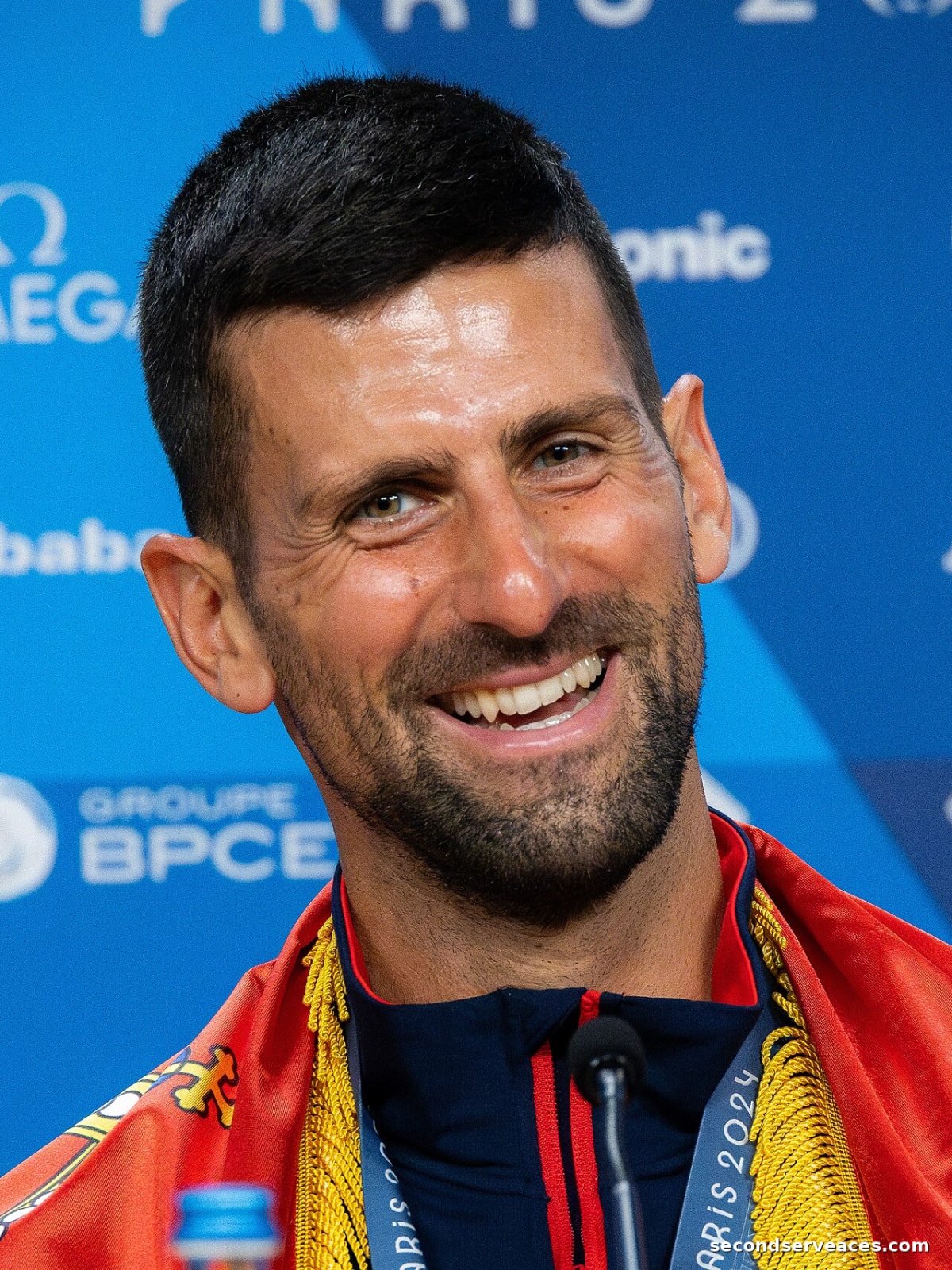
There is a distinct, almost architectural beauty in watching an aging master negotiate the terms of his own physical decline on a tennis court. In the second round of the China Open, Novak Djokovic did not merely play a match; he engaged in a tense, somatic dialogue with his own ribcage. Ultimately, the top-seeded Serbian secured a grueling 4-6, 7-6 (2), 6-2 victory over home favorite Yunchaokete Bu, preserving one of the sport's most mind-boggling statistical anomalies: a flawless 31-0 lifetime record on the hard courts of Beijing.
Listen to the Second Serve Podcast
Get our daily AI-synthesized audio briefings and match reviews on the go.
Yet, the raw numbers tell only a fraction of the story. For the second consecutive match, Djokovic found himself horizontal on the changeover bench, his torso splayed as a tournament trainer worked on his midsection. The scene echoed his opening-round encounter against Portugal's Nuno Borges, raising serious questions about the physical sustainability of this late-season campaign. In front of a highly partisan crowd inside the Diamond Court, the 39-year-old was pushed to the absolute limits of his legendary endurance by a young opponent playing with nothing to lose.
With this hard-fought triumph, Djokovic advances to the quarterfinals, where a formidable test awaits. He will face either the towering German Alexander Zverev or the rising Chinese talent Juncheng Shang. But before looking ahead, one must dissect the physical and tactical tightrope the world's most decorated player had to walk to survive this evening in Beijing.
The Beijing Invincibility and the Creeping Shadows of Physical Decay
To understand the weight of this match, one must first appreciate the historical context of Djokovic's relationship with the China Open. His 31-0 record here is not merely a streak; it is a monument of modern sport, a decade-plus reign of absolute sovereignty on these specific, fast-playing courts. Yet, as he stepped out to face Bu, the air felt different—heavy with the realization that the kinetic machinery of his 39-year-old body is beginning to protest the demands of elite competition.
Yunchaokete Bu, buoyed by the raucous home support, showed zero deference to the champion's resume. The young Chinese player utilized a high-octane baseline strategy, taking the ball exceptionally early and refusing to let Djokovic establish his preferred rhythm. Djokovic's movement, typically characterized by a near-supernatural elasticity, appeared slightly compromised from the opening games, with his lateral slides lacking their usual explosive snap.
As the first set slipped away, the stadium fell into a tense, expectant silence. Djokovic was not simply battling a highly motivated opponent; he was wrestling with a mechanical failure in his own core. The rib area, which serves as the crucial rotational axis for both the serve and the high-spin groundstrokes, had clearly become a source of acute discomfort, threatening to derail his historic unbeaten run in the Chinese capital.
Deconstructing the Tactical Pivot: How Bu Pushed the Champion to the Brink
Tactically, the opening set was a masterclass in aggressive court positioning by Bu. The local wild card consistently targeted Djokovic's backhand wing with heavy topspin, drawing short ball responses that he quickly punished with flat, inside-out forehands. This relentless pressure earned Bu a crucial break point opportunity, which he converted with a brilliant backhand passing shot down the line, eventually serving out the first set 6-4.
Facing adversity, Djokovic's legendary tactical IQ took over. Realizing he could not engage in endless, high-intensity baseline rallies without exacerbating his rib issue, he shifted his strategy in the second set. He began using his slice backhand to alter the match momentum, dropping the ball low and short to force the taller Bu out of his comfort zone. The Serb also heightened his first-serve precision, aiming for the lines rather than raw power to protect his vulnerable midsection.
The second-set tiebreak was where the match turned on its head. Djokovic summoned his trademark mental fortitude, playing nearly flawless tennis to claim the tiebreak 7-2. By mixing deep, looping topspin with sudden dropshots, he completely disrupted Bu's timing, forcing the match into a deciding third set where experience and psychological pressure ultimately broke the young challenger's resolve.
The Trainer's Touch and the Grim Mechanics of Rib Pain
The most alarming visual of the night occurred early in the second set when Djokovic gestured for the physiotherapist. The medical timeout was a grim reminder of his physical fragility, marking the second match in a row that his rib area required intensive manual therapy. Watching a 24-time Grand Slam champion grimace under the trainer's thumbs is an existential reminder of the inevitable toll that decades of athletic excellence take on the human frame.
A rib injury is particularly insidious in tennis because it compromises the kinetic chain. Every serve requires an intense arching of the back and a violent forward snap of the torso; every forehand relies on the rapid rotation of the thoracic spine. Without a fully functioning core, a player is forced to arm the ball, stripping their shots of depth and leaving them vulnerable to counter-attacks.
That Djokovic managed to win the third set 6-2 while clearly managing this physical deficit is a testament to his unparalleled ability to suffer constructively. According to the official ATP Tour tracking data, his average groundstroke speed actually decreased in the final set, yet his placement and depth remained so impeccable that Bu was left with few opportunities to mount a comeback.
Looking Ahead to the Beijing Quarterfinals
With this victory, Djokovic's pursuit of a 102nd career singles title remains alive, though the road ahead grows exponentially steeper. The physical recovery window between matches is now his primary opponent. In a sport where margins are measured in millimeters, playing at less than one hundred percent against elite opposition is a recipe for disaster.
His potential quarterfinal opponents present vastly different tactical challenges. A clash with Alexander Zverev would require Djokovic to endure brutal, physical baseline exchanges, while a matchup against Juncheng Shang would test his lateral movement against one of the quickest young players on the tour. The Serbian's coaching staff will undoubtedly be working overtime to manage his physical recovery protocol ahead of the next round.
For more details on Djokovic's career statistics and his historical performances on hard courts, fans can consult Novak Djokovic's Wikipedia page. For now, the tennis world watches and waits to see if the champion's body can endure the physical demands of his historic quest.
Rivalry Matchup & Player Profiles
To put Djokovic's current campaign into perspective, it is useful to look at his physical profile alongside his first-round opponent in Beijing, Nuno Borges, against whom he also required a medical timeout.
| Metric | Novak Djokovic | Nuno Borges |
|---|---|---|
| Rank | No. 11 | No. 49 |
| Country | Serbia | Portugal |
| Age | 39 | 29 |
| Height | 1.88 m (6'2") | 1.85 m (6'1") |
| Handedness | Right-handed | Right-handed |
| Play Style | Aggressive baseliner | All-court player |
| Career Titles | 101 | 1 |
Djokovic leads his head-to-head record against Borges 2-0. Their most recent encounter occurred in the first round of the 2026 China Open in Beijing, where Djokovic secured a 6-3, 7-6(2) victory. That match, much like the clash with Bu, demonstrated Djokovic's ability to navigate physical limitations through superior tactical positioning and mental resilience.
What Novak Djokovic Plays With
Head Speed Pro
Luxilon ALU Power 125
Head Prime Tour (12-Pack)
Asics Court FF 3 Novak
Analyze Novak Djokovic vs. Nuno Borges
Predict tactical adjustments, momentum swings, and serve strategy options for this match-up using our AI simulator.
The Aces Tactical Panel
This report was curated and edited by Bhaskar Goel. Tactical analysis and technical insights were provided by our specialized panel of expert correspondents.
Julian Price
Senior Tactical Correspondent
Stuffy, pedantic British academic and historian specializing in match momentum and historical context.
Elena Cruz
Director of Analytical Research
Data scientist specializing in court surface physics and movement patterns.
Bhaskar
The Editor & Fan
Passionate tennis player and site editor bringing everyday amateur insights and relatable fan commentary.
Arthur Vance
Senior Existential Analyst
Deep, eccentric, and DFW-inspired. Models court metaphysics, kinetic beauty, and player psychology.
Leo Sterling
High-Performance Consultant
Hard-nosed ex-trainer from Melbourne with a no-nonsense view on tour fitness.
Related Reports
Quick Answers
What was the final score of Novak Djokovic's match against Yunchaokete Bu?+
Novak Djokovic defeated Yunchaokete Bu with a final score of 4-6, 7-6 (2), 6-2.
Why did Novak Djokovic require medical attention during the match?+
Djokovic required medical attention and treatment from a trainer for his rib area, marking the second consecutive match in Beijing that he needed a medical timeout.
What is Novak Djokovic's historical record at the China Open?+
With his victory over Bu, Novak Djokovic extended his unbeaten lifetime record at the China Open to 31-0.