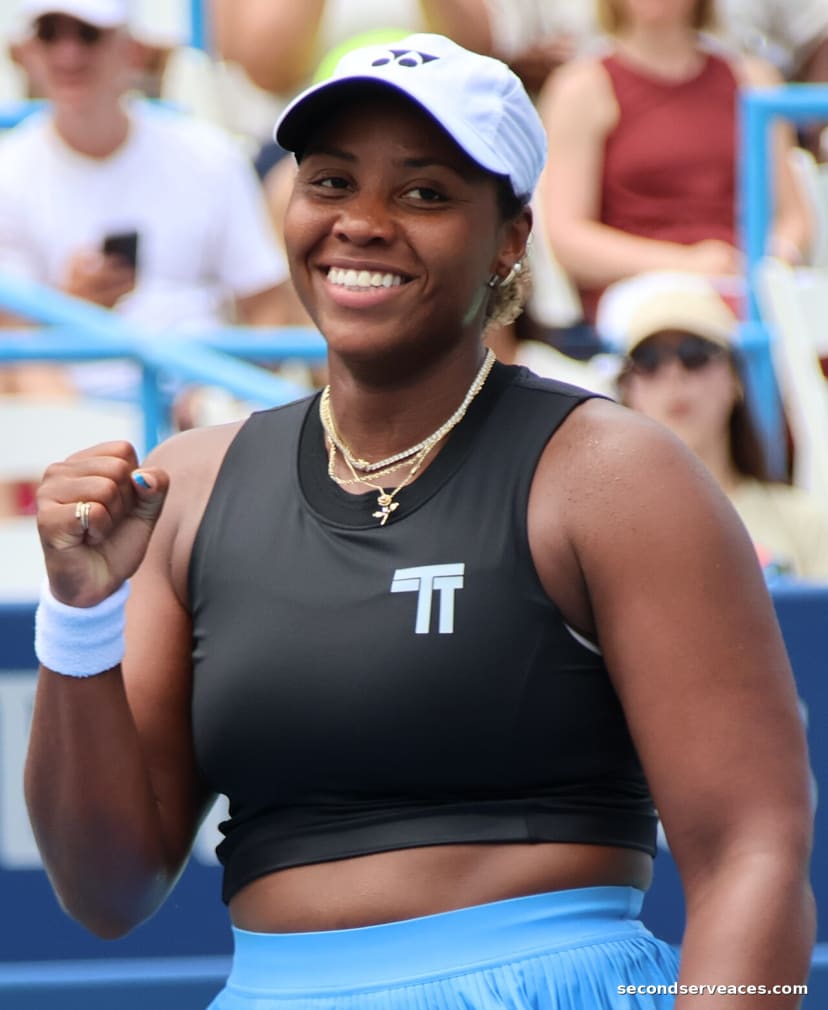
Naomi Osaka is notoriously candid, but her post-match press conference in South Florida carried a heavy, definitive undertone. Following a stark 5-7, 4-6 first-round exit at the Miami Open at the hands of Talia Gibson, the four-time Grand Slam champion dropped a bombshell regarding her professional future. Reconciling the grueling demands of professional tennis with the realities of motherhood is taking a severe physical and mental toll, prompting Osaka to declare she will not remain on the tour if she continues suffering early-round defeats.
Listen to the Second Serve Podcast
Get our daily AI-synthesized audio briefings and match reviews on the go.
Early 2026 has been a turbulent ride for the former world No. 1. During the Australian Open, physical hurdles forced a third-round withdrawal. A subsequent Round of 16 elimination at Indian Wells suggested she was gradually finding her baseline rhythm, but this opening-round departure in Miami fundamentally derails that narrative. Consequently, her upcoming schedule is shifting as she recalibrates her approach to the season.
- Skipping the Green Clay: Osaka formally confirmed her withdrawal from the upcoming WTA event in Charleston.
- European Swing Targets: Despite her current struggles, she intends to compete at the Madrid Open, the Italian Open in Rome, and eventually, the French Open.
The Tactical Breakdown
Evaluating a straight-sets loss like 5-7, 4-6 requires looking beyond raw baseline power. Osaka’s game has historically relied on dictating court geometry through heavy topspin off the forehand wing and penetrating flat drives down the line. When operating at peak capacity, her serve-plus-one combinations remove the opponent's ability to engage in prolonged exchanges. However, when a power-baseliner lacks peak match momentum and optimal court conditioning, timing becomes a fatal liability.
Talia Gibson exploited these transitional vulnerabilities with clinical precision. Players who successfully defuse heavy hitters on high-bouncing hard courts typically prioritize depth over pace. By keeping the ball deep in the center third of the court, an opponent can jam the strike zone, forcing the aggressive player to generate their own pace from awkward stances and defensive postures.
Furthermore, attacking the Osaka backhand with slice can heavily disrupt her rhythm, requiring her to hit up on the ball rather than driving cleanly through it. The lack of sustained rally tolerance from the Japanese star ultimately swung the pivotal break point opportunities in Gibson’s favor, denying Osaka the ability to string together consecutive holds of serve when the scoreboard pressure peaked.
The Bigger Picture
Stepping back from the baseline, this result underscores the immense friction of the modern tennis comeback. Returning to the elite echelon of the sport after childbirth is notoriously arduous. The process demands not just a rebuild of fast-twitch muscle fibers, but a complete rewiring of travel logistics, recovery protocols, and mental bandwidth. While Kim Clijsters managed a miraculous Grand Slam-winning return, and Serena Williams battled through multiple major finals post-maternity, each path is uniquely punishing.
Holding oneself to the standard of past Grand Slam glories can operate as a brutal psychological trap. Osaka’s stark assertion that she will not tolerate continuous first-round exits highlights a fierce competitive pride. Yet, it also funnels an extraordinary amount of pressure onto her upcoming European swing.
Clay has never been her preferred surface. Her lateral movement on the dirt requires sliding into defensive shots rather than relying on her traditional hard-court, hard-stop mechanics. Transitioning to the high altitude of Madrid and the heavy conditions of Rome will demand profound tactical adjustments. If she intends to alter her current trajectory and keep her legendary career active, she must find a way to navigate the physical grind of the clay season while managing the immense expectations she places on her own shoulders.
Analyze Naomi Osaka vs. Talia Gibson
Predict tactical adjustments, momentum swings, and serve strategy options for this match-up using our AI simulator.
The Aces Tactical Panel
This report was curated and edited by Bhaskar Goel. Tactical analysis and technical insights were provided by our specialized panel of expert correspondents.
Julian Price
Senior Tactical Correspondent
Stuffy, pedantic British academic and historian specializing in match momentum and historical context.
Elena Cruz
Director of Analytical Research
Data scientist specializing in court surface physics and movement patterns.
Bhaskar
The Editor & Fan
Passionate tennis player and site editor bringing everyday amateur insights and relatable fan commentary.
Arthur Vance
Senior Existential Analyst
Deep, eccentric, and DFW-inspired. Models court metaphysics, kinetic beauty, and player psychology.
Leo Sterling
High-Performance Consultant
Hard-nosed ex-trainer from Melbourne with a no-nonsense view on tour fitness.