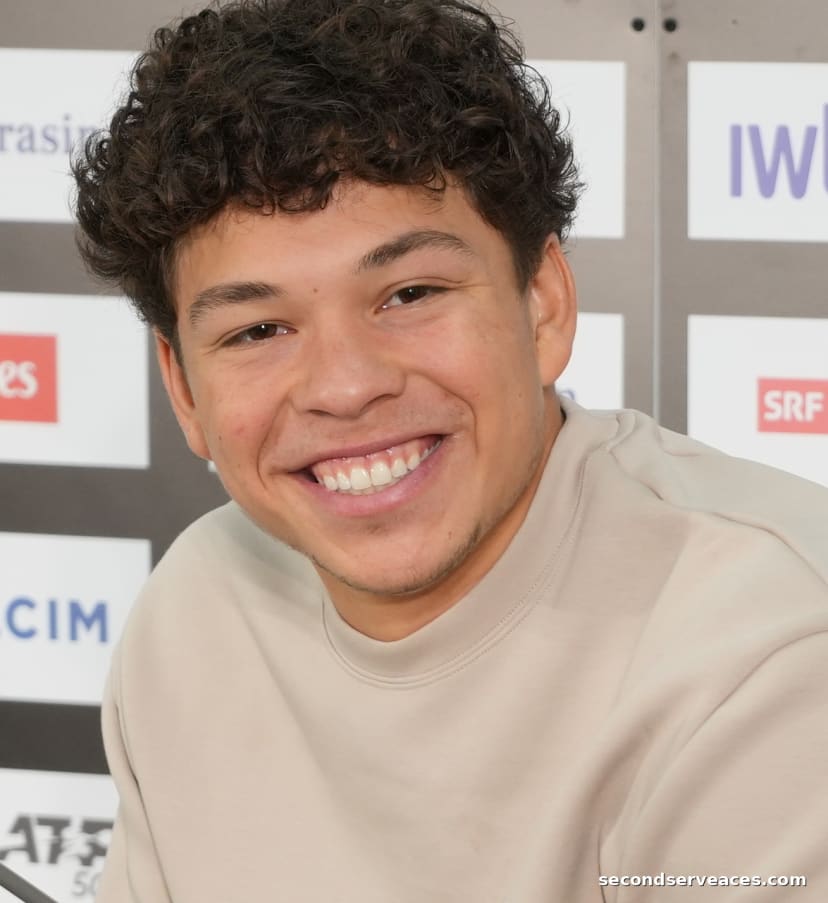
The scoreboard blinked an unforgiving reality on Thursday afternoon: 5-7, 6-4, 6-4. For 17-year-old French wild card Moise Kouame, those digits represented survival in the truest sense of the professional tennis grind. Stepping onto the blistering hard courts of the Miami Open for his first-ever Masters 1000 main draw, Kouame found himself immediately thrown into the deep end against the relentless consistency of Zachary Svajda. Tennis is a sport of solitary confinement, and when you drop the opening set in your premiere at this elite level, the court shrinks. The net looks higher. The margins evaporate. Yet, Kouame refused to fold.
Listen to the Second Serve Podcast
Get our daily AI-synthesized audio briefings and match reviews on the go.
Navigating the transition from junior phenom to the ATP Tour is less about raw ball-striking and entirely about mental endurance. When you are 17, adrenaline is your greatest asset and your most volatile liability. Dropping a tight 5-7 opening set to a disciplined baseliner like Svajda would typically signal the beginning of the end for a teenager. Doubt creeps into the footwork. The swing path shortens. Instead, Kouame anchored himself to the baseline, embracing the friction of the hard court, and slowly began to unravel his opponent's game plan over the subsequent two sets.
The Tactical Breakdown
Analyzing a turnaround of this magnitude requires looking beyond the raw emotion of a teenage debut. Svajda is known for his exceptional court coverage and flat, penetrating groundstrokes. To beat a player with that profile—especially after falling behind—you cannot simply try to hit through them. You have to disrupt their rhythm, change the geometry of the rallies, and manufacture controlled chaos.
Based on the stylistic matchup between a French prodigy finding his footing and a hardened American counter-puncher, several critical tactical themes emerged:
- Managing Match Momentum: Tennis scoring is inherently psychological. By holding early in the second set, Kouame arrested Svajda's momentum, forcing the American to continuously play from behind on the scoreboard. This invisible pressure often yields uncharacteristic errors from a frontrunner.
- Exploiting Court Geometry with Heavy Topspin: Svajda thrives on pace. When an opponent hits flat, it sits right in his strike zone. Kouame's likely adjustment was injecting heavy, looping topspin deep into the corners, particularly targeting the backhand side. This forces the opponent back, opening up short angles and creating time to dictate the point.
- Capitalizing on the Break Point: The difference between a good player and an elite competitor is performance on the high-leverage points. Kouame's ability to extract breaks of serve in both the second and third sets speaks to a mature understanding of when to pull the trigger and when to engage in a high-tolerance rally.
The Physical Toll of the Hard Court
Miami presents a unique environmental challenge. The hard courts are unforgiving on the joints, and the humidity sits on your chest like a weighted blanket. A three-set battle here requires not just cardiovascular fitness, but muscular endurance. For Kouame to maintain his explosive lateral movement deep into a decider—securing back-to-back 6-4 sets—indicates an off-court conditioning regimen that belies his 17 years.
The Bigger Picture
Breaking through at a Masters 1000 event as a teenager places you in an exclusive historical fraternity. The leap from the Challenger circuit to the main stage of the ATP is steep, paved with the broken rackets of highly touted juniors who could not solve the puzzle of professional defense. We often look at the early careers of legends like Novak Djokovic to understand the trajectory of these young prodigies. Before the Grand Slam counts piled up, Djokovic was a teenager learning how to manage his breathing, his emotions, and his shot selection against veterans who wanted nothing more than to expose his inexperience.
Kouame is now tasting that exact crucible. Securing a wild card is an opportunity; winning a three-set grinder to validate that wild card is a revelation. It alters the locker room perception. Peers no longer view you merely as a promising junior, but as a legitimate threat capable of problem-solving under duress.
For Svajda, this result stings. Surrendering a one-set lead to a younger, less experienced player is a bitter pill in a tournament that offers significant ranking points. He will need to review the tape, particularly analyzing his serve placement under pressure during the final two sets, to understand how the teenager wrestled control away from him.
As the dust settles on this Thursday battle, the tennis world will undoubtedly keep a closer eye on Kouame. The French federation has a rich history of producing aesthetically beautiful players, but the tour demands grit over grace. By grinding out a 5-7, 6-4, 6-4 victory when the easier path was capitulation, Kouame just proved he has the callouses required to survive the tour.
What Novak Djokovic Plays With
Head Speed Pro
Luxilon ALU Power 125
Asics Court FF 3 Novak
Analyze Moise Kouame vs. Novak Djokovic
Predict tactical adjustments, momentum swings, and serve strategy options for this match-up using our AI simulator.
The Aces Tactical Panel
This report was curated and edited by Bhaskar Goel. Tactical analysis and technical insights were provided by our specialized panel of expert correspondents.
Julian Price
Senior Tactical Correspondent
Stuffy, pedantic British academic and historian specializing in match momentum and historical context.
Elena Cruz
Director of Analytical Research
Data scientist specializing in court surface physics and movement patterns.
Bhaskar
The Editor & Fan
Passionate tennis player and site editor bringing everyday amateur insights and relatable fan commentary.
Arthur Vance
Senior Existential Analyst
Deep, eccentric, and DFW-inspired. Models court metaphysics, kinetic beauty, and player psychology.
Leo Sterling
High-Performance Consultant
Hard-nosed ex-trainer from Melbourne with a no-nonsense view on tour fitness.