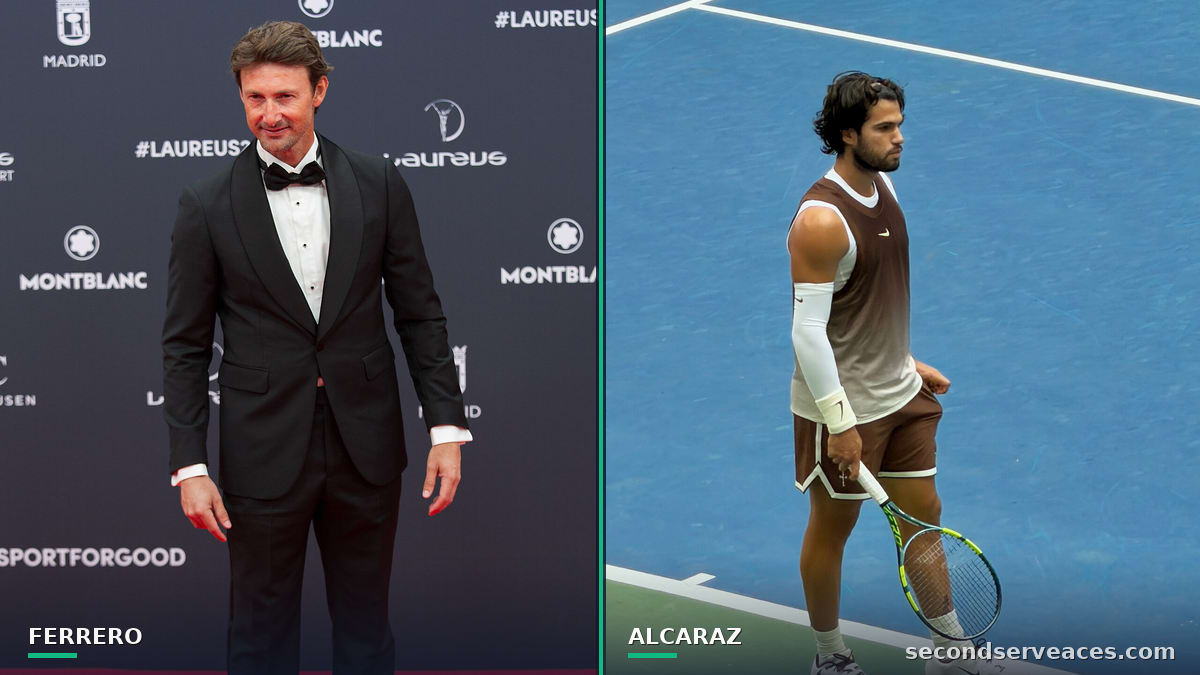
In December 2025, one of the most successful coaching alliances of the modern era quietly dissolved. Former World No. 1 Juan Carlos Ferrero and his protégé parted ways after a seven-year partnership that began in 2018. Ferrero, who built Alcaraz from a raw teenager into a multi-slam champion, recently reflected on the split, offering a candid assessment that went far deeper than standard post-coaching platitudes. Rather than focus on the final year of their partnership, Ferrero admitted he would change aspects of the young star's overall career trajectory if given the chance.
The December 2025 Separation After Seven Years of Development
Under Ferrero's watchful eye, Alcaraz evolved from a hyper-aggressive clay-courter into an all-court force capable of suffocating opponents from any area of the court. The tactical foundation built at the Equelite Academy in Villena emphasized early ball-striking, forward movement, and a relentless refusal to yield the baseline. Ferrero's coaching philosophy was never about maintaining a safe, defensive posture; it was about taking time away from the opponent by hugging the baseline and utilizing a devastating drop-shot-to-lob combination.
This departure marks a major turning point in men's tennis, as the duo had come to define the post-Big Three era. Ferrero's insights reveal that coaching a generational talent involves a constant struggle between immediate competitive success and long-term physical sustainability. The decision to step aside was not born out of a sudden conflict, but rather a mutual understanding that a new voice was required to guide the next phase of the Spaniard's career.
Listen to the Second Serve Podcast
Get our daily AI-synthesized audio briefings and match reviews on the go.
The coaching change was executed with professional precision, ensuring that Alcaraz's support system remained intact. By transitioning to a familiar face from within the same academy, the camp minimized the psychological disruption that often derails players during a major structural shift. This strategic move allowed Alcaraz to maintain his training intensity without having to rebuild his core team from scratch.
The Six Grand Slam Milestones and Court Positioning Masterclass
During their seven years together, the partnership yielded an astonishing haul of 24 ATP Tour singles titles, highlighted by six Grand Slam trophies. Ferrero's influence was most visible in how Alcaraz managed his positioning during high-stakes rallies. Instead of retreating deep behind the baseline, Alcaraz was trained to take the ball on the rise, converting defense to offense with a single, explosive forehand. This aggressive court positioning forced opponents to defend from deep corners, rendering their tactical game plans obsolete.
A key metric of their success was Alcaraz's efficiency at the net, where he frequently won over 75% of his approach points during major finals. Ferrero constantly preached the importance of transitioning forward behind heavy, high-topspin groundstrokes that pushed opponents wide of the doubles alley. This approach allowed Alcaraz to leverage his incredible hand-skills and soft touch, turning potentially grueling baseline exchanges into quick, decisive points that preserved his physical reserves.
While the raw statistics of their partnership are staggering, Ferrero's reflections focus on the developmental milestones that preceded the silverware. The transition from a junior player with erratic shot selection to a disciplined professional required rigorous tactical drilling. Ferrero worked tirelessly to curb Alcaraz's tendency to go for low-percentage winners early in rallies, instead teaching him to construct points systematically by utilizing heavy crosscourt patterns before executing down-the-line strikes.
The Samuel Lopez Transition and the 2026 Melbourne Triumph
Following the split, the coaching reins were handed over to Samuel Lopez, a highly respected coach who also operates out of Ferrero's academy. This internal transition ensured that Alcaraz's core training environment remained stable, avoiding the disruptive adjustments that often accompany a completely new coaching team. Lopez brought a subtle shift in perspective, focusing on optimizing Alcaraz's serve efficiency and reducing unforced errors during neutral baseline rallies.
The immediate dividends of this transition were realized on the hard courts of Melbourne. Alcaraz captured the 2026 Australian Open in his very first tournament since parting ways with Ferrero. During this championship run, Alcaraz displayed a highly disciplined return position, standing slightly further back to neutralize big serves before gradually working his way back up to the baseline as the rally progressed. His first-serve conversion rate hovered at an impressive 72% throughout the fortnight, showcasing the technical refinements implemented by Lopez.
Winning a major immediately after ending a historic coaching relationship sent a clear message to the rest of the tour. It demonstrated that Alcaraz's tactical acumen had matured to the point where he could adapt to new strategic directives without losing his competitive edge. The victory also validated the decision to keep his coaching transition within the Equelite family, maintaining the structural continuity that has been the bedrock of his professional rise.
Navigating the Four-Month Wrist Injury Layoff and Career Calibration
Despite the triumph in Melbourne, the 2026 season presented severe physical challenges for the young Spaniard. Alcaraz was sidelined for over four months, between April and August, due to a persistent right wrist injury. This forced layoff disrupted his match rhythm and highlighted the physical toll of his high-intensity playing style. The injury served as a stark reminder of the sustainability issues Ferrero had hinted at when discussing his desire to alter certain aspects of Alcaraz's career path.
During this extended rehabilitation period, the focus shifted from active competition to physical recalibration. The wrist injury required a temporary modification of his forehand take-back, encouraging a more relaxed wrist lag to prevent re-injury. As we discussed when Carlos Alcaraz Chases Match Rhythm at Vienna Open, regaining peak match fitness and timing after such a long absence is an arduous process that demands patience and tactical flexibility.
Now back on tour and climbing the ATP rankings, Alcaraz faces the challenge of balancing his signature explosive movement with a more calculated scheduling approach. Ferrero's retrospective comments underscore the reality that managing a superstar's career is as much about load management and injury prevention as it is about tactical execution on the court. As Alcaraz continues his journey under Lopez's guidance, the lessons learned during his seven years with Ferrero will undoubtedly remain the blueprint for his long-term success.
Rivalry Matchup & Player Profiles
| Metric | Juan Carlos Ferrero |
|---|---|
| Rank | Retired (Former World No. 1) |
| Country | Spain |
| Age | 46 |
| Handedness | Right-handed |
| Height | 1.83 m (6 ft 0 in) |
| Play Style | Aggressive baseliner |
| Career Titles | 16 |
Juan Carlos Ferrero’s career as an aggressive baseliner paved the way for the modern Spanish style of play, characterized by heavy topspin and exceptional court coverage. Winning 16 career titles, including Roland Garros in 2003, Ferrero understood the immense physical demands of the tour. This firsthand experience heavily influenced his coaching of Carlos Alcaraz, as he sought to instill the same baseline discipline while adapting to the faster, modern game.
Though Ferrero has transitioned away from the day-to-day touring grind with Alcaraz, his legacy as both a world-class competitor and a master tactician remains firmly intact. The structural foundation he built with Alcaraz will continue to serve as the benchmark for elite coaching transitions on the ATP Tour.
What Carlos Alcaraz Plays With
Babolat Pure Aero 98
Babolat RPM Blast 1.30
Babolat VS Original (12-Pack)
Nike Vapor Pro 2
Analyze Juan Carlos Ferrero vs. Carlos Alcaraz
Predict tactical adjustments, momentum swings, and serve strategy options for this match-up using our AI simulator.
The Aces Tactical Panel
This report was curated and edited by Bhaskar Goel. Tactical analysis and technical insights were provided by our specialized panel of expert correspondents.
Julian Price
Senior Tactical Correspondent
Stuffy, pedantic British academic and historian specializing in match momentum and historical context.
Elena Cruz
Director of Analytical Research
Data scientist specializing in court surface physics and movement patterns.
Bhaskar
The Editor & Fan
Passionate tennis player and site editor bringing everyday amateur insights and relatable fan commentary.
Arthur Vance
Senior Existential Analyst
Deep, eccentric, and DFW-inspired. Models court metaphysics, kinetic beauty, and player psychology.
Leo Sterling
High-Performance Consultant
Hard-nosed ex-trainer from Melbourne with a no-nonsense view on tour fitness.
Related Reports


Quick Answers
When did Juan Carlos Ferrero and Carlos Alcaraz end their coaching partnership?+
Juan Carlos Ferrero and Carlos Alcaraz parted ways in December 2025 after a highly successful seven-year partnership that began in 2018.
Who became Carlos Alcaraz's head coach after the split with Ferrero?+
Samuel Lopez, a coach from Juan Carlos Ferrero's academy, took over as Carlos Alcaraz's head coach following the split.
How many Grand Slam titles did Carlos Alcaraz win while working with Juan Carlos Ferrero?+
Carlos Alcaraz captured six Grand Slam singles titles and a total of 24 ATP Tour singles titles during his partnership with Ferrero.