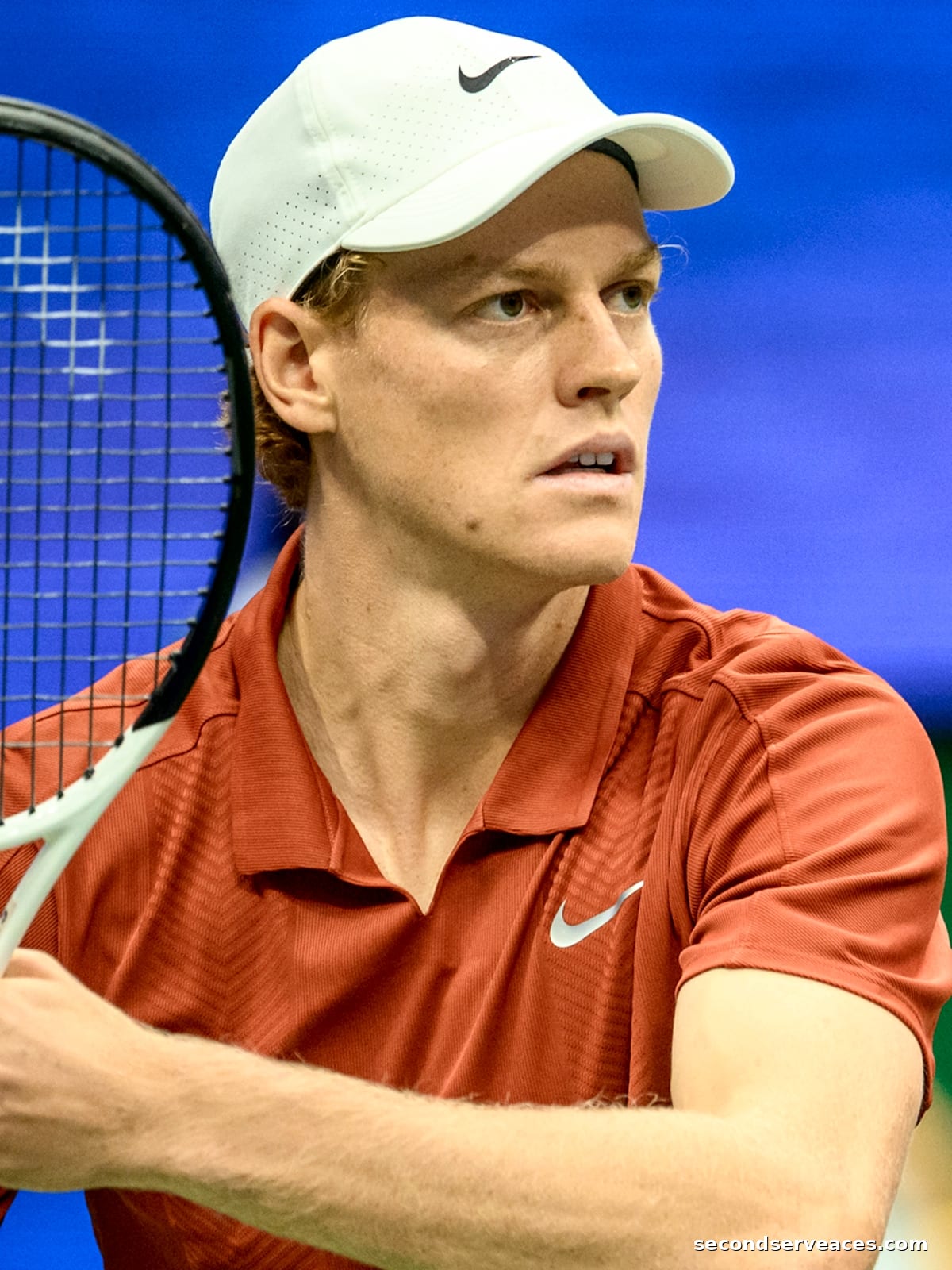
The modern baseline game is an exercise in violent deceleration, a reality made painfully clear as World No. 1 Jannik Sinner announced his withdrawal from the Cincinnati Open. Citing a persistent right knee injury, the Italian superstar has chosen to prioritize long-term joint integrity over immediate competitive glory. This decision follows his tactical absence from the Montreal Masters, illustrating a calculated effort to preserve his physical peak ahead of the year's final Grand Slam.
Listen to the Second Serve Podcast
Get our daily AI-synthesized audio briefings and match reviews on the go.
Sinner's departure occurs in tandem with World No. 2 Carlos Alcaraz, who recently pulled out due to a wrist injury, as detailed in our analysis of Alcaraz's physical setback. With both top seeds absent from the draw, the tournament loses its primary kinetic anchors, leaving the field wide open and raising urgent questions about physical sustainability on the grueling summer hard-court swing.
The Friction of Cincinnati’s Ultra-Fast Courts and Joint Strain
The Western & Southern Open is played on courts notorious for a high Court Pace Index (CPI), where the ball speeds through the court with minimal friction and forces players into extreme, low-slung defensive lunges. Sinner’s aggressive baseline style relies on sliding on hard courts to recover court position—a mechanical feat that subjects the patellar tendon to immense G-forces. At the fast Cincinnati venue, this mechanical strain is amplified, making a withdrawal logical to protect his knee before the grueling best-of-five format in New York.
According to current ATP rankings, Sinner holds a fragile grip on the top spot. Pushing through the high-impact, high-bounce environment of Ohio could have caused irreversible micro-tears, ending his season prematurely. By stepping back, Sinner protects his lateral movement mechanics, which are crucial for defending his deep-court position against flat-hitters.
Seeding Vibrations and Draw Vulnerabilities at Flushing Meadows
The double withdrawal of Sinner and Alcaraz fundamentally destabilizes the seeding hierarchy for the upcoming US Open, scheduled to begin on August 30. Without warm-up matches on North American hard courts, both players will enter New York with minimal match momentum, exposing them to early-round upsets against unseeded, rhythm-heavy opponents.
This vacuum at the top of the draw offers a golden opportunity for mid-tier seeds to secure top-four placements, avoiding early clashes with the game's elite. The tactical landscape of the US Open now shifts from a predictable two-horse race to a chaotic, wide-open battleground where physical endurance and adaptability will dictate who hoists the trophy.
Rivalry Matchup & Player Profiles
| Metric | Jannik Sinner | Carlos Alcaraz |
|---|---|---|
| Rank | No. 1 | No. 2 |
| Country | Italy | Spain |
| Age | 24 | 23 |
| Height | 1.91 m (6 ft 3 in) | 1.83 m (6 ft 0 in) |
| Handedness | Right-handed | Right-handed |
| Play Style | Aggressive baseliner | Aggressive all-court player |
| Career Titles | 30 singles titles | 26 singles titles |
While both athletes find themselves temporarily grounded by physical limitations, their competitive history remains one of the most compelling narratives in modern tennis. Carlos Alcaraz currently holds a 10-7 advantage in their official head-to-head matchups. Their encounters are defined by explosive court coverage and high-velocity baseline exchanges that push the boundaries of human athletic capability.
However, Sinner claimed the upper hand in their most recent meeting, securing a straight-sets victory in the 2026 Monte Carlo Masters final with a 7-6(5), 6-3 scoreline. As both players race against the clock to recover for the US Open, their physical readiness will determine whether tennis fans get to witness another installment of this premier rivalry on the hard courts of New York.
What Jannik Sinner Plays With
Head Speed MP 2024
Head Hawk Touch 1.25
Head Prime Tour (12-Pack)
Nike GP Challenge 1
Analyze Jannik Sinner vs. Carlos Alcaraz
Predict tactical adjustments, momentum swings, and serve strategy options for this match-up using our AI simulator.
The Aces Tactical Panel
This report was curated and edited by Bhaskar Goel. Tactical analysis and technical insights were provided by our specialized panel of expert correspondents.
Julian Price
Senior Tactical Correspondent
Stuffy, pedantic British academic and historian specializing in match momentum and historical context.
Elena Cruz
Director of Analytical Research
Data scientist specializing in court surface physics and movement patterns.
Bhaskar
The Editor & Fan
Passionate tennis player and site editor bringing everyday amateur insights and relatable fan commentary.
Arthur Vance
Senior Existential Analyst
Deep, eccentric, and DFW-inspired. Models court metaphysics, kinetic beauty, and player psychology.
Leo Sterling
High-Performance Consultant
Hard-nosed ex-trainer from Melbourne with a no-nonsense view on tour fitness.
Related Reports
Quick Answers
Why did Jannik Sinner withdraw from the Cincinnati Open?+
Jannik Sinner withdrew from the tournament due to a right knee injury, choosing to prioritize his recovery ahead of the upcoming US Open.
Which other top player withdrew from the Cincinnati Open alongside Sinner?+
World No. 2 Carlos Alcaraz also withdrew from the Cincinnati Open due to a wrist injury.
When is the US Open scheduled to begin?+
The US Open is scheduled to begin on August 30.