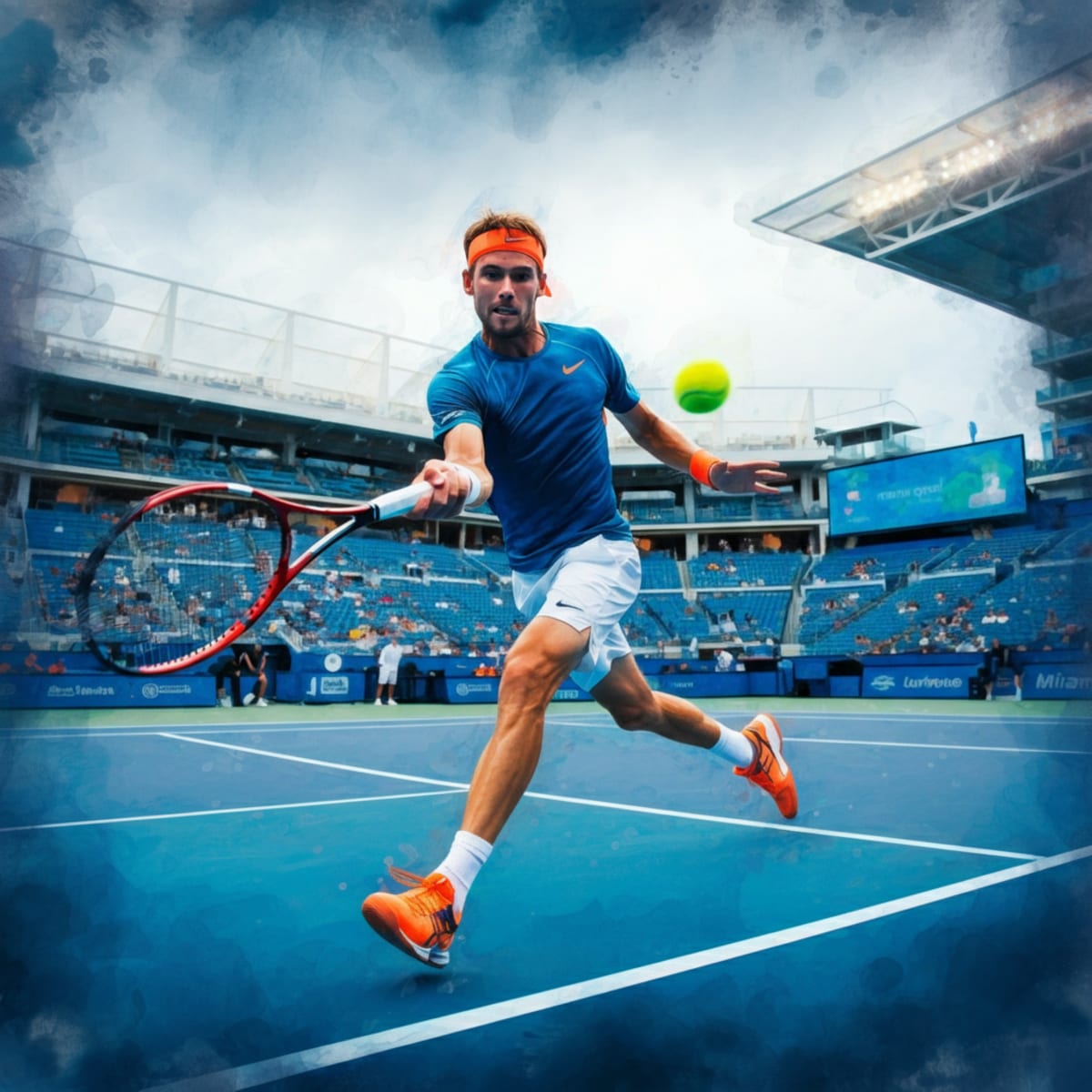
The hard courts of the Miami Open exist in a strange, oppressive microclimate of oceanic humidity and glaring ultraviolet light. It is a surface that traditionally rewards those who can cut through the heavy, dragging air with frictionless biomechanics. Enter Jannik Sinner. Following his meticulous victory over Frances Tiafoe, the Italian has arrived at a statistical precipice that demands our undivided attention. He has now won 30 consecutive sets at ATP Masters events. Thirty. It is a sequence of uninterrupted baseline asphyxiation, a marvel of modern athletic physics.
Listen to the Second Serve Podcast
Get our daily AI-synthesized audio briefings and match reviews on the go.
Let us examine the empirical reality of the "Sunshine Double"—the grueling, back-to-back gauntlet of Indian Wells and Miami. Historically, it operates as an endurance test designed to violently break down a player's physical and mental reserves. Yet, Sinner currently navigates this swing with a chilling efficiency.
The Mathematics of the American Hardcourts
- The Pinnacle Rate: Sinner holds a staggering 41-6 career win-loss record across the two tournaments.
- The Ultimate Metric: That translates to an 87.23% strike rate, the highest all-time win percentage at these combined events.
- The Context: To understand the sheer altitude of that number, consider the men he just surpassed. Novak Djokovic occupies the second-highest win rate at 83.61%, while Roger Federer sits at 81.88%.
Sinner has entirely rewritten the arithmetic of the American spring. He is now exactly two wins away from hoisting the Miami trophy and completing the elusive double.
The Tactical Breakdown
Sinner operates less like a traditional tennis player and more like a high-velocity ball-striking centrifuge. Against a dynamic, rhythm-dependent athlete like Frances Tiafoe, Sinner’s fundamental strategy relied on relentless spatial theft. By hugging the baseline and taking the ball exquisitely early, the Italian drastically reduces the temporal window his opponent has to recover and set their feet.
Tiafoe requires a fraction of a second to properly load up his explosive, kinetic forehand. Sinner simply deleted that fraction from the match equation. The ball was continuously arriving on Tiafoe's strings before the American's lower body could coil.
Now, looking ahead to the semifinal clash with third seed Alexander Zverev, the geometric puzzle shifts entirely. Zverev possesses a towering, concussive first serve and a fundamentally heavier, loopier groundstroke production off both wings. Sinner’s overarching objective will be to flatten the trajectory of the rallies. If Sinner can redirect Zverev’s pace down the line—particularly targeting the German’s forehand wing during cross-court backhand exchanges—he avoids the suffocating, high-bouncing, high-margin rallies that Zverev vastly prefers. The match will be decided by court positioning: whether Zverev can push Sinner backward with spin, or if Sinner can hold his ground upon the baseline and absorb the kinetic energy.
The Bigger Picture
Achieving an 87.23% win rate across two vastly different environmental conditions—the arid, high-bouncing desert air of California and the low-bouncing, swampy coastal plains of Florida—indicates an alarming surface agnosticism. Most professionals possess a distinct biological preference for one over the other. Sinner’s clean, abbreviated swings function as an all-weather operating system. The ball interacts with his racket face so briefly, and with such violent rotational force, that the atmospheric conditions become largely irrelevant.
This statistical summit is not merely a trivia note; it is a profound indicator of Sinner's evolutionary trajectory on the ATP Tour. Surpassing the established historical markers of Nadal, Djokovic, and Federer in any hardcourt metric requires a terrifying level of day-to-day consistency. The physical toll of the tour is a constant, grinding friction, tearing at the ligaments and the psyche alike. But right now, buoyed by the cleanest ball-striking in the modern game, Sinner is simply gliding above it.
What Jannik Sinner Plays With
Head Speed MP 2024
Head Hawk Touch 1.25
Nike GP Challenge 1
Analyze Jannik Sinner vs. Frances Tiafoe
Predict tactical adjustments, momentum swings, and serve strategy options for this match-up using our AI simulator.
The Aces Tactical Panel
This report was curated and edited by Bhaskar Goel. Tactical analysis and technical insights were provided by our specialized panel of expert correspondents.
Julian Price
Senior Tactical Correspondent
Stuffy, pedantic British academic and historian specializing in match momentum and historical context.
Elena Cruz
Director of Analytical Research
Data scientist specializing in court surface physics and movement patterns.
Bhaskar
The Editor & Fan
Passionate tennis player and site editor bringing everyday amateur insights and relatable fan commentary.
Arthur Vance
Senior Existential Analyst
Deep, eccentric, and DFW-inspired. Models court metaphysics, kinetic beauty, and player psychology.
Leo Sterling
High-Performance Consultant
Hard-nosed ex-trainer from Melbourne with a no-nonsense view on tour fitness.