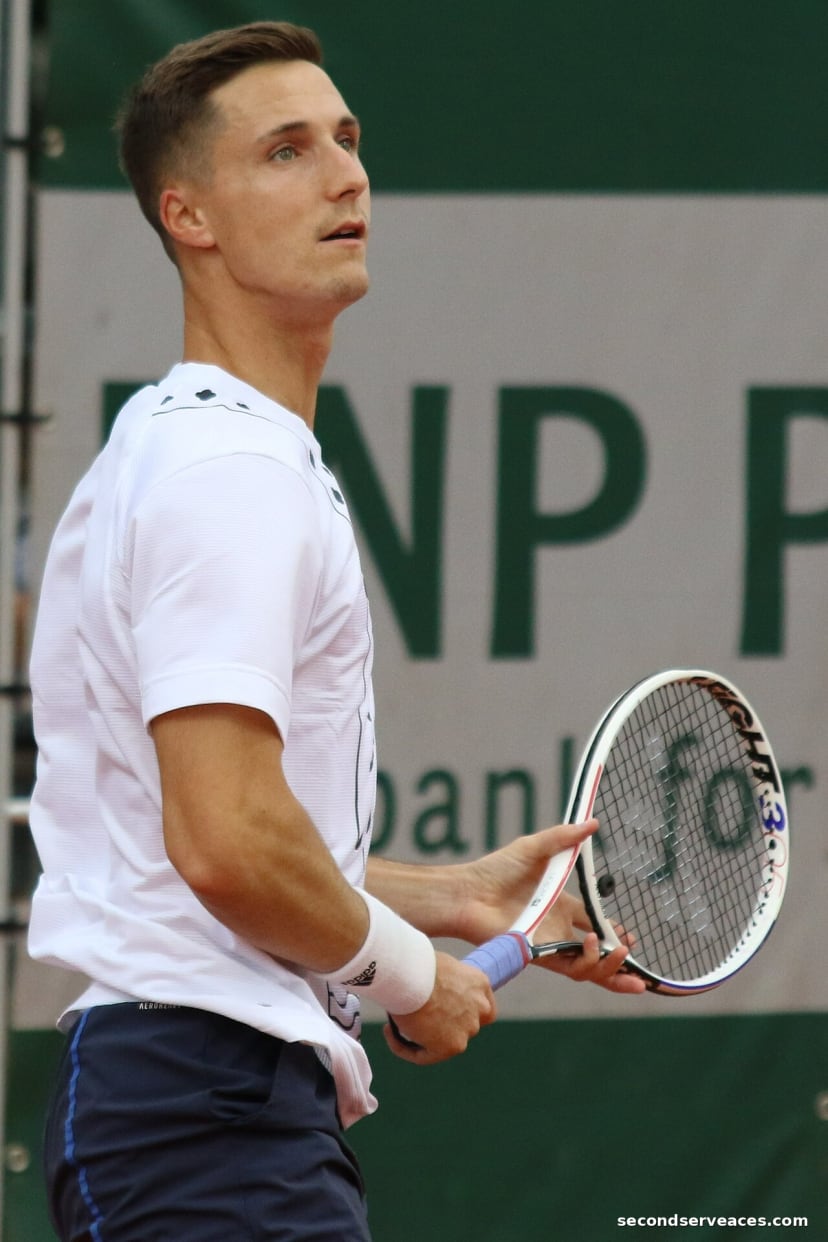
In the high-velocity geometry of professional tennis, doubles is often relegated to the margins—a secondary consideration in a sport obsessed with the solitary hero. Yet, for Jamie Murray, those margins became the center of a historic career. Now, at 40 years of age, Jamie Murray has announced his retirement, concluding a tenure defined by precision, spatial awareness, and a quiet tenacity that fundamentally reshaped the landscape for British players.
Listen to the Second Serve Podcast
Get our daily AI-synthesized audio briefings and match reviews on the go.
The Ascent to the Summit
Tennis is a game of infinitesimal margins, where the difference between a winner and an unforced error often resides in the timing of a split-second movement. On March 27, 2016, Murray transcended these variables, becoming the first British player to reach the world No. 1 spot on the ATP rankings. It was an ascent that verified the efficacy of his tactical approach—a style predicated on anticipation rather than brute force.
Grand Slam Milestones
His cabinet is a testament to longevity and adaptability, spanning nearly two decades of competition:
- 2007 Wimbledon: A breakthrough moment in mixed-doubles alongside Jelena Jankovic, demonstrating the early promise of his net craft.
- 2016 Australian Open & US Open: His dual-Slam surge with partner Bruno Soares, an exhibition of synchronicity that marked the absolute zenith of his career.
Beyond the individual accolades, Murray was a vital cog in a national resurgence. His partnership with his brother, Andy Murray, during the 2015 Davis Cup campaign provided the ballast that helped Great Britain secure its first title in 79 years. It was a victory of collective willpower, a rare convergence of history and current form that remains a cornerstone of British tennis lore.
Refining the Doubles Art
Throughout his time on the tour, Murray competed alongside a rotating cast of partners—including Joe Salisbury, Neal Skupski, Lloyd Glasspool, Julian Cash, Henry Patten, and John Peers—each collaboration requiring a recalibration of his court coverage. His ability to adapt to varying playstyles serves as a final, enduring lesson for those watching from the stands: in doubles, the synergy of two players is always greater than the sum of their individual kinetic outputs. As he walks away from the ATP Tour, the vacuum he leaves at the net is a profound one.
Analyze Jamie Murray vs. Andy Murray
Predict tactical adjustments, momentum swings, and serve strategy options for this match-up using our AI simulator.
The Aces Tactical Panel
This report was curated and edited by Bhaskar Goel. Tactical analysis and technical insights were provided by our specialized panel of expert correspondents.
Julian Price
Senior Tactical Correspondent
Stuffy, pedantic British academic and historian specializing in match momentum and historical context.
Elena Cruz
Director of Analytical Research
Data scientist specializing in court surface physics and movement patterns.
Bhaskar
The Editor & Fan
Passionate tennis player and site editor bringing everyday amateur insights and relatable fan commentary.
Arthur Vance
Senior Existential Analyst
Deep, eccentric, and DFW-inspired. Models court metaphysics, kinetic beauty, and player psychology.
Leo Sterling
High-Performance Consultant
Hard-nosed ex-trainer from Melbourne with a no-nonsense view on tour fitness.