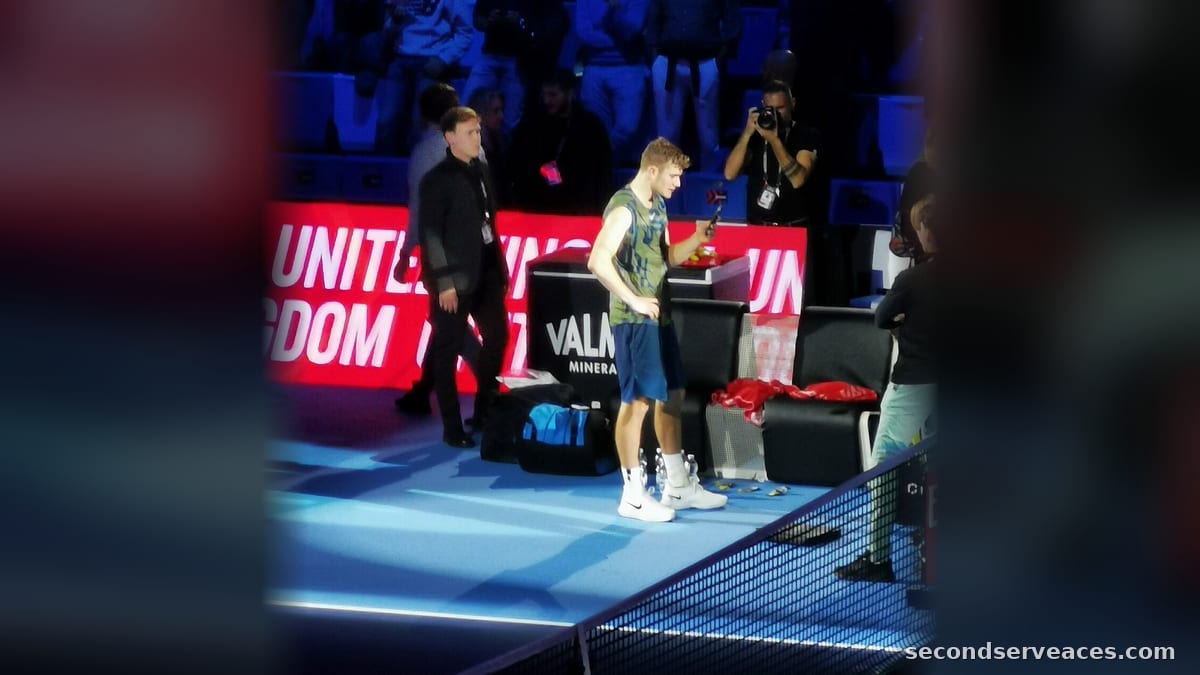
The Left Arm's Rebellion and the 15-Match Limit
The physical toll of modern professional tennis is rarely a quiet thing, but for Jack Draper, the 2026 season dissolved into a series of silent, agonizing withdrawals. The culprit was not a dramatic ligament tear or a sudden, cinematic pop on court, but rather the insidious, dull throb of bone bruising in his left arm—the very limb that generates his heavy, topspin-loaded groundstrokes. This persistent pathology limited the 24-year-old Briton to a mere 15 matches over the entire calendar year, transforming what should have been a period of consolidation into a medical exile.
The final act of his truncated campaign occurred in August at the Cincinnati Open, where the sheer mechanics of his high-velocity game finally buckled under the strain. There is something deeply tragic about a player of Draper's physical stature—standing a commanding 6 feet 4 inches—being brought to a complete standstill by an internal bruise. He departed the hard courts of Ohio not just with another physical setback, but with the stark realization that his body was actively rejecting the demands of the professional circuit.
This prolonged physical rebellion cost him dearly, completely erasing his presence from the grandest stages of the sport. The injury prevented Draper from contesting a single Grand Slam match in 2026, forcing him to watch from the sidelines as the tennis caravan rolled through Melbourne, Paris, London, and New York. For an athlete whose entire identity is forged in the crucible of elite competition, this enforced absence represented an agonizing competitive vacuum.
Listen to the Second Serve Podcast
Get our daily AI-synthesized audio briefings and match reviews on the go.
A Brutal Descent Below the Top 150 Threshold
The consequences of inactivity in the tennis ecosystem are mathematically merciless, and Draper's trajectory in 2026 serves as a sobering case study. Having once scaled the heights of the sport to reach a career-high ranking of World No. 4, his inability to defend points saw him plummet precipitously down the ladder. By the time the autumn leaves fell, the Briton found himself languishing outside the top 150, currently sitting at a modest No. 158 in the ATP rankings.
To understand the psychological weight of this descent, one must understand the sheer disparity between the elite tier and the Challenger-level wilderness. At No. 158, a player is no longer guaranteed direct entry into main draws, forced instead to contemplate the grueling qualifying rounds or rely on the capricious benevolence of wildcard committees. It is a humbling reality for a man who, not so long ago, was viewed as the vanguard of British tennis.
Yet, this statistical demotion does not fully capture the internal struggle of a player whose biological machinery has failed him. The ranking points are merely a numerical reflection of a deeper, more physical frustration—the knowledge that his aggressive baseline style, characterized by heavy topspin and explosive court coverage, is temporarily locked away behind a barrier of medical caution.
The Generational Warning from a Fractured Locker Room
Draper’s forced hiatus has transformed him from a quiet competitor into an outspoken critic of the sport’s structural architecture. Speaking with the raw honesty of someone who has spent months analyzing his own physical breakdown, the young left-hander directed a scathing critique at the current calendar. He stated unequivocally that the relentless, twelve-month schedule is "putting a whole generation in danger" of premature physical ruin.
This warning is not merely the complaint of an injured athlete seeking excuses, but rather a reflection of a growing systemic crisis within the locker room. The transition between different court surfaces, combined with the introduction of heavier balls and mandatory two-week Masters events, has left players with virtually no off-season to rest or recuperate. Draper’s bone bruising is a direct manifestation of this cumulative impact, a warning sign that the human frame is not designed to withstand such unyielding, repetitive stress.
By framing his personal misfortune as a generational hazard, Draper has aligned himself with a growing coalition of players demanding structural reform from governing bodies. The current model, which prioritizes commercial expansion over physical sustainability, is increasingly viewed as an unsustainable system. His words carry the heavy authority of a former top-five player who has paid the ultimate price in ranking points and physical health.
Rebuilding the Kinetic Engine in the Clay of Brazil
The path back to relevance for the British lefty begins far from the sterile, high-pressure environments of the tour, shifting instead to the clay courts of South America. Draper has quietly initiated his rehabilitation process, engaging in intense practice sessions in Brazil to rebuild his physical foundation. The choice of South American clay is highly tactical; the softer surface offers a more forgiving environment for his joints as he seeks to reconstruct his kinetic chain from the ground up.
These training sessions represent a patient, methodical attempt to restore the fluid power of his left-handed forehand without re-aggravating the delicate bone structure of his arm. Under the watchful eyes of his coaching team, Draper is focusing on bio-mechanical efficiency, ensuring that the explosive force of his serve is generated through his entire body rather than overloading his forearm. The goal is not immediate peak performance, but rather long-term durability.
Looking forward, Draper has bypassed any rushed attempts to salvage the current year, instead focusing his sights entirely on a comprehensive return to the ATP Tour in 2027. This decision to take a prolonged, deliberate break reflects a mature understanding of his own physical limitations. By refusing to rush his recovery, the 24-year-old is betting on a second act that will allow him to reclaim his rightful place among the game's elite.
Rivalry Matchup & Player Profiles
| Metric | Jack Draper |
|---|---|
| Rank | 158 (Career-High: 4) |
| Country | Great Britain |
| Age | 24 |
| Handedness | Left-handed |
| Height | 6 ft 4 in (1.93 m) |
| Play Style | Aggressive baseliner |
| Career Titles | 3 |
Jack Draper's statistical profile highlights a player with immense potential currently bottlenecked by physical fragility. At 24 years old, his left-handed aggressive baseline game has already proven capable of matching the absolute elite, as evidenced by his career-high ranking of World No. 4 and three career titles. His 6-foot-4 frame allows him to generate devastating angles, yet that same leverage places immense strain on his upper extremities, particularly his left forearm.
As he prepares to navigate his way back from No. 158, the primary challenge will not be technical, but physical. If his rehabilitation in Brazil can successfully fortify his arm against the rigors of the tour, his baseline weapons remain potent enough to orchestrate a rapid ascent back toward the top tiers of the sport.
What Jack Draper Plays With
Dunlop FX 500 Tour
Solinco Hyper-G 1.25
Tourna Grip Original (10-Pack)
Nike Vapor Pro 2
Simulate Jack Draper Match Scenarios
Simulate high-pressure scenarios, score leverage points, and tactical responses for ATP and WTA players.
The Aces Tactical Panel
This report was curated and edited by Bhaskar Goel. Tactical analysis and technical insights were provided by our specialized panel of expert correspondents.
Julian Price
Senior Tactical Correspondent
Stuffy, pedantic British academic and historian specializing in match momentum and historical context.
Elena Cruz
Director of Analytical Research
Data scientist specializing in court surface physics and movement patterns.
Bhaskar
The Editor & Fan
Passionate tennis player and site editor bringing everyday amateur insights and relatable fan commentary.
Arthur Vance
Senior Existential Analyst
Deep, eccentric, and DFW-inspired. Models court metaphysics, kinetic beauty, and player psychology.
Leo Sterling
High-Performance Consultant
Hard-nosed ex-trainer from Melbourne with a no-nonsense view on tour fitness.
Related Reports


Quick Answers
Why did Jack Draper play only 15 matches in the 2026 season?+
Draper was sidelined for most of the season due to persistent bone bruising in his left arm, which prevented him from playing any Grand Slam matches.
What is Jack Draper's current ATP singles ranking?+
Following his injury-forced absence, Draper's ranking dropped outside the top 150 to World No. 158.
Where is Jack Draper training for his planned return to the tour?+
Draper is currently conducting practice sessions on the clay courts of Brazil as he prepares for a full return to the ATP Tour in 2027.