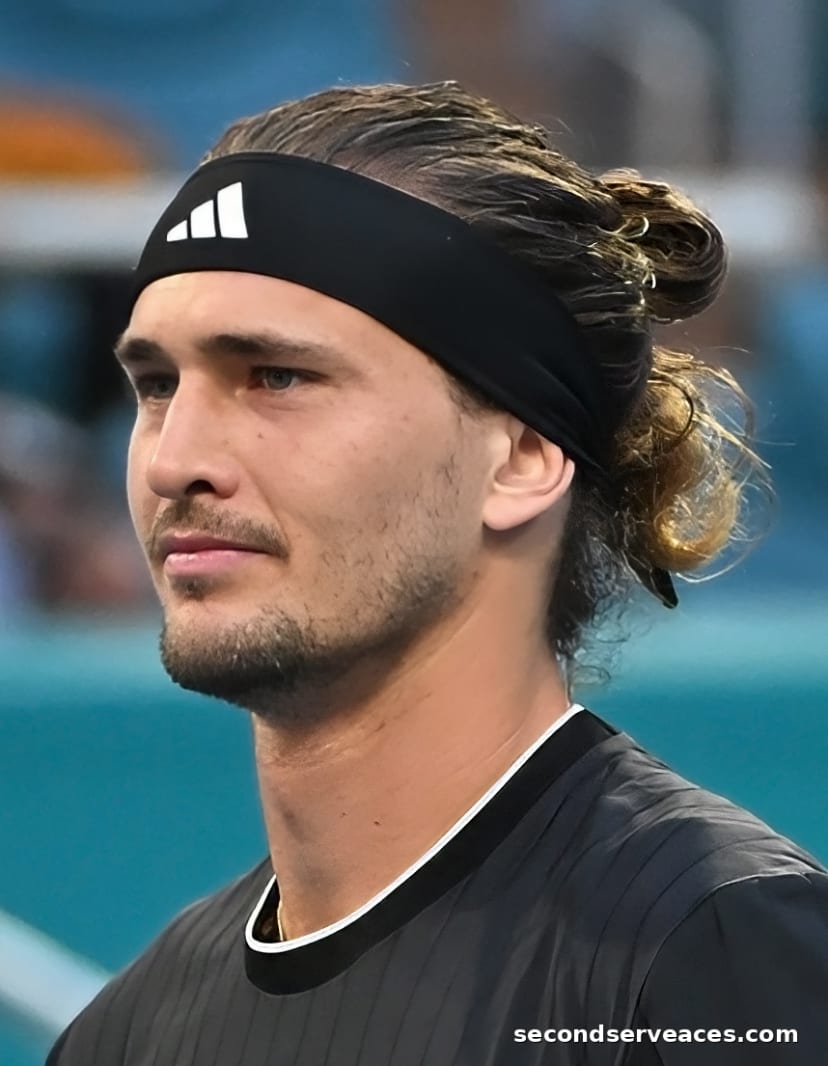
There is something inherently unforgiving about the hard courts of Indian Wells. The air in the Coachella Valley is thin, arid, and possessed of a specific thermal density that makes the tennis ball fly through the atmosphere like a spherical bullet, only to grab the high-friction, sand-infused Plexipave surface and explode upward. It is a surface that demands biomechanical perfection. It is not, historically speaking, the sort of place where a man whose dominant arm was recently structurally compromised comes to slay a dragon.
Listen to the Second Serve Podcast
Get our daily AI-synthesized audio briefings and match reviews on the go.
And yet, here we are. In an outcome that seemingly defies the standard kinematics of professional tennis, Jack Draper defeated Novak Djokovic at Indian Wells. To understand the magnitude of this, one must first understand the void from which the young Brit has just emerged.
For half a year, Draper was a ghost on the ATP Tour. He missed six agonizing months of action due to a bone injury in his left arm. Consider, for a moment, the anatomical nightmare of this specific ailment for a left-handed professional tennis player. The left arm is the primary lever of Draper’s entire professional existence; a muscle tear can be rehabbed with elastic bands and patience, but a bone injury is a fundamental failure of the chassis itself. To return from such a skeletal betrayal requires not just physical healing, but a psychological exorcism. Draper made his quiet return to competitive tennis just last month, testing the newly-fused architecture of his arm by playing for Great Britain against Norway in the Davis Cup. It was a necessary crucible. But Norway in February is a long, long way from Novak Djokovic in the Californian desert.
The Tactical Breakdown
Beating Novak Djokovic is less about playing tennis and more about solving a terrifyingly adaptive, real-time quadratic equation. Djokovic is the ultimate baseline metronome—a player who absorbs pace, recalibrates it, and redirects it with an orthogonal precision that suffocates his opponent's match momentum. So, how does a freshly-healed southpaw dismantle the greatest defensive matrix in the history of the sport?
The answer lies in the aggressive, unapologetic geometry of the left-handed game. While we do not need to parse the specific rotational velocities to understand the aesthetic truth of the match, we can observe the tactical pillars upon which a victory against a player of Djokovic’s caliber must be built:
- The Southpaw Geometry: Historically, left-handers who trouble Djokovic (think Nadal, or a peaking Verdasco) use a violently curling cross-court forehand to pin the Serbian against the backhand corner. Draper’s swing, generating immense topspin, forces the ball to kick up above the ideal strike zone, momentarily neutralizing Djokovic’s ability to flatten out the backhand and change down-the-line direction.
- Serve Placement and Exploitation: The slider out wide in the Ad court is the left-hander's bread and butter. Against a returner who essentially possesses echolocation, hitting spots isn't enough; the serve must physically pull Djokovic off the doubles alley, opening the court for a first-strike baseline winner.
- Protecting the Break Point: In the modern ATP ecosystem, facing a break point against Djokovic usually induces a kind of localized panic. Draper’s tactical triumph relies on an eerie rally tolerance—an insistence on playing high-margin, heavy-spin balls when under pressure, rather than pulling the trigger too early out of fear.
Draper’s heavy, looping trajectories and sheer physical heft create a parabolic riddle that, on this specific hard court, proved impenetrable. He didn’t just out-hit Djokovic; he out-maneuvered him within the strict confines of the baseline’s geometry.
The Bigger Picture
We are forced to contextualize what this means in the grand, sweeping narrative of the ATP Tour. The sport of tennis is a notoriously cruel meritocracy. It does not care about your time in rehab; it does not care about your six months of existential dread waiting for a bone to calcify. You either defend your ranking points, or you plummet into the abyssal depths of the Challenger circuit.
The Paradigm of the Comeback
Draper’s trajectory has been dramatically altered by this desert victory. Returning from the Davis Cup tie against Norway, the expectation was a slow, agonizing grind back to match fitness. A developmental phase, essentially. Instead, by toppling Djokovic—a man whose very name is synonymous with physiological invulnerability—Draper has effectively bypassed the waiting room.
There is a profound beauty in watching a player realize, in real-time, that his body will hold up against the absolute zenith of the sport. The bone in his left arm held. The kinetic chain remained unbroken. As the tour shifts through the Spring hard-court swing, Draper is no longer just a compelling prospect with an unfortunate medical chart. He is the man who cracked the Serbian code in the desert sun, armed with a repaired left wing and the sort of topspin that borders on the miraculous.
What Novak Djokovic Plays With
Head Speed Pro
Luxilon ALU Power 125
Asics Court FF 3 Novak
Analyze Jack Draper vs. Novak Djokovic
Predict tactical adjustments, momentum swings, and serve strategy options for this match-up using our AI simulator.
The Aces Tactical Panel
This report was curated and edited by Bhaskar Goel. Tactical analysis and technical insights were provided by our specialized panel of expert correspondents.
Julian Price
Senior Tactical Correspondent
Stuffy, pedantic British academic and historian specializing in match momentum and historical context.
Elena Cruz
Director of Analytical Research
Data scientist specializing in court surface physics and movement patterns.
Bhaskar
The Editor & Fan
Passionate tennis player and site editor bringing everyday amateur insights and relatable fan commentary.
Arthur Vance
Senior Existential Analyst
Deep, eccentric, and DFW-inspired. Models court metaphysics, kinetic beauty, and player psychology.
Leo Sterling
High-Performance Consultant
Hard-nosed ex-trainer from Melbourne with a no-nonsense view on tour fitness.