The Shadow of the Absent Champion
Tennis is a game of exquisite geometry, yet it is often defined by who is missing from the frame. As the red dust of Roland-Garros prepares to welcome the world’s elite on May 24th, the absence of Carlos Alcaraz—the man who claimed the clay throne in both 2024 and 2025—leaves a sudden, vacuum-like silence in the draw. His withdrawal is more than a logistical shuffle; it is a structural earthquake that resets the tactical expectations of the entire ATP field.
Listen to the Second Serve Podcast
Get our daily AI-synthesized audio briefings and match reviews on the go.
In the high-stakes theater of modern tennis, the withdrawal of a double-defending champion alters the kinetic energy of every service game. Without the volatile, high-RPM forehand of the Spaniard, the trajectory of the tournament shifts from a coronation to a scramble. Players who conditioned their off-season training to neutralize Alcaraz’s particular brand of court-coverage now find themselves recalibrating against a different sort of entropy.
This is the harsh physics of professional sport: the architecture of the bracket is only as stable as the bodies that inhabit it. As the tour moves toward Paris, the narratives that once promised a definitive clash of generations have been truncated, leaving the tennis public to ponder the tactical void left by a player who redefined the baseline intensity for the current era.
The 25th Pinnacle: Ivanovic’s Assessment of the Serb
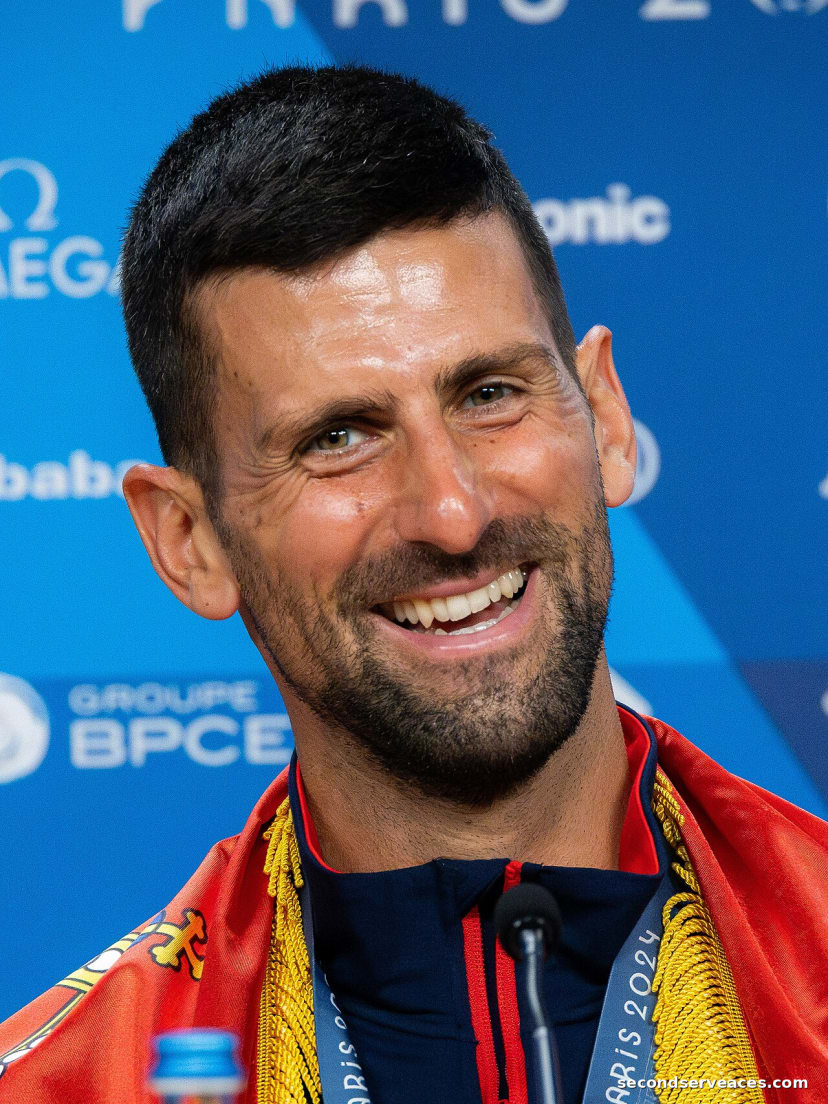
While the draw feels lighter, the historical weight resting on Novak Djokovic has only intensified. With 24 Grand Slam titles already etched into the collective memory of the sport, the Serbian’s push for a 25th is viewed by peers like Ana Ivanovic as a plausible inevitability. Ivanovic, speaking from the vantage point of one who knows the singular pressure of the French capital, has expressed confidence in his capacity to navigate the tournament’s specific physical toll.
Djokovic’s survival at the highest level is not merely a matter of endurance, but of iterative precision. We witnessed this most recently during the 2026 Australian Open, where his victory over Jannik Sinner provided a masterclass in defensive resilience. The match was a study in counter-punching geometry—Djokovic absorbing the explosive, flat-hitting power of Sinner and transmuting it into controlled, high-margin depth that eventually fractured the Italian’s resolve.
The question for Paris is whether the seasoned veteran can replicate this metabolic efficiency on the slower, less forgiving surface of clay. The transition from the plexicushion of Melbourne to the crushed brick of Roland-Garros requires a recalibration of slide mechanics and spin rates. Ivanovic’s confidence suggests she sees in Djokovic not just the stamina, but the cognitive flexibility required to outmaneuver a field now lacking the primary disruptor of the last two years.
The Collective Anxiety of the Next Generation
Behind the main protagonists, the rising wave—Mirra Andreeva, Hailey Baptiste, and Emma Raducanu—watch the unfolding French Open narrative with a mix of anticipation and calculated ambition. The ATP side, specifically, finds players like Alexander Zverev navigating the psychological turbulence of an open draw, where the departure of a titan like Alcaraz turns every opening-round match into a high-stakes, pressure-cooker environment.
It is in these moments of uncertainty that the true hierarchy of the tour reveals itself. When the overwhelming favorite withdraws, the remaining contenders must grapple with the sudden proximity of their own opportunity. It is a psychological pivot point; the belief that “this is the one” can either catalyze a breakthrough or paralyze a nervous system, leading to unforced errors during critical, momentum-defining points.
As the tour congregates in Paris, the lack of Alcaraz forces the remaining seeds to contend with the burden of expectation. They are no longer playing against a singular, insurmountable wall, but against the specter of what could have been. The tournament will now be decided by who can best manage this shift in reality, finding a way to maintain structural integrity when the draw feels wide open.
Physics and the Fade of the Red Clay
The French Open is an exercise in endurance where the ball loses velocity with every bounce, turning the game into a prolonged negotiation with gravity. The absence of a player who could dictate terms through sheer raw power and aerobic endurance changes the math of the tournament. The rallies will likely be longer, the defensive angles more acute, and the mental tax exponentially higher for those remaining in the hunt.
As we approach May 24th, we must look to the historical markers: Djokovic’s 24 majors are a testament to his ability to treat each match as a discrete, solvable puzzle. Whether he can find the necessary physical composure to add a 25th to his record will depend on his capacity to leverage his experience against younger challengers whose lack of deep-tournament fatigue might just bridge the gap left by Alcaraz’s absence.
Ultimately, the beauty of the sport lies in this very unpredictability. The data suggests one thing, but the human element—the subtle tremors in a service toss, the fraction of a second lost in movement, the weight of expectation—dictates the actual outcome. We are entering a Parisian fortnight defined by what is missing, which paradoxically makes the eventual champion’s achievement all the more profound.
What Novak Djokovic Plays With
Head Speed Pro
Luxilon ALU Power 125
Asics Court FF 3 Novak
Analyze Novak Djokovic vs. Ana Ivanovic
Predict tactical adjustments, momentum swings, and serve strategy options for this match-up using our AI simulator.
The Aces Tactical Panel
This report was curated and edited by Bhaskar Goel. Tactical analysis and technical insights were provided by our specialized panel of expert correspondents.
Julian Price
Senior Tactical Correspondent
Stuffy, pedantic British academic and historian specializing in match momentum and historical context.
Elena Cruz
Director of Analytical Research
Data scientist specializing in court surface physics and movement patterns.
Bhaskar
The Editor & Fan
Passionate tennis player and site editor bringing everyday amateur insights and relatable fan commentary.
Arthur Vance
Senior Existential Analyst
Deep, eccentric, and DFW-inspired. Models court metaphysics, kinetic beauty, and player psychology.
Leo Sterling
High-Performance Consultant
Hard-nosed ex-trainer from Melbourne with a no-nonsense view on tour fitness.