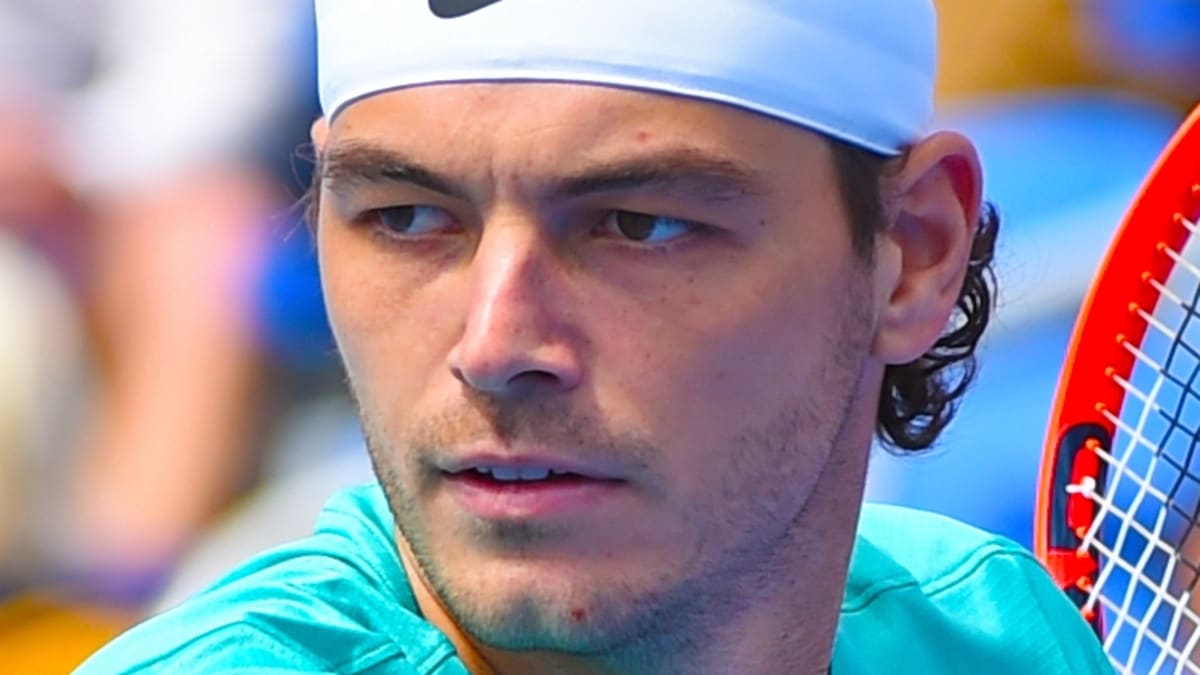
Cerundolo Dismantles Fritz with Baseline Attrition and High-Spin Forehands
The physical demands of Flushing Meadows took a severe toll on home favorite Taylor Fritz, who surrendered a commanding two-set lead to fall 3-6 4-6 6-3 6-4 6-4 to Argentina's Francisco Cerundolo. Fritz initially dictated the terms of the match with his trademark flat groundstrokes and highly efficient first-serve delivery. However, as the temperature rose, Cerundolo adjusted his positioning behind the baseline, utilizing extreme topspin revolutions to push the American out of his comfort zone.
Listen to the Second Serve Podcast
Get our daily AI-synthesized audio briefings and match reviews on the go.
Fritz's mechanical efficiency began to decline in the third set. His first-serve percentage dropped from a stellar 68% in the opening frames to a meager 52% as physical fatigue set in. Cerundolo capitalized on this drop in output, executing rapid directional changes off his forehand wing. The kinetic energy generated by the Argentine's racket head allowed him to dominate the longer rallies, forcing Fritz into defensive positions where his 6'5" frame was less agile.
As we observed in our analysis of battle-tested players at the US Open, court speed at Flushing Meadows rewards players who can redirect pace with penetrating depth. Cerundolo did exactly that, punishing Fritz's short balls and converting crucial break points. Fritz was unable to arrest the slide, ultimately dropping the final three sets in identical fashion as his physical endurance faltered under the relentless pressure.
Blockx Outpowers Cobolli as Italian's Baseline Consistency Crumbles
Flavio Cobolli's campaign ended abruptly in the third round as Belgian prospect Alexander Blockx executed a masterclass in aggressive baseline tennis to secure a 6-7 (4-7) 6-3 6-0 6-3 victory. Cobolli started strong, clinching a highly competitive opening set tiebreak with precise counter-punching. However, the physical toll of maintaining that defensive intensity quickly caught up with the Italian in the subsequent sets.
Blockx capitalized on Cobolli's mounting unforced errors, sweeping through the third set 6-0 with relentless power. The Belgian teenager showed incredible durability, maintaining high ball speed off both wings and refusing to let Cobolli dictate play. According to official metrics tracked by the ATP Tour, Blockx won 78% of his first-serve points, preventing Cobolli from establishing any rhythm on return games.
Cobolli's struggles with his ball-striking depth allowed Blockx to step inside the baseline and dictate play with heavy angles. The Italian struggled to find his targets, registering 42 unforced errors over the course of the four-set encounter. This physical decline highlights the demanding nature of the courts at the US Open, where high friction and high heat test even the most resilient competitors.
Zverev Maintains Efficiency to Avoid the Seed-Shedding Epidemic
While other top-10 seeds faltered, Alexander Zverev delivered a highly clinical performance to dispatch Alejandro Tabilo 6-2 7-6 (7-2) 6-2. Zverev's game was built on mechanical precision, particularly his formidable first serve, which clocked an average speed of 131 mph. This consistent weapon allowed him to hold service games with minimal physical exertion, preserving energy for the latter stages of the tournament.
Tabilo attempted to disrupt Zverev's rhythm with frequent drop shots and slice variations, but the German's court coverage neutralized these tactics. Zverev committed only 14 unforced errors throughout the entire match, demonstrating the structural discipline required to survive the early rounds of a Major. The second-set tiebreak was the only moment of real pressure, which Zverev navigated with flawless baseline depth.
By advancing to the last 16, Zverev positions himself as a prime contender in a rapidly depleting draw. His ability to conserve energy in straight-sets victories will be a major asset as the tournament progresses into the second week, where physical durability becomes the ultimate metric of success. Zverev's racket specs and tension setup appear perfectly calibrated for the heavy New York tennis balls.
Navone Stuns Djokovic as British Doubles Pair Advances
The tournament's trend of high-profile casualties was established early when Novak Djokovic fell to Argentina's Mariano Navone. In an extraordinary first-round match, Navone pushed the legendary Serb to five sets, ultimately securing one of the biggest upsets in modern tennis history. Djokovic, who has historically dominated early rounds at Majors, struggled to find his usual depth and precision, bowing out in the opening round.
Navone exploited Djokovic's physical vulnerability by engaging in grueling baseline exchanges, testing the Serb's lateral movement on the demanding hard courts. This shocking early exit sent shockwaves through the draw, opening up the bottom half of the bracket. For Navone, the victory represents a career-defining milestone, proving that disciplined, high-percentage tennis can dismantle even the most formidable defensive structures in the sport.
On the doubles court, Britain's Arthur Fery and Joshua Paris secured a hard-fought victory over Anirudh Chandrasekar and Ivan Liutarevich. Fery and Paris executed a highly coordinated serve-and-volley strategy to win 6-4 5-7 6-4. The British duo demonstrated exceptional net coverage and reflex volleys, neutralizing the physical baseline power of their opponents to progress to the next round.
Rivalry Matchup & Player Profiles
| Metric | Taylor Fritz | Francisco Cerundolo |
|---|---|---|
| Rank | No. 10 | No. 25 |
| Country | United States | Argentina |
| Age | 28 | 28 |
| Height | 6'5" (1.96 m) | 6'1" (1.85 m) |
| Handedness | Right-handed | Right-handed |
| Play Style | Aggressive baseliner | Aggressive baseliner |
| Career Titles | 11 | 5 |
Following this encounter, Francisco Cerundolo leads their head-to-head record 2-1. The matchup dynamics highlight Cerundolo's ability to absorb Fritz's flat, aggressive ball-striking and counter with high-spin revolutions that disrupt the American's rhythm, especially in extended five-set formats.
According to the official ATP rankings, Fritz remains inside the top 10, but this early exit severely impacts his points defense. Cerundolo's physical durability and tactical consistency continue to make him a highly dangerous opponent on high-friction hard courts.
What Taylor Fritz Plays With
Head Radical MP 2024
Yonex Poly Tour Strike
Tourna Grip Original (10-Pack)
Analyze Taylor Fritz vs. Francisco Cerundolo
Predict tactical adjustments, momentum swings, and serve strategy options for this match-up using our AI simulator.
The Aces Tactical Panel
This report was curated and edited by Bhaskar Goel. Tactical analysis and technical insights were provided by our specialized panel of expert correspondents.
Julian Price
Senior Tactical Correspondent
Stuffy, pedantic British academic and historian specializing in match momentum and historical context.
Elena Cruz
Director of Analytical Research
Data scientist specializing in court surface physics and movement patterns.
Bhaskar
The Editor & Fan
Passionate tennis player and site editor bringing everyday amateur insights and relatable fan commentary.
Arthur Vance
Senior Existential Analyst
Deep, eccentric, and DFW-inspired. Models court metaphysics, kinetic beauty, and player psychology.
Leo Sterling
High-Performance Consultant
Hard-nosed ex-trainer from Melbourne with a no-nonsense view on tour fitness.
Related Reports


Quick Answers
What was the final score of the match between Taylor Fritz and Francisco Cerundolo?+
Francisco Cerundolo defeated Taylor Fritz 3-6, 4-6, 6-3, 6-4, 6-4 in the third round of the US Open.
Who defeated Flavio Cobolli in the third round of the US Open?+
Flavio Cobolli was defeated 6-7 (4-7), 6-3, 6-0, 6-3 by Alexander Blockx.
What was the result of the doubles match featuring Arthur Fery and Joshua Paris?+
Arthur Fery and Joshua Paris won their men's doubles match 6-4, 5-7, 6-4 against Anirudh Chandrasekar and Ivan Liutarevich.