The Science of Court Speed: How CPI Rewrote Modern Tennis
To the casual observer, tennis is a battle of wills, physical conditioning, and racket-head speed. But to those of us who analyze the game through a technical lens, every match is a complex equation of friction, material science, and physics. At the center of this equation is the Court Pace Index (CPI)—the International Tennis Federation’s mathematical metric for measuring court speed. Over the last two decades, a quiet revolution in court preparation has homogenized the sport, forever altering player tactics and equipment specifications.
Listen to the Second Serve Podcast
Get our daily AI-synthesized audio briefings and match reviews on the go.
Deconstructing the Court Pace Index (CPI)
The ITF categorizes court speeds into five distinct zones based on the CPI formula, which calculates the ratio of the ball's inbound speed to its outbound speed, alongside the angle of bounce. Mathematically, it is expressed through the coefficient of friction (COF) and the coefficient of restitution (COR):
CPI = 100 * (1 - COF) + a * (COR - b)
Where a and b are constant scaling factors. A CPI under 30 is classified as Category 1 (Slow), while anything above 45 is Category 5 (Fast). In the 1990s, the delta between the fastest and slowest professional courts was a chasm. Wimbledon's lightning-fast grass hovered around a CPI of 48-50, while the red clay of Roland Garros sat in the low 20s. Today, almost every premium tournament on the calendar has converged toward a medium-slow to medium-fast sweet spot (CPI 34 to 40).
The Homogenization Era: Grass, Clay, and Acrylic
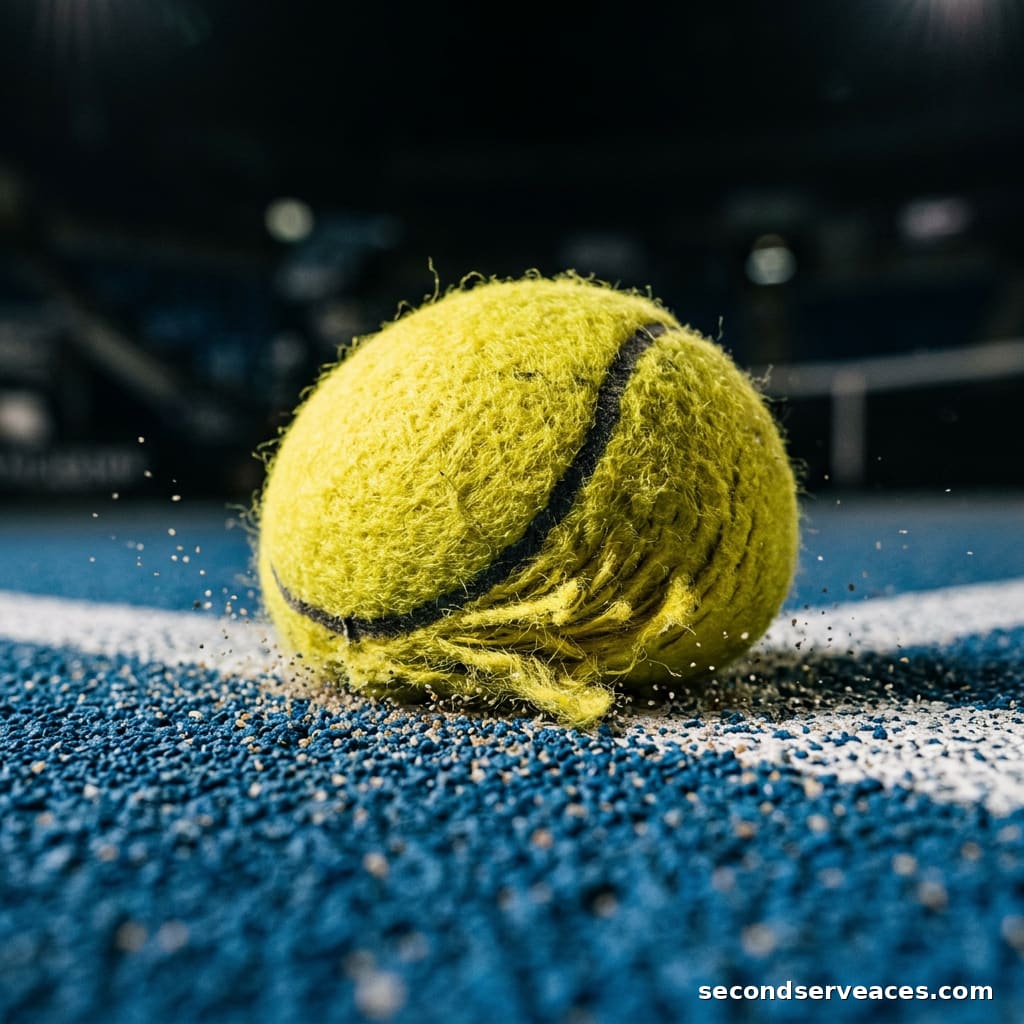
This convergence was not accidental. In 2001, Wimbledon transitioned from a mix of Creeping Red Fescue and Perennial Ryegrass to 100% Perennial Ryegrass. The structural change created a denser soil bed, resulting in a higher, truer, and crucially, slower bounce. Simultaneously, hard-court tournaments adjusted the ratio of silica sand mixed into their acrylic topcoats. More sand increases the coefficient of friction, slowing the ball down post-bounce while shredding the ball's felt cover at an accelerated rate.
For players operating at the peak of the ATP rankings, this homogenization neutralized specialists. The serve-and-volley purists were priced out of the market, replaced by elite baseline movers who thrive on predictability.
The Gear Shift: How Equipment Responded
When the court surface stops doing the work for you, your gear must adapt. The shift to slower, high-friction hard courts forced a massive evolution in footwear. As we analyzed in our analysis of tennis shoe engineering, modern outsoles must balance high lateral abrasion resistance with calculated slide-readiness on hard courts. The rubber compounds must withstand extreme thermal friction without melting or losing structural integrity.
Furthermore, because the average rally length has increased exponentially due to slower court speeds—exemplified by the grueling physical chess of the Djokovic vs Nadal rivalry—racket specs have shifted. Players now favor slightly lighter static weights paired with higher swingweights to maximize torque and plow-through without sacrificing shoulder durability over a four-hour match.
The Verdict: A Double-Edged Sword
From a "bang for buck" spectator perspective, homogenized court speeds have delivered longer, more dramatic rallies. But from a technical and tactical standpoint, it has diluted the stylistic diversity that once made tennis a fascinating clash of contrasting systems. When every court plays like a medium-slow hard court, the premium on pure variety drops, and the physical tax on the athlete's body rises to an unsustainable premium.
What Novak Djokovic Plays With
Head Speed Pro
Luxilon ALU Power 125
Head Prime Tour (12-Pack)
Asics Court FF 3 Novak
Analyze Novak Djokovic vs. Rafael Nadal
Predict tactical adjustments, momentum swings, and serve strategy options for this match-up using our AI simulator.
The Aces Tactical Panel
This report was curated and edited by Bhaskar Goel. Tactical analysis and technical insights were provided by our specialized panel of expert correspondents.
Julian Price
Senior Tactical Correspondent
Stuffy, pedantic British academic and historian specializing in match momentum and historical context.
Elena Cruz
Director of Analytical Research
Data scientist specializing in court surface physics and movement patterns.
Bhaskar
The Editor & Fan
Passionate tennis player and site editor bringing everyday amateur insights and relatable fan commentary.
Arthur Vance
Senior Existential Analyst
Deep, eccentric, and DFW-inspired. Models court metaphysics, kinetic beauty, and player psychology.
Leo Sterling
High-Performance Consultant
Hard-nosed ex-trainer from Melbourne with a no-nonsense view on tour fitness.
Related Reports
Quick Answers
What is the Court Pace Index (CPI) in tennis?+
The Court Pace Index (CPI) is the ITF's mathematical rating system used to measure the speed of a court surface, calculated using the ball's inbound and outbound velocities and its bounce angle.
How did Wimbledon change its court speed in 2001?+
In 2001, Wimbledon transitioned to 100% Perennial Ryegrass, which created a denser soil bed that produced a slower, higher, and more consistent bounce compared to previous years.
How does sand affect hard court speed?+
Adding more silica sand to the acrylic paint mixture of a hard court increases the surface's coefficient of friction, slowing down the ball's post-bounce speed while increasing ball wear.