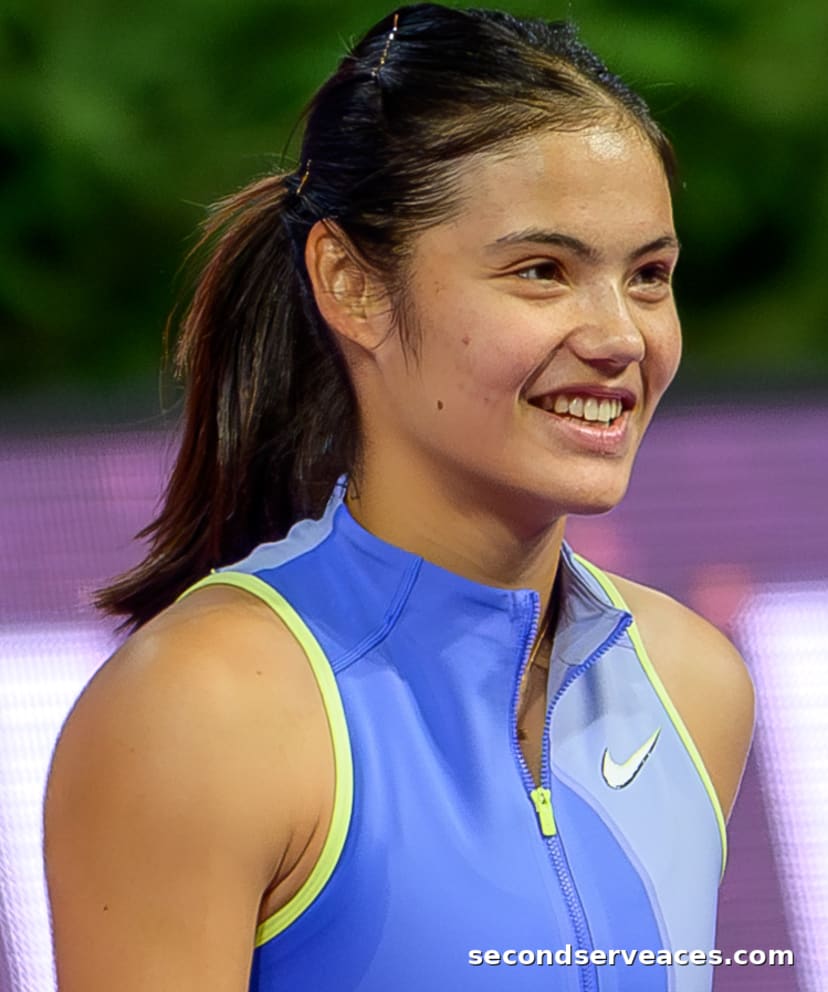
The Miami Open is a theater of extremes. The heat is oppressive, the balls fly through the dense coastal air with an almost reckless velocity, and the underlying Laykold hard courts demand a brutal kind of physical solvency. To survive here, a player must be a perfectly calibrated engine of kinetic energy. Yet, for Emma Raducanu, the complex geometry of this week’s event will remain entirely theoretical. As confirmed by tournament officials, the British star has officially withdrawn from the Miami Open, sidelined by a recent illness rather than the overt biomechanical breakdowns that more frequently punctuate the sport.
Listen to the Second Serve Podcast
Get our daily AI-synthesized audio briefings and match reviews on the go.
Rather than a torn ligament or a fractured metatarsal, it is the microscopic, invisible invasion of an everyday virus that halts her campaign. This reality underscores a foundational, often ignored truth of professional tennis: the athlete is a highly sensitive biological organism first, and a baseline gladiator second. The modern professional game requires the cardiovascular endurance of a marathoner coupled with the explosive twitch-muscle capability of a sprinter. When an illness depletes the metabolic currency required to fuel this machine, stepping onto a sun-baked hard court becomes not just tactically unwise, but physically hazardous.
There is a profound melancholy in the empty draw space. A tennis tournament is a living, breathing ecosystem, and a withdrawal alters the atmospheric pressure of the entire bracket. Fans and analysts alike are left to construct hypothetical scenarios, imagining the parabolic arcs and sharp angles that will now remain unrealized on the Floridian concrete.
The Tactical Breakdown
What exactly is the hard-court ecosystem missing in her absence? Raducanu’s game, at its absolute zenith, is a sublime study in redirection, timing, and angular geometry. She is not a player who overpowers opponents through sheer brute force, but rather one who suffocates them by stealing away their most precious resource: time.
Historically, her tactical mechanics on this specific surface rely on a few crucial elements that create immense pressure for the opponent across the net:
- Baseline Proximity: Raducanu operates perilously close to the baseline. By refusing to retreat, she intercepts the ball at the apex of its bounce, cutting off the angles and using the opponent’s own pace against them.
- Linear Topspin: Unlike the heavy, looping revolutions favored by clay-court specialists, Raducanu hits a flatter ball with piercing topspin. It clears the net by millimeters and skids off the hard court, denying the opponent the necessary time to set their feet.
- Return Aggression: Her capacity to neutralize massive first serves and instantly flip the dynamic of a point is integral to her success. When she is striking the ball cleanly, she manufactures break point opportunities out of seemingly neutral rallies.
- Seizing Match Momentum: Tennis is uniquely governed by unseen waves of psychological and tactical advantage. Raducanu’s ability to hit down the line seamlessly from both wings allows her to abruptly shift the match momentum, turning defense into offense in a single fluid motion.
When an illness infiltrates the system, it is precisely this razor-thin margin of timing that is compromised. Hitting a flat backhand down the line while leaning into the court requires absolute neuromuscular synergy. Even a fractional delay in the kinetic chain—a millisecond of lethargy brought on by a fever or fatigue—results in a ball sailing long or crashing into the tape. Tactical brilliance cannot compensate for a biological lag.
The Bigger Picture
The narrative arc of any professional athlete is rarely a straight, upward trajectory; it is an oscillating waveform of peaks, valleys, and frustrating plateaus. For Raducanu, the broader context of this withdrawal is the ongoing quest for continuity. Since her historic, anomalous sprint to the US Open title as a qualifier—an achievement built on flawless execution and a sort of joyful, weightless momentum—her journey on the WTA Tour has been an exercise in navigating the harsh realities of physical maintenance.
Tennis possesses a brutal, unrelenting amnesia. The tour stops for no one. The calendar rolls perpetually from the deserts of California to the humidity of Miami, and soon across the Atlantic to the crushed brick of the European clay. A player’s ranking is a rolling 52-week ledger of their physical availability. Missing a high-yield tournament like the Miami Open removes a critical opportunity to gather data, accrue points, and refine the match-play instincts that simply cannot be replicated on the practice court.
Yet, there is a silver lining in the nature of this specific absence. Illness, unlike a structural joint injury, is transient. It is a necessary pause, a momentary resetting of the biological clock rather than a fundamental threat to her physical mechanics. In a sport that constantly whispers the temptation to play through the pain, choosing to honor the body's need for recovery is a mature, if entirely frustrating, tactical decision in its own right.
As the Miami Open proceeds into the second week, generating its own new narratives and crowning its eventual champions, the space left by Raducanu’s withdrawal serves as a quiet reminder of the game's inherent fragility. The perfect physics of a topspin forehand or the strategic brilliance of a well-constructed point mean nothing without the health to execute them. We are left waiting for her return, anticipating the moment when the biological machine is once again ready to meet the unforgiving geometry of the court.
Simulate Emma Raducanu Match Scenarios
Simulate high-pressure scenarios, score leverage points, and tactical responses for ATP and WTA players.
The Aces Tactical Panel
This report was curated and edited by Bhaskar Goel. Tactical analysis and technical insights were provided by our specialized panel of expert correspondents.
Julian Price
Senior Tactical Correspondent
Stuffy, pedantic British academic and historian specializing in match momentum and historical context.
Elena Cruz
Director of Analytical Research
Data scientist specializing in court surface physics and movement patterns.
Bhaskar
The Editor & Fan
Passionate tennis player and site editor bringing everyday amateur insights and relatable fan commentary.
Arthur Vance
Senior Existential Analyst
Deep, eccentric, and DFW-inspired. Models court metaphysics, kinetic beauty, and player psychology.
Leo Sterling
High-Performance Consultant
Hard-nosed ex-trainer from Melbourne with a no-nonsense view on tour fitness.