By Elena Cruz
Listen to the Second Serve Podcast
Get our daily AI-synthesized audio briefings and match reviews on the go.
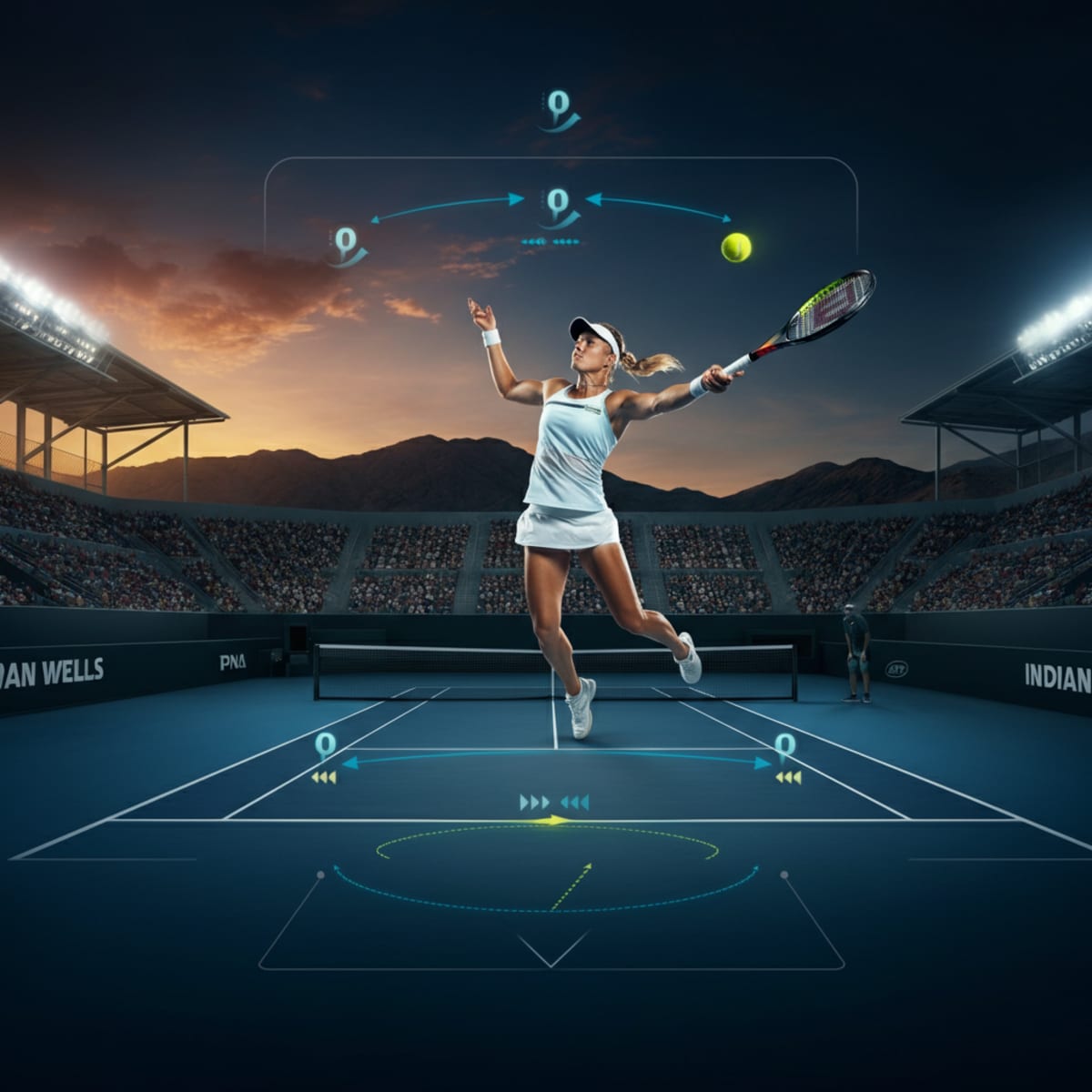
Listen, when Elena Rybakina steps onto a slow hard court and finds her rhythm, the standard physics of tennis simply cease to apply. The ball doesn't bounce; it skids, it accelerates, and it leaves opponents grasping at shadows. In a clash of contrasting styles in the Californian desert, Elena Rybakina defeated Elina Svitolina to advance to the Indian Wells final.
This result sets the stage for a massive showdown. The Indian Wells final is scheduled to be played on Sunday, and it won't just be any championship bout. The upcoming Sunday match will be a highly anticipated rematch of January's Australian Open final, bringing a wave of Grand Slam intensity straight to the Coachella Valley.
But before we look ahead to Sunday, we have to look at the baseline masterclass that got Rybakina there. Svitolina, one of the most resilient and tactically astute defenders on the WTA tour, threw everything she had into the rallies, but Rybakina’s first-strike tennis ultimately dismantled the Ukrainian’s defensive perimeter.
Match Highlights at a Glance
- The Result: Elena Rybakina defeated Elina Svitolina to advance to the Indian Wells final.
- The Stakes: The upcoming Sunday match will be a direct rematch of January's Australian Open final.
- Tactical Edge: Rybakina’s ability to step inside the baseline neutralized Svitolina's heavy topspin defense.
The Tactical Breakdown
Let’s get into the mechanics of this matchup, because it’s a textbook example of aggressive court positioning beating defensive depth. Historically, when these two meet, it’s a classic battle of first-strike power versus lateral endurance. Svitolina’s game is built on incredible court coverage and her ability to hit a heavy topspin ball deep into the opponent's court, pushing them back against the perimeter fencing.
But Indian Wells features notoriously gritty hard courts. The ball checks up. It sits. If you are a flat hitter who waits for the ball to come to you, you will get bogged down in the slow conditions. Rybakina, however, doesn’t wait. She takes the ball exceptionally early, effectively rushing her opponents and stealing their recovery time. By stepping inside the baseline, Rybakina shrinks the court geometry for Svitolina.
Serve Placement Patterns
You cannot talk about Rybakina without talking about her serve. It is arguably the most lethal weapon in the women's game today, alongside Aryna Sabalenka's. What makes it devastating isn't just the miles per hour; it's the disguise. Rybakina uses an identical ball toss for her slider out wide and her flat heat down the T. Against a great returner like Svitolina, who uses her low center of gravity to block balls back deep, Rybakina's precision is paramount. By painting the lines, she earns free points, neutralizing any break point danger before it even materializes.
Rally Tolerance vs. First Strike
Svitolina wants to extend the point. Her tactical objective is to drag Rybakina into deep waters, forcing an unforced error on the fourth or fifth shot. But Rybakina's tactical execution involves taking a massive cut at the first short ball she sees. Whenever Svitolina dropped her depth by even a couple of feet, Rybakina stepped in, took the ball on the rise, and fired a flat forehand into the open court. When you dictate the center of the court like that, the match momentum stays firmly on your racket.
The Bigger Picture
This victory isn't just about surviving a tough semifinal; it's about making a profound statement on the tour. Elena Rybakina is cementing her reputation as an unstoppable force on the biggest stages. Reaching the Indian Wells final validates her early-season form and proves that her heavy, flat hitting translates brilliantly even on surfaces that actively try to slow her down.
And then there is the Sunday final. A rematch of January’s Australian Open final is exactly the kind of narrative the sport needs. Grand Slam finals leave psychological scars, and they also forge tactical blueprints. When you play someone for a major title, you learn their patterns, their tells under pressure, and their structural weaknesses. Sunday will not just be a test of forehands and backhands; it will be a high-stakes chess match of adjustments.
For Svitolina, this tournament remains a massive positive. Her return to the upper echelons of the sport has been nothing short of inspiring. Her tactical acumen remains as sharp as ever, and her run in the desert proves she is still a formidable threat to anyone in the top 10. But on this day, the sheer velocity and unyielding aggression of Rybakina were simply too much to absorb.
As we look to the Sunday final, the question becomes: can Rybakina maintain this suffocating level of first-strike tennis? In the Australian Open final, we saw how razor-thin the margins are at the absolute pinnacle of the sport. If Rybakina serves the way she did to close out Svitolina, she’s holding all the cards. But tennis is a game of adjustments, and Sunday in the desert promises to be an absolute thriller.
Analyze Elena Rybakina vs. Elina Svitolina
Predict tactical adjustments, momentum swings, and serve strategy options for this match-up using our AI simulator.
The Aces Tactical Panel
This report was curated and edited by Bhaskar Goel. Tactical analysis and technical insights were provided by our specialized panel of expert correspondents.
Julian Price
Senior Tactical Correspondent
Stuffy, pedantic British academic and historian specializing in match momentum and historical context.
Elena Cruz
Director of Analytical Research
Data scientist specializing in court surface physics and movement patterns.
Bhaskar
The Editor & Fan
Passionate tennis player and site editor bringing everyday amateur insights and relatable fan commentary.
Arthur Vance
Senior Existential Analyst
Deep, eccentric, and DFW-inspired. Models court metaphysics, kinetic beauty, and player psychology.
Leo Sterling
High-Performance Consultant
Hard-nosed ex-trainer from Melbourne with a no-nonsense view on tour fitness.