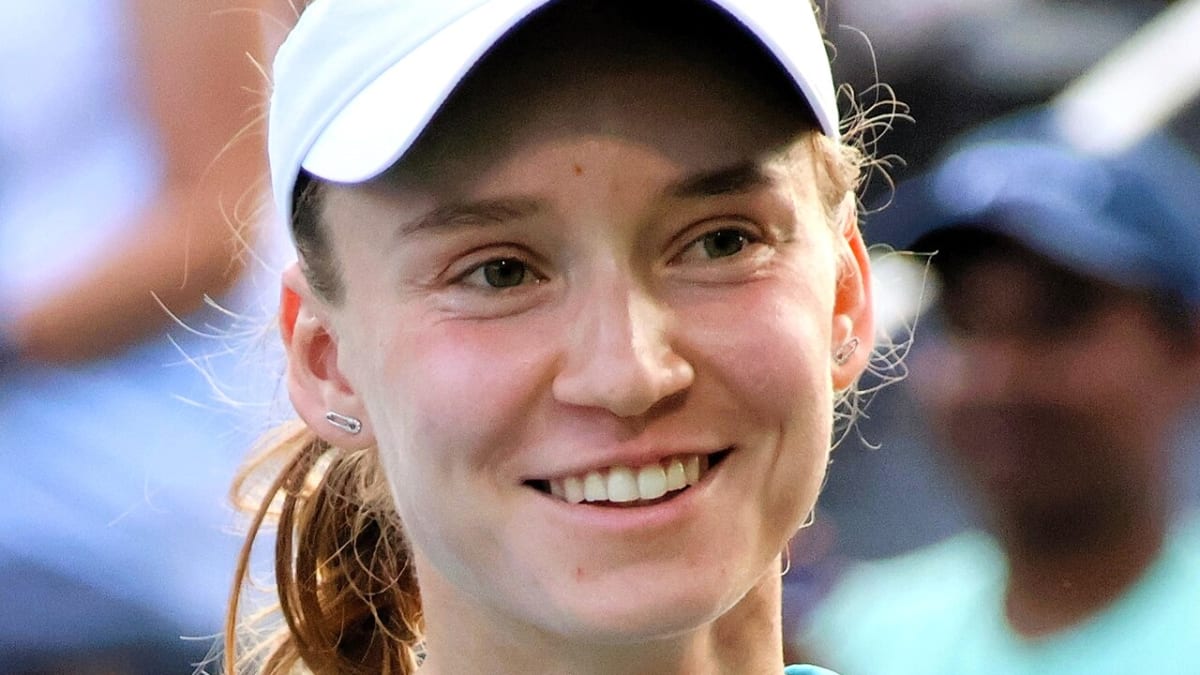
When analyzing the structural durability of modern tennis players, few profiles present as complex a mechanical equation as Elena Rybakina. The World No. 2 possesses one of the most formidable games on the WTA Tour, built on a foundation of clean ball-striking and immense leverage. However, the physical toll of maintaining this high-velocity output has once again come to the forefront. At the 2026 US Open, the focus shifts from her baseline depth to her physical hardware, specifically her left ankle and foot stability.
Listen to the Second Serve Podcast
Get our daily AI-synthesized audio briefings and match reviews on the go.
The Cincinnati Retirement Against Iga Swiatek
The alarm bells sounded on August 20 during the Cincinnati Open quarterfinals. Facing World No. 8 Iga Swiatek, Rybakina was forced to retire while trailing 4-1 in the first set. Observers noted a severe deficit in her lateral movement, as she struggled to load her weight onto her left leg when defending the outer thirds of the court. The sudden halt to the match raised immediate questions about her structural readiness for the final Grand Slam of the season.
Following the retirement, official communications from the WTA and US Open accounts cited a left ankle or foot injury. Despite rampant speculation among fans and media, there has been no official confirmation of an Achilles tear or rupture. Instead, the medical focus remains on localized inflammation and ligament strain, which are common when translating high-velocity change-of-direction movements onto unforgiving hard court surfaces.
From a gear and biomechanical perspective, Rybakina's 6'0" frame requires exceptional torsional stability from her footwear. Hard courts offer high traction but zero natural slide, meaning the deceleration forces when stopping laterally are absorbed entirely by the ankle joint. When a player's footwear fails to disperse this energy, or when cumulative fatigue compromises joint alignment, the surrounding ligaments are subjected to micro-trauma, leading to the exact type of acute soreness that forced her Cincinnati exit.
The 2026 Wimbledon Triumph and Grass-to-Hard Court Transition
To understand the current physical deficit, we must look back at her peak performance window earlier this season. Rybakina celebrated winning her Ladies' Singles title at the 2026 Wimbledon Championships, a run that showcased her elite movement on grass. The low-bounce, slick turf of Southwest London requires deep knee flexion and subtle adjustment steps, which suited her long levers and allowed her to dictate play without the jarring stops associated with concrete courts.
The transition from the soft turf of SW19 to the abrasive, high-friction hard courts of the North American swing is one of the most demanding phases of the professional calendar. On hard courts, the outsole compound of a tennis shoe grips the court instantly. For a tall, aggressive baseliner, this instant grip creates a high-torque pivot point. This mechanical reality likely exacerbated the underlying joint stress, leading to her eventual withdrawal from the mixed doubles event at Flushing Meadows to manage her physical workload.
Having previously secured the Australian Open title, Rybakina understands the physical tax required to win seven consecutive best-of-three-set matches. Stripping the mixed doubles from her schedule is a highly calculated move designed to optimize her recovery windows. By reducing her competitive footprint, she limits the cumulative shear stress on her lower extremities, giving her medical team a realistic chance to manage her symptoms between singles matches.
The Biomechanical Demands of Rybakina's Aggressive Baseline Style
Rybakina’s game is built on a high-efficiency kinetic chain. Her serve, which regularly clocks among the fastest on tour, relies heavily on a deep knee bend and an explosive leg drive. If the left ankle cannot tolerate the landing forces—which can equal up to three times a player's body weight—the entire motion breaks down. This force reduction inevitably leads to a drop in first-serve percentage and velocity, stripping her of her most valuable weapon.
In contrast to competitors who utilize extreme sliding techniques to defend, Rybakina relies on precise positioning and clean footwork. As we noted in our profiling of US Open battle-tested players, mechanical efficiency is the ultimate predictor of tournament longevity. When a player's movement is compromised by even a fraction of a second, they are forced to hit from unstable platforms, increasing the error rate and putting additional strain on the shoulder and wrist joints.
To mitigate these forces, elite players often turn to customized orthotics and highly rigid midfoot shanks to prevent lateral twisting. For Rybakina, finding the exact balance between cushioning and structural support is critical. Her footwear must provide enough heel cushioning to dampen the impact of vertical landings while retaining a low-profile forefoot to ensure she maintains court feel and responsive acceleration during rallies.
The Path Forward at the 2026 US Open
As the tournament progresses, Rybakina's campaign will be a test of load management and medical preparation. The modern tennis schedule leaves virtually no room for complete rest, meaning top athletes must learn to win when operating at less than 100% physical capacity. Her early-round matches will serve as a live-fire test of her ankle's structural integrity under match pressure.
According to the official WTA Tour website, Rybakina's high seeding gives her a slight buffer in the opening rounds, but the intensity will ramp up quickly. For fans tracking her historical performance metrics and career achievements, her detailed career trajectory can be explored on her Wikipedia profile. Her ability to keep points short with her serve and first-strike forehand will be crucial in preserving her physical reserves.
Ultimately, the "bang for buck" of Rybakina's remaining season depends entirely on this recovery phase. Playing through acute joint pain can lead to compensatory injuries elsewhere in the kinetic chain, such as the knee or lower back. By prioritizing her singles draw and utilizing state-of-the-art bracing and taping techniques, Rybakina is taking the necessary steps to safeguard her long-term career prospects while remaining a dangerous threat in New York.
Rivalry Matchup & Player Profiles
| Metric | Elena Rybakina | Iga Swiatek |
|---|---|---|
| Rank | World No. 2 | World No. 8 |
| Country | Kazakhstan | Poland |
| Age | 27 | 25 |
| Height | 6' 0" (1.84 m) | 5' 9" (1.76 m) |
| Handedness | Right-handed | Right-handed |
| Play Style | Aggressive baseliner | Aggressive baseliner |
| Career Titles | 13 | 26 |
The rivalry between Elena Rybakina and Iga Swiatek remains one of the most compelling matchups on the WTA Tour, currently led 8-6 by Swiatek. Their contrasting physical builds and movement profiles create a fascinating tactical dynamic. While Swiatek utilizes slides and extreme topspin to dictate rallies, Rybakina relies on flat, penetrating groundstrokes that take time away from her opponents.
Their most recent encounter at the 2026 Cincinnati Open quarterfinals ended prematurely due to Rybakina's left ankle injury, with Swiatek leading 4-1 in the opening set. This head-to-head record highlights how closely matched these two champions are when fully healthy, making Rybakina's physical recovery a critical storyline for the rest of the 2026 season.
What Iga Swiatek Plays With
Tecnifibre Tempo 298 Iga
Tecnifibre Razor Code 1.25
Tecnifibre Pro Contact Overgrip
Analyze Elena Rybakina vs. Iga Swiatek
Predict tactical adjustments, momentum swings, and serve strategy options for this match-up using our AI simulator.
The Aces Tactical Panel
This report was curated and edited by Bhaskar Goel. Tactical analysis and technical insights were provided by our specialized panel of expert correspondents.
Julian Price
Senior Tactical Correspondent
Stuffy, pedantic British academic and historian specializing in match momentum and historical context.
Elena Cruz
Director of Analytical Research
Data scientist specializing in court surface physics and movement patterns.
Bhaskar
The Editor & Fan
Passionate tennis player and site editor bringing everyday amateur insights and relatable fan commentary.
Arthur Vance
Senior Existential Analyst
Deep, eccentric, and DFW-inspired. Models court metaphysics, kinetic beauty, and player psychology.
Leo Sterling
High-Performance Consultant
Hard-nosed ex-trainer from Melbourne with a no-nonsense view on tour fitness.
Related Reports


Quick Answers
Why did Elena Rybakina retire from her match against Iga Swiatek in Cincinnati?+
Elena Rybakina retired from the Cincinnati Open quarterfinal on August 20 due to a left ankle injury while trailing 4-1 in the first set.
Has there been an official confirmation of an Achilles tear for Elena Rybakina?+
No, the WTA and US Open accounts cited a left ankle or foot injury rather than officially confirming an Achilles tear or rupture.
What scheduling adjustment did Rybakina make at the US Open to manage her recovery?+
Elena Rybakina withdrew from the mixed doubles event at the US Open to reduce her physical workload and manage her left ankle recovery.