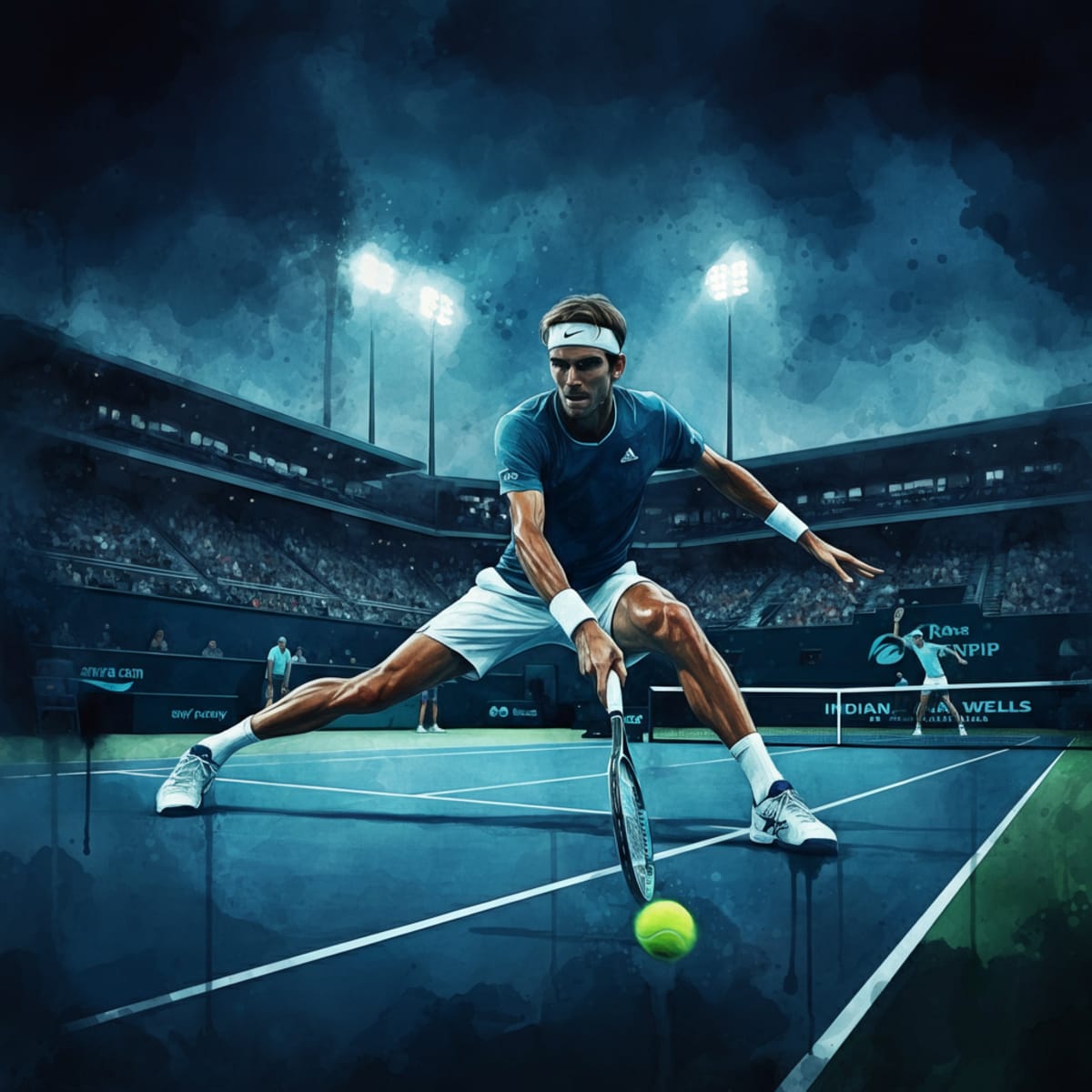
There is a specific, almost oppressive quality to the air in the Coachella Valley—a heavy, dry heat that fundamentally alters the physics of a tennis ball. The slow, gritty hard courts of Indian Wells demand not just athletic prowess, but a sort of sweat-drenched calculus. It is an environment where pure, unchecked aggression often goes to die, suffocated by the friction of the surface. And it is here, in the arid theater of the desert, that Daniil Medvedev authored a performance of terrifyingly precise architectural dominance to defeat World No. 1 Carlos Alcaraz in the semifinals.
Listen to the Second Serve Podcast
Get our daily AI-synthesized audio briefings and match reviews on the go.
To watch Carlos Alcaraz play tennis is to witness a joyful explosion of kinetic energy. He is all fast-twitch muscle and violent, whipping topspin. But to watch Daniil Medvedev—especially when the Russian is locked into his deeply peculiar, spidery, totally un-textbook rhythm—is to observe a masterclass in spatial manipulation. In what can only be described as a comprehensive dismantling, Medvedev dominated the match from start to finish, proving that the most effective antidote to explosive youth is, quite simply, distance and exhaustion.
The Tactical Breakdown
The central strategic mandate for Medvedev in this semifinal was clear, yet diabolically difficult to execute against a player of Alcaraz's caliber: make the World No. 1 run. And not just run, but run extensively, laterally and vertically, until the lactic acid begins to cloud the decision-making process.
Alcaraz's game is built around dictating the terms of engagement. He wants to step inside the baseline, take the ball early, and use heavy, looping topspin to push his opponent into the stadium tarps before utilizing his devastating drop shot. Medvedev’s tactical genius lies in his refusal to engage in this expected paradigm. By retreating so far behind the baseline that he practically requires a different zip code, Medvedev radically alters the geometry of the court.
The Physics of the Counter-Punch
Historically, players who attempt to out-hit Alcaraz find themselves rapidly overwhelmed by the sheer velocity of the Spaniard's heavy ball. Medvedev, however, operates as a human backboard, absorbing pace rather than generating it from scratch. His tactical execution in this semifinal hinged on several key mechanical truths:
- Absorbing the Heavy Topspin: By standing extraordinarily deep, Medvedev allows Alcaraz's massive topspin to peak and drop into his strike zone. Instead of fighting the rising ball, Medvedev flattens out his responses, sending low, skidding trajectories back across the net that force Alcaraz to continuously dig the ball out of his shoelaces.
- Forced Lateral Marathons: Medvedev’s strategy involved relentlessly shifting the angle of the rally. Because his shots travel with less spin and more linear penetration, the ball skids through the gritty Indian Wells court just enough to drag Alcaraz from tramline to tramline. The sheer physical toll of these extended rallies decisively shifted the match momentum.
- Neutralizing the Net Approach: Alcaraz is a brilliant front-court player, but approaching the net against Medvedev is a profoundly complex geometric puzzle. Because Medvedev is so deep, the passing lanes are elongated. An approach shot that would be a clean winner against 99% of the tour becomes just another ball Medvedev can track down with his sprawling, octopus-like strides, forcing Alcaraz to hit an extra volley—and usually, one volley too many.
The result was a match devoid of the usual Alcaraz highlight-reel dominance. Instead, we were treated to the quiet, inexorable suffocation of a prodigy by a master tactician. Every time Alcaraz attempted to force the issue, to create a break point or manufacture a sudden shift in match momentum, Medvedev was there, returning a flat, unbothered ball, essentially asking, "Can you do it again?"
The Bigger Picture
What this dominant victory signifies for the ATP Tour is profound. When a player ascends to World No. 1, as Alcaraz has with such historic speed and undeniable brilliance, a narrative often forms that their specific brand of tennis is the new, unassailable future. Alcaraz represents the ultimate all-court modern player: capable of defending like Djokovic, hitting forehands like Nadal, and volleying with the touch of a Federer.
But tennis is not a game played in a vacuum; it is an ongoing, intensely iterative dialectic. Every thesis invites an antithesis. If Alcaraz is the tour's thesis—raw, kinetic, aggressive, topspin-heavy—then Medvedev is its brilliant, stubborn antithesis.
This semifinal performance at Indian Wells serves as a crucial blueprint for the rest of the locker room. It proves that you do not need to out-muscle the World No. 1. You cannot beat the Spaniard at his own game of explosive acceleration. But what you can do is lengthen the court, drag him into the deep waters of physical endurance, and force him to hit through an impossibly stout defense.
For Medvedev, this victory is a resounding reaffirmation of his status as the ultimate problem solver of his generation. His strokes may not belong in an instructional video, and his aesthetic may lack the fluid grace of his peers, but in the brutal, sweat-soaked reality of a slow hard court, efficiency reigns supreme. He turned the desert into a chessboard, and he made the World No. 1 chase every single piece.
What Daniil Medvedev Plays With
Tecnifibre T-Fight 305 Isoflex
Tecnifibre Razor Soft
Analyze Daniil Medvedev vs. Carlos Alcaraz
Predict tactical adjustments, momentum swings, and serve strategy options for this match-up using our AI simulator.
The Aces Tactical Panel
This report was curated and edited by Bhaskar Goel. Tactical analysis and technical insights were provided by our specialized panel of expert correspondents.
Julian Price
Senior Tactical Correspondent
Stuffy, pedantic British academic and historian specializing in match momentum and historical context.
Elena Cruz
Director of Analytical Research
Data scientist specializing in court surface physics and movement patterns.
Bhaskar
The Editor & Fan
Passionate tennis player and site editor bringing everyday amateur insights and relatable fan commentary.
Arthur Vance
Senior Existential Analyst
Deep, eccentric, and DFW-inspired. Models court metaphysics, kinetic beauty, and player psychology.
Leo Sterling
High-Performance Consultant
Hard-nosed ex-trainer from Melbourne with a no-nonsense view on tour fitness.