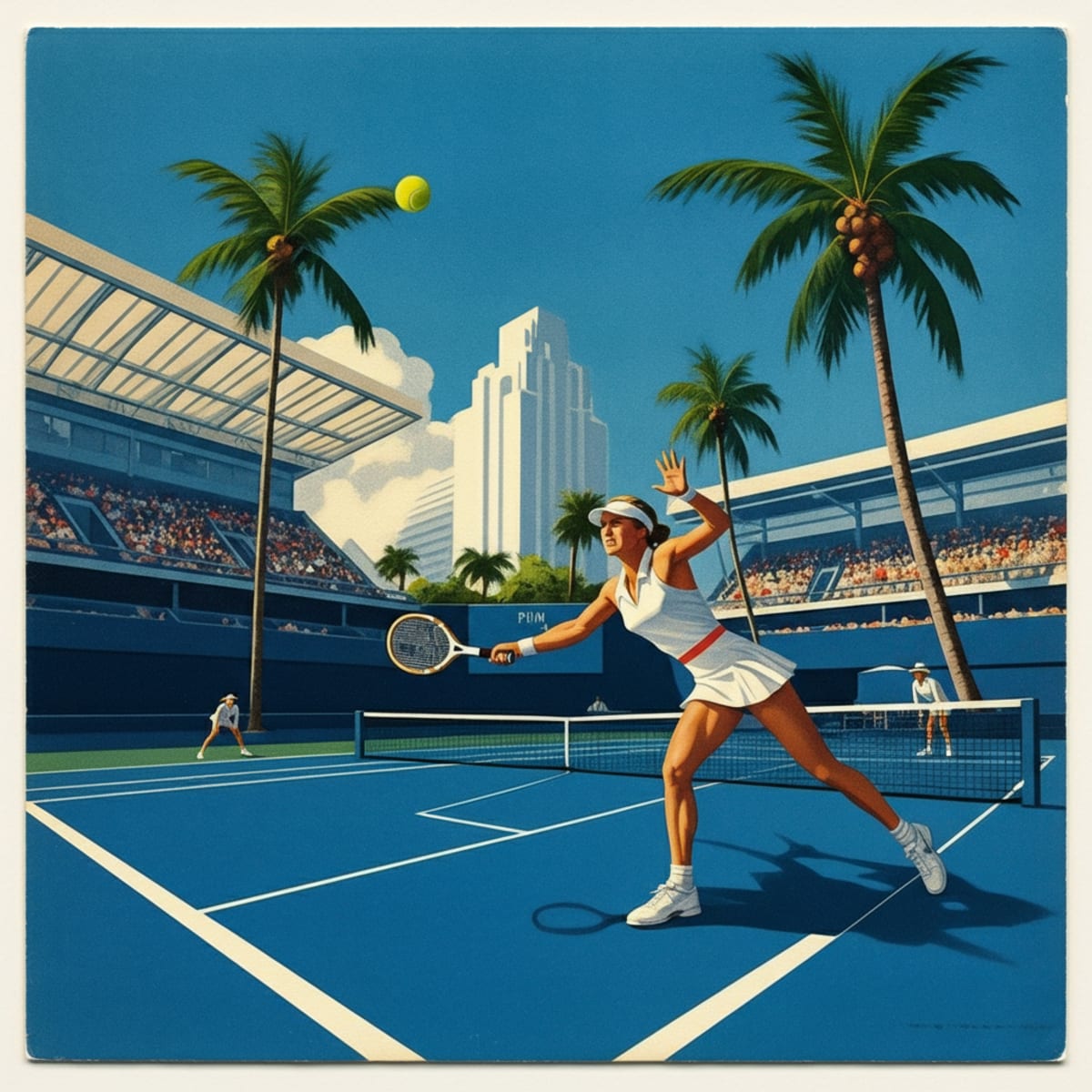
Welcome to the sun-splashed courts of the Magic City, where the air is thick with humidity and heavy anticipation. We are officially on collision course for a magnificent championship bout, as Coco Gauff and Aryna Sabalenka are scheduled to face each other in the Miami Open final. When the pride of Florida meets the booming baseline artillery of the world's elite, the sport's tectonic plates tend to shift.
Listen to the Second Serve Podcast
Get our daily AI-synthesized audio briefings and match reviews on the go.
This isn't merely a contest of strength; it is a fascinating clash of geometric styles and contrasting philosophies. The overall head-to-head record between the tenacious American and the Belarusian powerhouse currently sits deadlocked at six wins each. Neither player is willing to concede an inch on the vivid blue concrete, setting the stage for a brilliantly volatile afternoon.
The Tactical Breakdown
To fully grasp the dynamics of this matchup, one must look beyond sheer velocity. Danielle Collins recently traded her racquet for a broadcast headset, sharing phenomenal tactical analysis on Tennis Channel. According to the Floridian veteran, the blueprint for a Gauff victory rests entirely on disrupting her opponent's rhythmic baseline strikes.
- Altering the Strike Zone: Collins astutely noted that Gauff's looping high balls are designed to kick up violently upon bouncing. This strategy forces Sabalenka to generate her own pace from an uncomfortable altitude, playing well outside her preferred strike zone.
- Elite Court Coverage: Gauff’s supernatural movement essentially shrinks the court. By tracking down seemingly impossible balls, she dares her opponent to aim closer to the lines, which inevitably induces unforced errors.
When the match momentum swings, Sabalenka prefers to step inside the baseline and unleash flat, linear drives that skid through the hard court. To counter this aggression, Gauff relies heavily on whipping topspin. By rolling the ball deep into the corners, the American prevents the world number one from stepping in and dictating the terms of the rally. A crucial metric for this final will be how often Gauff can defend a critical break point by extending the rally past five shots—a twilight zone where her defensive geometry historically outlasts raw power.
The Bigger Picture
Breaking a 6-all tie in a high-octane rivalry requires a reservoir of mental fortitude. When the stakes reach their absolute highest, Gauff has historically found a higher gear against her fierce rival. According to the scraped broadcast text, Gauff has captured both of their previous meetings in finals, which took place at the 2022 US Open and last year's Roland Garros.
Those championship clashes illuminate a fascinating psychological edge. Sabalenka possesses the weaponry to hit through any surface on the globe, but finals are often decided by who manages the emotional turbulence more effectively. Gauff thrives off the kinetic energy of a domestic crowd. Every time she tracks down a booming cross-court forehand, the stadium erupts, creating an atmospheric pressure cooker for anyone standing across the net.
A triumph here in Florida would dramatically reshape the hard-court hierarchy as the season marches onward. Sabalenka is actively fighting to solidify her reign at the summit of the sport, while Gauff continues to violently defend her turf on home soil. Whoever dictates the height of the ball—and ultimately, the geometry of the court—will hoist the magnificent trophy under the Miami sun.
What Coco Gauff Plays With
Head Boom MP 2024
Head Lynx Tour 1.25
Analyze Coco Gauff vs. Aryna Sabalenka
Predict tactical adjustments, momentum swings, and serve strategy options for this match-up using our AI simulator.
The Aces Tactical Panel
This report was curated and edited by Bhaskar Goel. Tactical analysis and technical insights were provided by our specialized panel of expert correspondents.
Julian Price
Senior Tactical Correspondent
Stuffy, pedantic British academic and historian specializing in match momentum and historical context.
Elena Cruz
Director of Analytical Research
Data scientist specializing in court surface physics and movement patterns.
Bhaskar
The Editor & Fan
Passionate tennis player and site editor bringing everyday amateur insights and relatable fan commentary.
Arthur Vance
Senior Existential Analyst
Deep, eccentric, and DFW-inspired. Models court metaphysics, kinetic beauty, and player psychology.
Leo Sterling
High-Performance Consultant
Hard-nosed ex-trainer from Melbourne with a no-nonsense view on tour fitness.