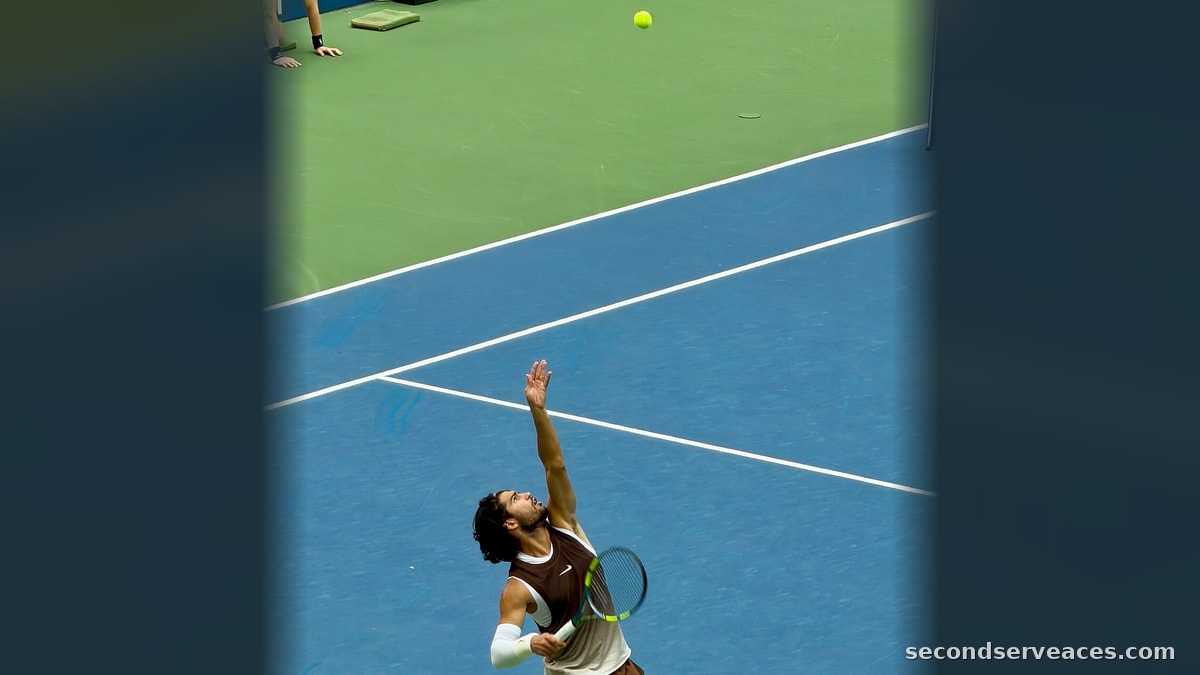
The Shanghai Meltdown Against Zizou Bergs
Carlos Alcaraz's campaign at the Shanghai Masters came to an abrupt halt on October 12, as the Spanish superstar suffered a straight-set defeat to unseeded Belgian Zizou Bergs in the round of 32. Operating on the fast, high-friction hard courts, the World No. 3 struggled to establish his typical baseline dominance. The defeat highlighted a rare vulnerability in Alcaraz's defensive transition, where his explosive footwork was neutralized by Bergs' flat, penetrating groundstrokes.
Listen to the Second Serve Podcast
Get our daily AI-synthesized audio briefings and match reviews on the go.
Throughout the encounter, Alcaraz visibly struggled with the playing conditions, repeatedly expressing frustration with the tournament balls and the court surface. From a technical standpoint, the interaction between a player's racket string bed and the felt of the ball determines the precise launch angle and topspin RPM. When these specs deviate from a player's preferred baseline, it can severely disrupt their timing, as we saw with Alcaraz's uncharacteristic unforced errors.
This friction over tournament gear and court speed is not a new narrative for the young Spaniard. In fact, his struggles with the equipment in China echo the discussions we highlighted in our coverage of Alcaraz Ball Complaints & Ohanian's Williams Nostalgia. Furthermore, these complaints continue to fuel the broader discussion around how modern court surfaces are prepared, a topic we previously explored when analyzing how Alcaraz & Sinner Fuel the Modern Court Speed Debate.
Benoit Maylin Confronts the Ego of World No. 3
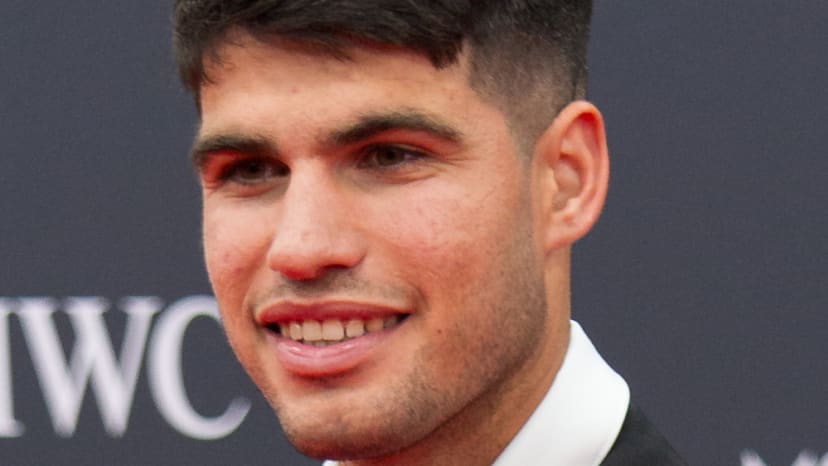
Following the defeat, French tennis insider Benoît Maylin did not hold back, launching a sharp critique of the young Spaniard's public complaints. Maylin accused Alcaraz of possessing a bloated ego, suggesting that blaming external factors like balls and court speed was an easy way to avoid taking responsibility for a subpar performance. On the grueling professional circuit, mental resilience is as critical as physical durability, and Maylin argued that champions must adapt rather than complain.
Prior to the tournament's commencement, Alcaraz had publicly criticized the dense ATP Tour schedule, arguing that the relentless calendar pushes players past their physical limits. The Spaniard claimed that the sheer volume of mandatory events leaves little room for recovery, increasing the risk of long-term wear and tear. Maylin, however, countered that elite competitors must manage their schedules intelligently rather than demanding systemic changes to suit their individual needs.
While the debate over schedule density continues to divide the locker room, the physical toll on players is undeniable. According to the official ATP Tour website, the transition between different continents and court surfaces requires elite athletes to constantly recalibrate their physical conditioning. For an aggressive baseliner like Alcaraz, whose game relies on explosive changes of direction, the lack of an extended off-season remains a highly contentious point of discussion.
Navigating the Brutal ATP Tour Calendar
The technical demands of competing at the highest level require a delicate balance of gear optimization and physical management. Hard courts, such as those used in Shanghai, offer zero shock absorption, meaning every hard stop transmits high-impact kinetic energy directly through the player's ankles and knees. When players are forced to compete week after week without adequate rest, their movement mechanics degrade, leading to the exact timing issues Alcaraz experienced against Bergs.
Alcaraz is expected to try and bounce back at his next scheduled stop, the Erste Bank Open in Vienna. This transition to the indoor hard courts of Europe will present a completely different set of technical challenges, including lower-bounce profiles and faster air resistance. To succeed in Vienna, Alcaraz will need to fine-tune his tension specs and ensure his physical reserves are replenished after a taxing Asian swing.
The challenge of staying healthy through the final months of the year is a recurring theme on the men's tour. As we noted in our analysis of how Zverev Claims 2026 Year-End No. 1 Amid Sinner & Alcaraz Injuries, premature exits and physical fatigue frequently reshape the top of the ATP rankings. Alcaraz's ability to withstand these demands will ultimately determine his longevity at the pinnacle of the sport.
Rivalry Matchup & Player Profiles
| Metric | Carlos Alcaraz | Benoît Maylin |
|---|---|---|
| Rank | World No. 3 | N/A (Tennis Journalist) |
| Age | 23 | 59 |
| Country | Spain | France |
| Height | 1.83 m (6 ft 0 in) | N/A |
| Handedness | Right-handed | N/A |
| Play Style | Aggressive baseliner | N/A (Tennis Journalist / Analyst) |
| Career Titles | 27 | N/A |
Carlos Alcaraz and Benoît Maylin have never faced each other in an official match, as Maylin is a prominent French tennis journalist and media commentator rather than a professional competitor on the ATP Tour. This head-to-head record remains a purely rhetorical one, defined by Maylin's analytical critiques and Alcaraz's on-court performances.
While Alcaraz continues to build his legacy as one of the most decorated young players in tennis history with 27 career titles, commentators like Maylin provide a critical lens on the sport's shifting dynamics. As the tour moves toward the indoor season, the tension between player physical limits and media expectations will undoubtedly remain a focal point of discussion.
For gear enthusiasts, tracking how Alcaraz adjusts his equipment setup to combat physical fatigue on the indoor courts will be key. Whether he opts to lower his string tension to gain easy depth or sticks to his standard specifications, his tactical evolution under media scrutiny remains highly compelling.
What Carlos Alcaraz Plays With
Babolat Pure Aero 98
Babolat RPM Blast 1.30
Babolat VS Original (12-Pack)
Nike Vapor Pro 2
Analyze Benoit Maylin vs. Carlos Alcaraz
Predict tactical adjustments, momentum swings, and serve strategy options for this match-up using our AI simulator.
The Aces Tactical Panel
This report was curated and edited by Bhaskar Goel. Tactical analysis and technical insights were provided by our specialized panel of expert correspondents.
Julian Price
Senior Tactical Correspondent
Stuffy, pedantic British academic and historian specializing in match momentum and historical context.
Elena Cruz
Director of Analytical Research
Data scientist specializing in court surface physics and movement patterns.
Bhaskar
The Editor & Fan
Passionate tennis player and site editor bringing everyday amateur insights and relatable fan commentary.
Arthur Vance
Senior Existential Analyst
Deep, eccentric, and DFW-inspired. Models court metaphysics, kinetic beauty, and player psychology.
Leo Sterling
High-Performance Consultant
Hard-nosed ex-trainer from Melbourne with a no-nonsense view on tour fitness.
Related Reports


Quick Answers
Who defeated Carlos Alcaraz at the Shanghai Masters?+
Carlos Alcaraz was defeated in straight sets by unseeded Belgian Zizou Bergs in the round of 32 on October 12.
What were Carlos Alcaraz's main complaints in Shanghai?+
Alcaraz criticized the dense ATP Tour schedule for pushing players too hard and expressed frustration with the tournament balls and court surface conditions.
What was Benoit Maylin's criticism of Carlos Alcaraz?+
Benoit Maylin accused Alcaraz of having a big ego and using complaints about the schedule and playing conditions as excuses for his defeat.