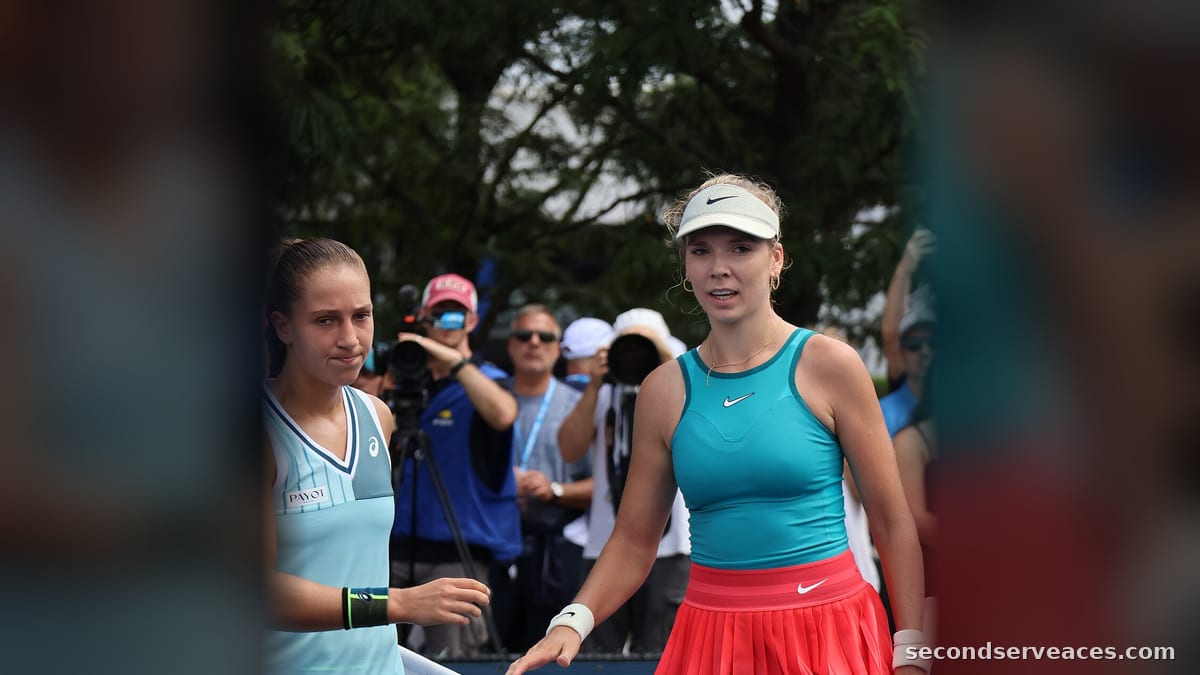
In professional tennis, efficiency under pressure is the ultimate metric of success. At the hard-court tournament in Osaka, British competitor Katie Boulter put on an absolute clinic in high-leverage defense, turning away a barrage of break opportunities to secure a 6-3 6-1 victory over Japan's Himeno Sakatsume. The match, which began on Monday under threatening skies, was suspended due to rain with Boulter holding a set lead and a 3-1 advantage in the second. When play resumed on Tuesday, the British player wasted no time closing out the contest, demonstrating exceptional focus and physical calibration.
Listen to the Second Serve Podcast
Get our daily AI-synthesized audio briefings and match reviews on the go.
This opening-round victory at the WTA Tour event highlights Boulter's evolving tactical maturity on quick surfaces. Rather than relying solely on raw power, she managed her service games with calculated precision, navigating several multi-deuce games. With top-tier competitors adjusting their schedules late in the season, capitalizing on these early-round opportunities is essential for maintaining a strong position in the global rankings.
Analyzing Boulter's High-Pressure Defense and Break Point Conversion Metrics
The defining metric of this encounter was Boulter's efficiency when backed into a corner. Sakatsume generated a staggering 13 break-point opportunities over the course of two sets, yet Boulter successfully neutralized 12 of them. This 92.3% save rate points to excellent tactical execution on second serves and disciplined baseline positioning. Instead of rushing the point or committing unforced errors under duress, Boulter utilized her 5'11" frame to dictate play with heavy topspin, forcing her opponent into low-percentage recovery shots.
On the return side, Boulter displayed highly clinical efficiency. She manufactured nine break-point opportunities against the Sakatsume serve and converted five of them, yielding a 55.6% conversion rate. This ability to maximize return opportunities while shutting down her opponent's advances prevented Sakatsume from generating any sustainable match momentum. According to official data, Boulter's return depth consistently landed within two meters of the baseline, keeping the Japanese qualifier on the defensive throughout their service exchanges.
Managing the Overnight Rain Delay and Maintaining Match Momentum
Interrupted matches present a unique psychological and physical challenge, requiring players to reset their physiological systems overnight. When rain halted play on Monday, Boulter was in a commanding position but faced the prospect of a cold restart on Tuesday morning. The transition back to the match court was seamless; she surrendered zero service games upon resumption, executing her patterns with the same mechanical precision she displayed on day one. This level of focus is highly indicative of a seasoned competitor who understands how to manage extended downtime without losing competitive edge.
This disciplined performance comes at an intriguing time for British women's tennis. As we recently analyzed in our coverage of how Sonay Kartal became British No. 1 after her Wuhan run, the competition at the top of the national ladder is intensifying. Boulter's ability to grind out tough service holds in Osaka ensures she remains a central figure in this domestic race, keeping the pressure on her compatriots as the Asian swing progresses.
Tactical Outlook Against Golubic and the Broader Asian Swing Landscape
With Sakatsume defeated, Boulter shifts her focus to a second-round encounter against Switzerland's Viktorija Golubic. Golubic presents a completely different tactical puzzle, utilizing a classic single-handed backhand and heavy slice to disrupt her opponent's rhythm. To advance, Boulter must maintain her aggressive baseline stance, using her flat groundstrokes to pierce Golubic's defensive slice before the Swiss can establish comfortable angles. Keeping the error count low will be paramount against Golubic's change-of-pace style.
Meanwhile, the wider WTA landscape continues to experience significant shifts. World No. 1 Iga Swiatek recently withdrew from the upcoming Ningbo Open due to a persistent thigh injury, altering the draw dynamics in China. As top-tier seeds manage physical wear and tear, players positioned in the mid-tiers of the WTA rankings have a prime window to accumulate valuable points. Boulter's robust physical showing in Osaka suggests she has the durability to capitalize on these late-season draw vacancies.
Match Performance Statistics
| Statistic | Katie Boulter | Himeno Sakatsume |
|---|---|---|
| Break Points Saved | 12 / 13 (92.3%) | 4 / 9 (44.4%) |
| Break Points Converted | 5 / 9 (55.6%) | 1 / 13 (7.7%) |
| Match Outcome | Won (6-3, 6-1) | Lost (3-6, 1-6) |
Rivalry Matchup & Player Profiles
| Metric | Katie Boulter |
|---|---|
| Current WTA Rank | 58 |
| Country | Great Britain |
| Age | 30 |
| Height | 5' 11" (1.82 m) |
| Handedness | Right-handed |
| Play Style | Aggressive baseliner |
| Career Singles Titles | 4 WTA Singles |
As detailed in her profile, Katie Boulter operates as a textbook aggressive baseliner, relying on her height to generate steep angles on her serve and flat trajectory on her groundstrokes. At 30 years old, she possesses the tactical maturity required to navigate difficult weather suspensions and high-pressure breakpoints. To read more about her career trajectory and milestones, you can visit her dedicated Katie Boulter Wikipedia page.
Essential Matchday Add-Ons
Tournament-tested accessories and high-frequency consumables every competitive player keeps in their bag.
Tourna Grip Original Dry Feel Overgrip (10-Pack)
4.8 ★ (12,000+ reviews)
The gold standard for sweaty hands. Proprietary dry feel absorbs moisture better as play intensifies.
Luxilon ALU Power 125 Silver String Set
4.9 ★ (3,500+ reviews)
Unrivaled control and spin potential used by over 50% of the ATP Top 100 players.
Babolat Custom Damp Vibration Dampener (2-Pack)
4.7 ★ (4,200+ reviews)
Customizable dampening with removable central O-ring for fine-tuning court feedback and sound.
Penn Championship Extra Duty Tennis Balls (4-Can Pack)
4.7 ★ (8,900+ reviews)
Official ball of USTA League Tennis with extra-duty felt designed for abrasive hard courts.
Analyze Katie Boulter vs. Himeno Sakatsume
Predict tactical adjustments, momentum swings, and serve strategy options for this match-up using our AI simulator.
The Aces Tactical Panel
This report was curated and edited by Bhaskar Goel. Tactical analysis and technical insights were provided by our specialized panel of expert correspondents.
Julian Price
Senior Tactical Correspondent
Stuffy, pedantic British academic and historian specializing in match momentum and historical context.
Elena Cruz
Director of Analytical Research
Data scientist specializing in court surface physics and movement patterns.
Bhaskar
The Editor & Fan
Passionate tennis player and site editor bringing everyday amateur insights and relatable fan commentary.
Arthur Vance
Senior Existential Analyst
Deep, eccentric, and DFW-inspired. Models court metaphysics, kinetic beauty, and player psychology.
Leo Sterling
High-Performance Consultant
Hard-nosed ex-trainer from Melbourne with a no-nonsense view on tour fitness.
Related Reports


Quick Answers
What was the final score of Katie Boulter's match against Himeno Sakatsume at the Japan Open?+
Katie Boulter defeated Himeno Sakatsume with a final score of 6-3, 6-1 in the first round of the Japan Open.
How many break points did Katie Boulter save during her match against Sakatsume?+
Boulter saved an impressive 12 out of 13 break points (92.3%) to prevent her opponent from gaining momentum.
Who will Katie Boulter face in the second round of the Japan Open?+
Boulter will face Viktorija Golubic of Switzerland in the second round of the tournament.