By Leo Sterling
Listen to the Second Serve Podcast
Get our daily AI-synthesized audio briefings and match reviews on the go.
Altitude changes everything in the Spanish capital. The ball flies faster, the air burns the lungs just a fraction more, and finding your rhythm on the dirt becomes a delicate science. But this year, the fiercest battles at the Madrid Open might not just be about surviving a break point in the third set—they are about simply finding a place to hit a tennis ball.
Expanding a Masters 1000 event to a 96-player singles draw creates an immediate, suffocating bottleneck. The Caja Magica, scheduled to host the tournament from April 20 to May 3, is suddenly strapped for space. When dozens of the world's elite descend on a single facility, the scramble for court time disrupts the very foundation of a player's preparation.
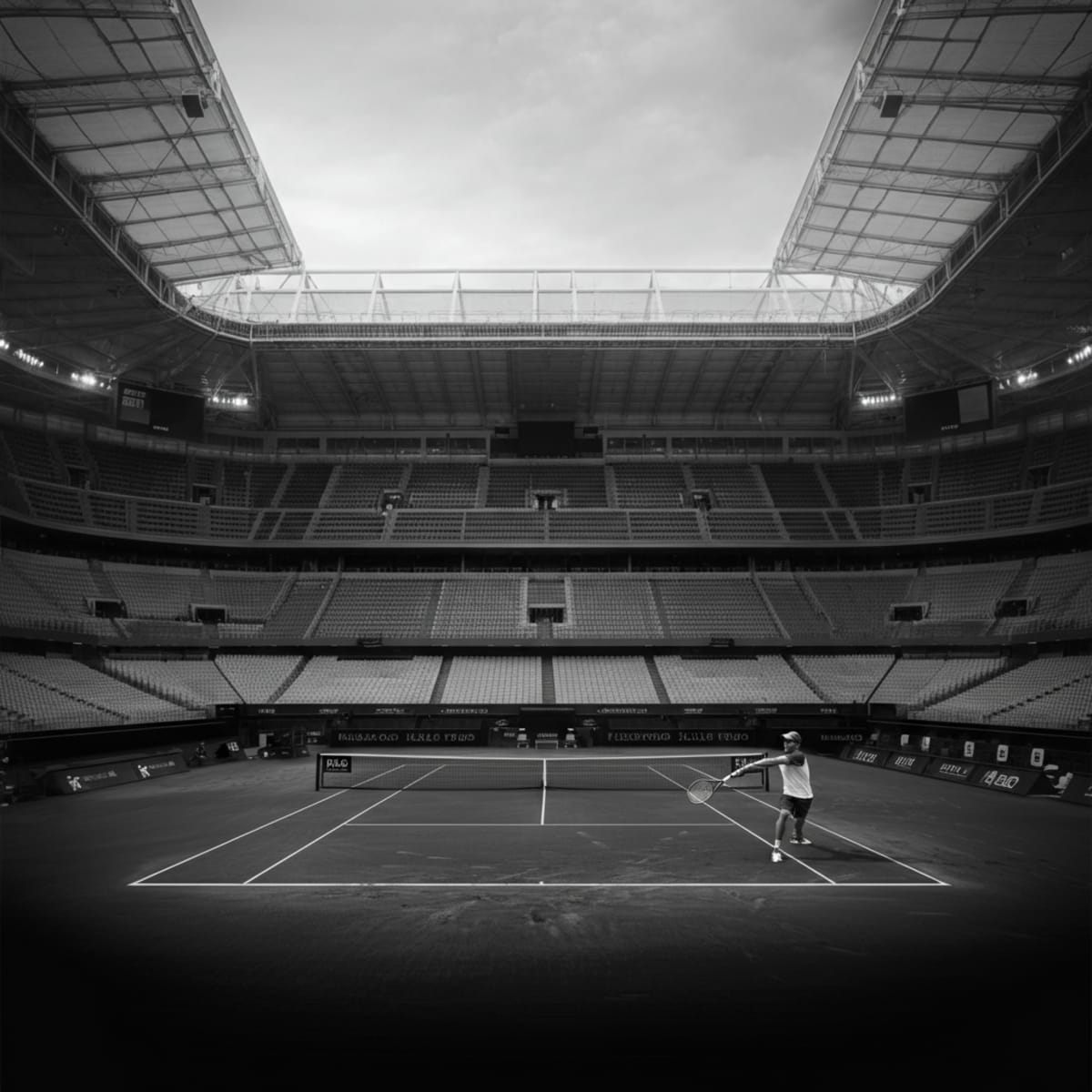
Enter an unprecedented logistical audible: Real Madrid’s iconic Santiago Bernabeu stadium.
The Bernabeu Solution
To alleviate the crushing demand for practice facilities, tournament organizers are constructing a temporary clay court directly inside the Bernabeu. This isn't a PR stunt designed to pack the stands. In fact, it is the exact opposite. Here are the hard realities of the arrangement:
- Strictly Private: Practice sessions will take place between April 23 and 30, entirely closed to the public.
- Zero Competition: Absolutely no official tournament matches will be played at the football stadium.
- Targeted Relief: The sole purpose is to siphon practice traffic away from the congested Caja Magica.
The Tactical Breakdown
Tennis is an open book of routines, and disrupting those routines shatters a player's mental equilibrium. When 96 players are fighting for 45-minute practice slots, anxiety spikes. You spend more time watching the clock than feeling the ball.
Hitting a heavy topspin forehand in Madrid’s thin air requires meticulous calibration. Players like Carlos Alcaraz rely on repetitive, undisturbed drilling to dial in their sliding mechanics and contact points. If you are rushed off a practice court because the next seed is waiting, you cannot properly test your string tension or groove your kick serve. You step onto the match court fundamentally undercooked.
By shifting practice sessions to an isolated environment like the Bernabeu, players reclaim control over their environment. A closed-door session allows for pure tactical experimentation. You can drill specific return patterns, simulate high-pressure scenarios, and build vital match momentum without the prying eyes of opponents, coaches, or fans sitting two courts over.
The Bigger Picture
Tournament infrastructure is currently buckling under the weight of the tour's relentless expansion. The shift to two-week Masters 1000 formats pushes legacy facilities to their absolute limit. Madrid Tournament Director Feliciano Lopez understands the unique pressures of the modern tour, and this cross-sport venue collaboration highlights a growing trend in tennis operations: survival through adaptation.
Legends like Roger Federer and Rafael Nadal established an era where meticulous, undisturbed preparation was the baseline for championship success. They engineered their schedules down to the minute. Today, an expanded draw threatens that hyper-controlled environment. If a player cannot practice exactly when their physical therapist and coach dictate, their entire physical peaking process is thrown off axis.
For Alcaraz, defending home turf on the clay requires absolute physical and mental clarity. A private sanctuary inside one of the world's most famous sporting arenas provides exactly that. The Madrid Open is proving that managing a 96-player draw isn't just about scheduling more matches—it is about managing the psychological grind of the players before the first ball is even tossed.
What Carlos Alcaraz Plays With
Babolat Pure Aero 98
Babolat RPM Blast 1.30
Nike Vapor Pro 2
Analyze Carlos Alcaraz vs. Rafael Nadal
Predict tactical adjustments, momentum swings, and serve strategy options for this match-up using our AI simulator.
The Aces Tactical Panel
This report was curated and edited by Bhaskar Goel. Tactical analysis and technical insights were provided by our specialized panel of expert correspondents.
Julian Price
Senior Tactical Correspondent
Stuffy, pedantic British academic and historian specializing in match momentum and historical context.
Elena Cruz
Director of Analytical Research
Data scientist specializing in court surface physics and movement patterns.
Bhaskar
The Editor & Fan
Passionate tennis player and site editor bringing everyday amateur insights and relatable fan commentary.
Arthur Vance
Senior Existential Analyst
Deep, eccentric, and DFW-inspired. Models court metaphysics, kinetic beauty, and player psychology.
Leo Sterling
High-Performance Consultant
Hard-nosed ex-trainer from Melbourne with a no-nonsense view on tour fitness.