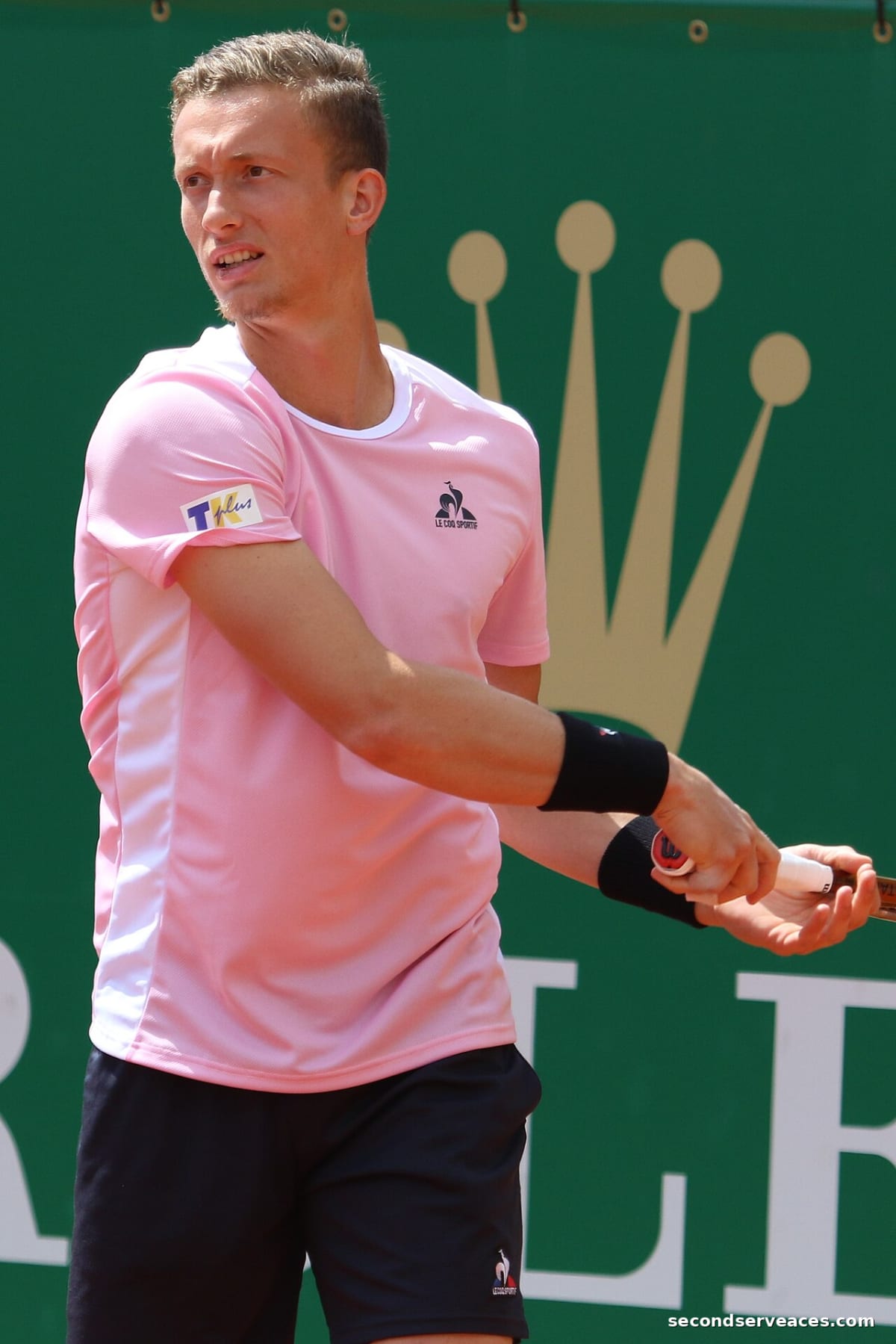
Jodar's High-Bounce Forehand vs. Lehecka's Shoulder-Height Strike Zone
Rafael Jodar's recent run to the final of the Citi Open the week prior has set a high-performance benchmark for his hard-court campaign. In our previous coverage of the scheduling adjustments in Washington, we noted how Jodar's heavy topspin forehand dominates high-bounce environments. At 6'3", Jodar consistently strikes his forehand at an average contact point of 1.2 meters, allowing him to pull opponents deep behind the baseline and control the center of the court.
Listen to the Second Serve Podcast
Get our daily AI-synthesized audio briefings and match reviews on the go.
Jiri Lehecka enters this match with a solid 23-14 match record for the season, establishing himself as a formidable threat in the ATP rankings. His aggressive baseline style is built on linear ball striking, but the high-bouncing surface in Montreal presents a unique challenge. If Lehecka is forced to strike balls above his shoulder, his clean, flat groundstrokes can quickly break down into unforced errors, disrupting his rhythm.
To counteract Jodar's heavy forehand, Lehecka must adjust his court positioning. Taking the ball on the rise—approximately 0.9 meters off the ground—will prevent Jodar's topspin from climbing into the danger zone. By shortening his backswing and stepping inside the baseline, Lehecka can redirect Jodar's pace and dictate the tempo before the young Spaniard can establish control of the rally.
Nakashima's Low-Skidding Backhand vs. Rinderknech's Serve-and-Volley Pressure
Brandon Nakashima faces Arthur Rinderknech in another highly tactical matchup in the Montreal draw. Nakashima holds a 1-0 head-to-head record against the Frenchman and recently reached the semifinals at the Citi Open, demonstrating his current comfort on fast North American hard courts. His compact strokes and exceptional lateral movement are perfectly suited for neutralizing big-serving opponents on this surface.
Nakashima's backhand will be his primary weapon, typically crossing the net with a mere 15 centimeters of clearance. This flat, low-skidding trajectory makes it incredibly difficult for the 6'5" Rinderknech to find comfortable half-volleys when moving forward. Keeping the ball low and deep is the ultimate antidote to Rinderknech's aggressive net rushes, forcing him to hit up on his volleys.
Rinderknech will look to shorten rallies, aiming to keep point lengths under four shots with his serve-and-volley tactics. Nakashima must counter this by maintaining a first-serve return rate above 75%, forcing Rinderknech into protracted baseline exchanges. If Nakashima can drag the Frenchman into longer rallies, his superior consistency from the back of the court will inevitably wear down his opponent.
Norrie's Flat Crosscourt Dippers vs. Fils' Explosive Lateral Movement
Elsewhere in the draw, Cameron Norrie set up his first career meeting with Arthur Fils after a commanding victory over Alex de Minaur. Norrie's tactical blueprint relies on physical conditioning and a highly unorthodox, flat backhand that skids low off the court. This unique spin profile makes it difficult for opponents to generate rhythm, especially on the quicker courts of the National Bank Open.
Arthur Fils represents a highly explosive challenge, relying on rapid lateral recovery and heavy topspin off both wings. Norrie must use his short-angled forehand to pull Fils wide, opening up the line for his flat backhand. If Norrie allows Fils to dictate from the center of the court, the Frenchman's raw power will overwhelm him, particularly on short mid-court balls.
The physical toll of this matchup will be decided in the mid-length rallies. When rallies extend past seven shots, Fils' unforced error rate historically climbs. Norrie's objective must be to extend these exchanges, using deep, looping topspin to push Fils back and force him to generate his own pace from defensive positions rather than stepping up to punish short balls.
Rivalry Matchup & Player Profiles
| Metric | Jiri Lehecka | Rafael Jodar |
|---|---|---|
| Rank | 12 | 15 |
| Age | 24 | 19 |
| Country | Czech Republic | Spain |
| Height | 6 ft 1 in (1.85 m) | 6 ft 3 in (1.91 m) |
| Handedness | Right-handed | Right-handed |
| Play Style | Aggressive baseliner | Aggressive baseliner |
| Career Titles | 2 | 1 |
Rafael Jodar holds a 1-0 head-to-head advantage over Jiri Lehecka, having secured a straight-sets victory (6-3, 6-3) in their previous encounter in the Round of 16 at the National Bank Open in Montreal. Jodar's high-bouncing topspin matched up perfectly against Lehecka's flat, aggressive strokes, allowing the young Spaniard to control the tempo from the baseline and exploit Lehecka's positioning.
We previously analyzed Jodar's tactical progression and baseline patterns in our Jodar vs. Moutet Montreal Preview. To reverse this head-to-head matchup, Lehecka must improve his first-serve percentage, which hovered below 60% in their last meeting, leaving him vulnerable to Jodar's aggressive second-serve returns. Redirecting Jodar's heavy forehand early in the rally will be essential.
This match represents a classic clash of styles on the Montreal hard courts. Elsewhere in the draw, Nuno Borges holds a 2-1 head-to-head advantage over Luciano Darderi, showcasing how baseline adaptability remains the ultimate currency this week. The winner of Lehecka vs. Jodar will likely be the player who successfully controls the height of the rallies and dictates court positioning from the very first strike.
Essential Matchday Add-Ons
Tournament-tested accessories and high-frequency consumables every competitive player keeps in their bag.
Tourna Grip Original Dry Feel Overgrip (10-Pack)
4.8 ★ (12,000+ reviews)
The gold standard for sweaty hands. Proprietary dry feel absorbs moisture better as play intensifies.
Luxilon ALU Power 125 Silver String Set
4.9 ★ (3,500+ reviews)
Unrivaled control and spin potential used by over 50% of the ATP Top 100 players.
Babolat Custom Damp Vibration Dampener (2-Pack)
4.7 ★ (4,200+ reviews)
Customizable dampening with removable central O-ring for fine-tuning court feedback and sound.
Penn Championship Extra Duty Tennis Balls (4-Can Pack)
4.7 ★ (8,900+ reviews)
Official ball of USTA League Tennis with extra-duty felt designed for abrasive hard courts.
Analyze Jiri Lehecka vs. Rafael Jodar
Predict tactical adjustments, momentum swings, and serve strategy options for this match-up using our AI simulator.
The Aces Tactical Panel
This report was curated and edited by Bhaskar Goel. Tactical analysis and technical insights were provided by our specialized panel of expert correspondents.
Julian Price
Senior Tactical Correspondent
Stuffy, pedantic British academic and historian specializing in match momentum and historical context.
Elena Cruz
Director of Analytical Research
Data scientist specializing in court surface physics and movement patterns.
Bhaskar
The Editor & Fan
Passionate tennis player and site editor bringing everyday amateur insights and relatable fan commentary.
Arthur Vance
Senior Existential Analyst
Deep, eccentric, and DFW-inspired. Models court metaphysics, kinetic beauty, and player psychology.
Leo Sterling
High-Performance Consultant
Hard-nosed ex-trainer from Melbourne with a no-nonsense view on tour fitness.
Related Reports
Quick Answers
What is the head-to-head record between Jiri Lehecka and Rafael Jodar?+
Rafael Jodar leads the head-to-head record 1-0, having defeated Jiri Lehecka 6-3, 6-3 in their previous Montreal Round of 16 meeting.
How did Rafael Jodar perform in the week leading up to Montreal?+
Rafael Jodar reached the final of the Citi Open in Washington the week prior to the National Bank Open.
What is Jiri Lehecka's match record for the season entering this match?+
Jiri Lehecka entered the match with a 23-14 match record for the season.