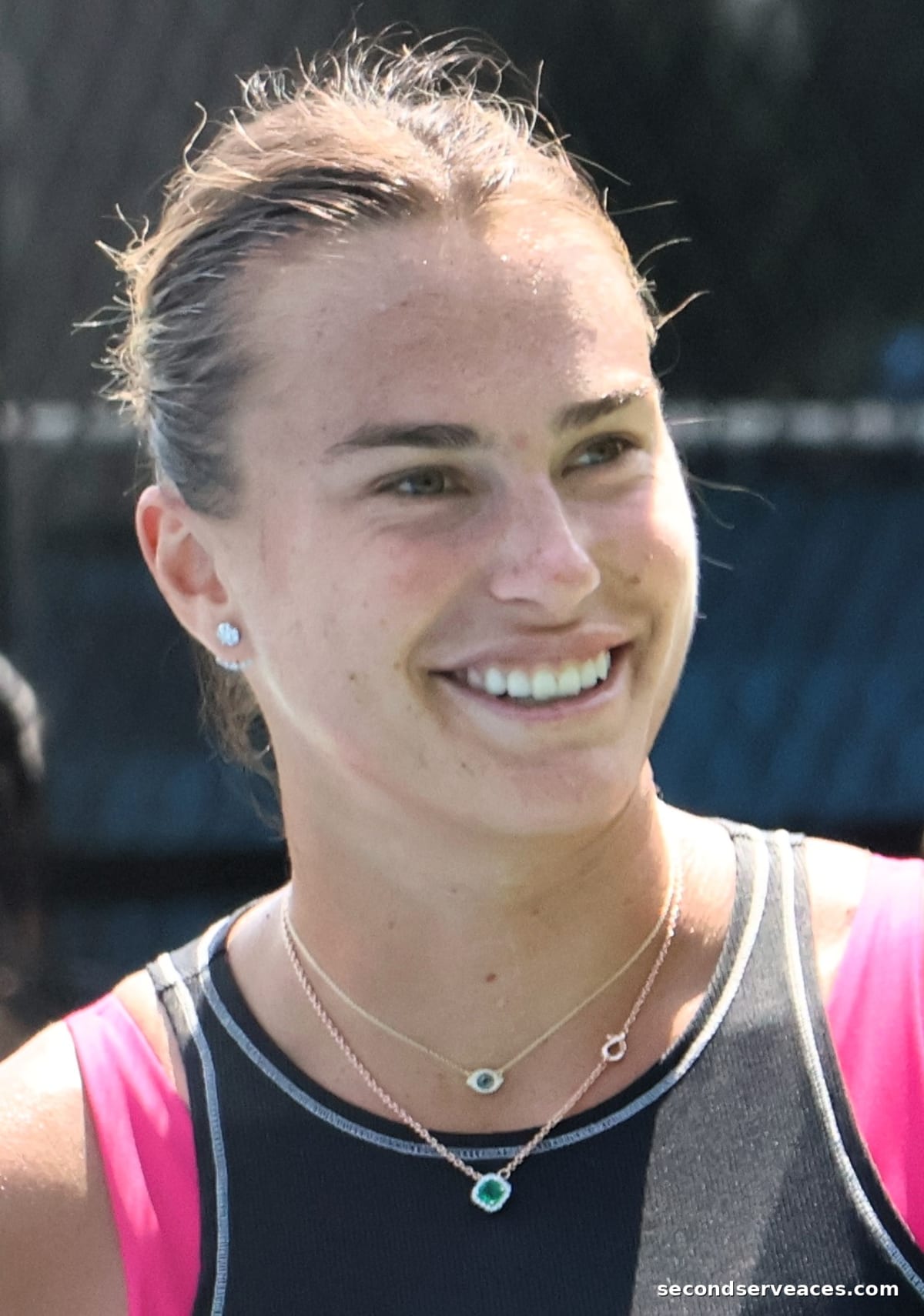
There is a peculiar, almost violent contrast to grass-court tennis, a surface where the ball does not so much bounce as it skids, darting away like a startled animal. At the Berlin Tennis Open, this physical reality was brought into sharp relief as Aryna Sabalenka secured a 6-4, 6-4 victory over Ekaterina Alexandrova in the second round. The match itself was a masterclass in controlled aggression, a display of raw, kinetic energy that we previously anticipated in our previous analysis of the Berlin draw. Yet, what should have been a celebration of athletic dominance quickly dissolved into something far more complicated, highlighting the strange, often surreal relationship between the modern gladiator and the media apparatus that surrounds them.
Listen to the Second Serve Podcast
Get our daily AI-synthesized audio briefings and match reviews on the go.
To watch Sabalenka on grass is to witness a fascinating struggle against the court's natural desire to minimize reaction time. Unlike the high-bouncing clay, grass demands an almost sub-atomic level of footwork adjustment, a constant lowering of the center of gravity that taxes the quadriceps and tests the limits of human kinetic chain alignment. Sabalenka, a four-time Grand Slam champion, navigated these demands with a brutal elegance, her heavy topspin groundstrokes cutting through the humid German air to repeatedly pierce Alexandrova's defense. The scoreline, a clean and symmetrical 6-4, 6-4, reflects a match where key break points were decided not by luck, but by the sheer, unyielding imposition of physical will.
Alexandrova, no stranger to the slick dynamics of the lawn, attempted to counter Sabalenka's weight of shot with flat, early-taken backhands, trying to redirect the force back into the open spaces of the court. But Sabalenka's serve remained a formidable fortress, rescuing her whenever the match momentum threatened to swing. It was a performance that reestablished her credentials as a premier force on this surface, proving once again that her power is not merely a blunt instrument, but a highly calibrated weapon capable of dismantling the most disciplined defensive structures in the women's game.
The Brutal Geometry of the Lawn and the 6-4, 6-4 Reality
To understand the depth of Sabalenka's triumph, one must appreciate the sheer speed of transition play required on this surface. The ball leaves the racket and arrives in the opponent's strike zone in a fraction of a second, leaving no room for hesitation or technical doubt. Sabalenka's ability to consistently find the sweet spot of her racket while moving laterally on a slippery green carpet is a feat of extraordinary neuromuscular coordination. Every stroke is a high-stakes gamble against the low bounce, a challenge she accepted and won with remarkable frequency during the eighty-minute contest.
Alexandrova's serving patterns, which often rely on subtle slice variations to slide wide on the deuce court, were systematically neutralized by Sabalenka's aggressive return positioning. By stepping inside the baseline, the world No. 1 took time away from her opponent, forcing hurried errors and securing the crucial breaks of serve in each set. This proactive tactical stance prevented Alexandrova from finding any rhythm, effectively turning the match into a series of short, explosive rallies dominated by Sabalenka's heavy baseline artillery.
The final game of the second set served as a microcosm of the entire encounter. Facing a momentary lapse in concentration, Sabalenka refocused, producing a series of unreturnable first serves that extinguished any hope of an Alexandrova comeback. The final point, a thunderous forehand winner down the line, was met with a roar of satisfaction from the crowd—a crowd that was about to witness a very different kind of performance just moments later on the very same court.
The Post-Match Inquisition and the Ghost of Roger Federer
No sooner had the sweat dried on Sabalenka's brow than the atmosphere inside the stadium shifted from athletic appreciation to acute social discomfort. The post-match on-court interview, historically a platform for benign platitudes and crowd thank-yous, took a sharp turn into the bizarre. The reporter on site embarked on a highly convoluted line of questioning that left both the player and the spectators visibly bewildered, shifting the focus away from her hard-fought victory to abstract queries about her historical standing.
The interviewer chose to highlight Sabalenka's cumulative 95 weeks at the world No. 1 spot in the official WTA rankings, only to clumsily pivot to an unexpected comparison with Roger Federer. The premise of the question was as confusing as it was uncomfortable, asking Sabalenka to contextualize her achievements through the lens of a retired male legend, a move that felt both irrelevant to the match that had just transpired and profoundly tone-deaf. The crowd's reaction was a mixture of hushed silence and scattered, uneasy murmurs, sensing the palpable awkwardness unfolding on the grass.
Online, the backlash was swift and unforgiving, with fans and tennis commentators labeling the interview as "bizarre" and "uncomfortable." It highlighted a recurring issue in modern sports journalism: the tendency to bypass the immediate, visceral reality of a female athlete's victory in favor of forced, grand narratives or awkward comparisons. Sabalenka handled the moment with as much grace as could be expected, offering a polite but strained smile, but the incident cast a lingering shadow over what should have been a moment of pure sporting satisfaction.
The Heavy Burden of Ninety-Five Weeks at the Summit
To fully appreciate the absurdity of the interview, one must understand the immense gravity of what Sabalenka has achieved in her career. According to her career profile on Wikipedia, she is a four-time Grand Slam champion who has spent nearly two full years of her life carrying the target that comes with the world No. 1 ranking. That level of sustained excellence requires a psychological fortitude that cannot be easily distilled into a post-match soundbite, let alone compared arbitrarily to the career of another player from a different tour.
The mental load of elite tennis is exhausting; it is a sport where you are entirely alone on an island, responsible for every error, every double fault, and every strategic miscalculation. To remain at the top of the WTA standings for 95 weeks is not just a statistical milestone, but a monument to daily discipline, physical recovery, and the ability to block out the relentless noise of the tour. To reduce that monumental effort to a confusing trivia question on a hot afternoon in Berlin is an insult to the complexity of the sport.
Yet, Sabalenka's longevity at the top is precisely what makes her the favorite every time she steps onto the court. Her evolution from an emotionally volatile young player into a composed, tactically astute champion is one of the most compelling narratives in modern tennis. She has learned to embrace the pressure, transforming the anxiety of expectation into the fuel that powers her devastating groundstrokes, a transformation that was on full display against Alexandrova.
Looking Ahead to the Quarterfinal Clash with Nikola Bartůňková
With the drama of the second round behind her, Sabalenka must now redirect her focus to the upcoming quarterfinal match at the Berlin Tennis Open. Her next opponent is the rising talent Nikola Bartůňková, who earned her place in the final eight with a surprisingly dominant 6-1, 6-4 victory over Elise Mertens. This upcoming clash presents a fascinating contrast in styles and experience, setting the stage for another high-stakes battle on the German grass.
Bartůňková's performance against Mertens demonstrated a mature understanding of grass-court dynamics, characterized by exceptional transition play and an ability to take the ball early on the rise. To upset Sabalenka, the young challenger will need to do more than just defend; she will have to actively disrupt Sabalenka's rhythm, using slice and short angles to prevent the top seed from planting her feet and dictating play from the baseline. It is a monumental task, but one that Bartůňková will approach with the freedom of having absolutely nothing to lose.
For Sabalenka, the match is another opportunity to fine-tune her grass-court instincts ahead of the year's third Major. The key will be maintaining her focus on the court and ignoring the external distractions that seem to follow her off it. If she can find the same kinetic harmony that carried her past Alexandrova, while avoiding the strange distractions of the post-match microphone, she remains the undisputed player to beat in Berlin.
What Aryna Sabalenka Plays With
Wilson Blade 98 v9 (16x19)
Luxilon ALU Power 125
Analyze Aryna Sabalenka vs. Ekaterina Alexandrova
Predict tactical adjustments, momentum swings, and serve strategy options for this match-up using our AI simulator.
The Aces Tactical Panel
This report was curated and edited by Bhaskar Goel. Tactical analysis and technical insights were provided by our specialized panel of expert correspondents.
Julian Price
Senior Tactical Correspondent
Stuffy, pedantic British academic and historian specializing in match momentum and historical context.
Elena Cruz
Director of Analytical Research
Data scientist specializing in court surface physics and movement patterns.
Bhaskar
The Editor & Fan
Passionate tennis player and site editor bringing everyday amateur insights and relatable fan commentary.
Arthur Vance
Senior Existential Analyst
Deep, eccentric, and DFW-inspired. Models court metaphysics, kinetic beauty, and player psychology.
Leo Sterling
High-Performance Consultant
Hard-nosed ex-trainer from Melbourne with a no-nonsense view on tour fitness.
Related Reports
Quick Answers
What was the score of Aryna Sabalenka's match against Ekaterina Alexandrova in Berlin?+
Aryna Sabalenka defeated Ekaterina Alexandrova with a score of 6-4, 6-4 in the second round.
Who will Aryna Sabalenka play in the quarterfinals of the 2026 Berlin Open?+
Sabalenka will face Nikola Bartůňková, who secured her spot by defeating Elise Mertens 6-1, 6-4.
Why did Aryna Sabalenka's post-match interview in Berlin cause controversy?+
Fans and analysts labeled the on-court interview as 'bizarre' and 'uncomfortable' due to the reporter's awkward questions regarding her No. 1 ranking and Roger Federer.