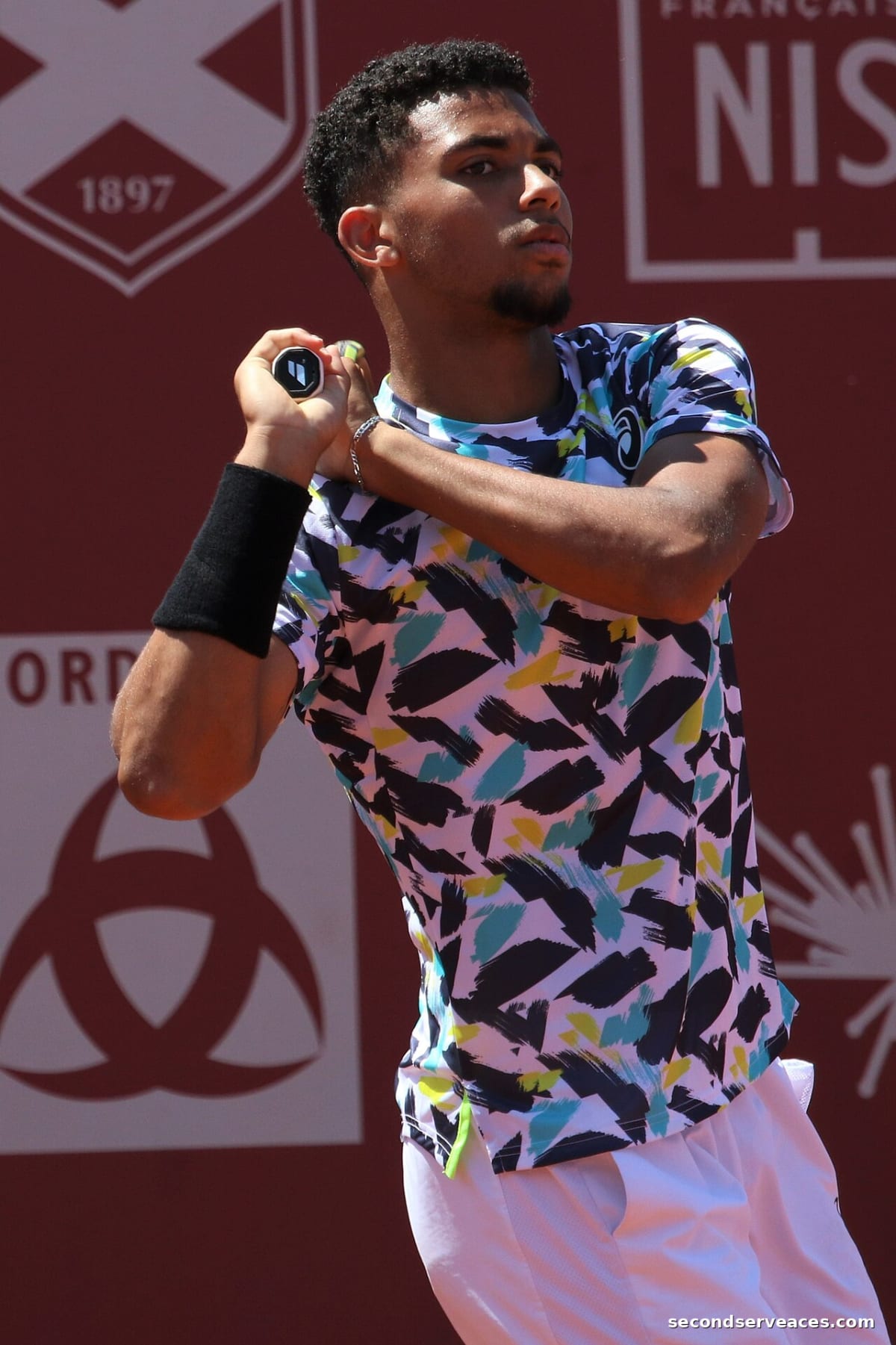
To watch Arthur Fils operate on a fast hard court is to witness a profound study in explosive deceleration. In his semifinal clash at the Cincinnati Open, the 22-year-old Frenchman dismantled No. 7 seed Flavio Cobolli 6-3, 6-4, securing a place in his first-ever career Masters 1000 final. The scoreline, while efficient, does not fully convey the sheer physical exertion required to dictate play on these punishingly quick Mason, Ohio courts, where the ball skids low and rewards only the most precise stroke mechanics.
Listen to the Second Serve Podcast
Get our daily AI-synthesized audio briefings and match reviews on the go.
The Violent Physics of Fils' Forehand and Cobolli's Deep Court Positioning
From the opening game, Fils established a clear tactical intention: establish immediate dominance with his heavy forehand topspin to push Cobolli well behind the baseline. The Italian, known for his fluid movement and heavy groundstrokes, found himself consistently rushed, forced to strike the ball at uncomfortable heights. Fils utilized his explosive lateral movement to cut off angles early, refusing to let Cobolli settle into the rhythmic baseline exchanges he usually prefers.
This relentless pressure directly impacted the scoreboard. Fils' ability to generate extreme racket head speed allowed him to control the center of the court, hitting his spots with clinical accuracy. This aggressive positioning on the quick hard court is a primary reason the Frenchman is set to rise to a career-high position in the official ATP singles rankings, landing at world No. 11. It is a rapid ascent that traces back to his fourth career title won earlier this season at the Barcelona Open 500 event.
The tactical contrast was stark when compared to the women's draw, where defensive resilience took center stage. Earlier in the day, Jessica Pegula defeated world No. 1 Iga Swiatek 7-5, 4-6, 6-4 in a grueling match lasting two hours and 47 minutes to reach the women's final. While Pegula relied on flat, absorbing counter-punches, Fils chose pure, unadulterated aggression, a strategy we previously analyzed during our coverage of Coco Gauff's early exit from the tournament.
Decoupling Cobolli's Backhand Wing and the Break Point Dynamics in Set One
The critical juncture of the first set arrived at 4-3, with Cobolli serving under immense pressure. Fils systematically targeted the Italian's backhand wing, deploying high-looping balls that forced Cobolli to strike from above his shoulder. This biomechanical strain disrupted Cobolli's timing, leading to a series of costly unforced errors and ultimately handing Fils the decisive break of the set.
On his own delivery, Fils was virtually untouchable. He won an impressive percentage of his first-serve points, utilizing a wide slice out wide on the ad-court to pull Cobolli off the canvas entirely. This serve-plus-one formula allowed Fils to finish points at the net or with simple mid-court drive volleys, keeping the physical toll of each game to an absolute minimum.
Cobolli's frustration was palpable as the set closed out 6-3. The Italian attempted to alter his return position, stepping closer to the baseline to block the ball back early, but Fils adjusted instantly by body-serving him, jamming his hands and preventing any clean extension through the ball. It was a masterclass in tactical adaptability from the young Frenchman.
The Second Set Surge and French Athleticism on the Mason Hard Courts
In the second set, Fils consolidated his lead with a display of pure kinetic brilliance and lateral coverage. When Cobolli attempted to drop-shot him at 2-2, Fils covered the distance in a staggering burst of acceleration, sliding into a delicate forehand squash shot that landed inches inside the sideline. The physical effort left the crowd in raptures and visibly deflated his opponent.
Cobolli, despite his fluid movement, looked fatigued by the sheer weight of Fils' groundstrokes. The Frenchman's average forehand speed hovered around 84 mph, a relentless barrage that left Cobolli scrambling. This win marks Fils' first-ever entry into an ATP Masters 1000 final, a milestone that matches his immense physical ceiling.
The tennis world's attention is highly divided this week, especially with the shocking news that Serena Williams and Carlos Alcaraz are scheduled to team up in the US Open mixed doubles tournament. Yet, on the fast courts of Cincinnati, Fils made sure that the present spotlight remained firmly on his singles breakthrough, demonstrating a maturity that suggests he is ready for the sport's biggest stages.
Tactical Divergence and the Path to the Cincinnati Silverware
To understand Fils' victory is to understand the deliberate pacing of his service games. He took his time between points, bouncing the ball exactly eight times before launching into his high toss. This rhythmic consistency frustrated Cobolli, who prefers a quicker, more erratic tempo to find his rhythm.
The match concluded at 6-3, 6-4, a scoreline that accurately reflects Fils' absolute control over the match momentum. By winning the vast majority of his first-serve points, the young Frenchman never allowed Cobolli a look at a break back in the final games of the second set, closing out the match with a thunderous ace down the T.
This victory places Fils in a prime position for the upcoming final, where he will look to translate this hard-court prowess into his biggest career title yet. As we saw in other surprising runs this season—such as when Sara Bejlek stunned Aryna Sabalenka—momentum is the ultimate currency in modern tennis, and Fils is currently playing with a very full wallet.
Rivalry Matchup & Player Profiles
| Metric | Arthur Fils | Flavio Cobolli |
|---|---|---|
| Rank | No. 21 (Live Rank No. 11) | No. 10 (Live Rank No. 6) |
| Age | 22 | 24 |
| Country | France | Italy |
| Height | 1.85 m (6 ft 1 in) | 1.83 m (6 ft 0 in) |
| Handedness | Right-handed | Right-handed |
| Play Style | Aggressive baseliner with explosive power | Aggressive baseliner with fluid movement |
| Career Titles | 4 | 3 |
Arthur Fils continues to dominate his head-to-head rivalry with Flavio Cobolli, extending his perfect career record to 3-0. Across their three professional meetings, Fils has yet to drop a single set against the Italian, a statistical anomaly that highlights how perfectly the Frenchman's heavy, high-velocity groundstrokes neutralize Cobolli's flatter, counter-punching style.
While Cobolli currently holds the superior official ranking, Fils' live ranking rise to No. 11 reflects a player whose peak performance level on fast hard courts is rapidly catching up to the world's elite. This latest 6-3, 6-4 victory in the Cincinnati semifinals serves as definitive proof of that competitive shift.
What Iga Swiatek Plays With
Tecnifibre Tempo 298 Iga
Tecnifibre Razor Code 1.25
Tecnifibre Pro Contact Overgrip
Analyze Arthur Fils vs. Flavio Cobolli
Predict tactical adjustments, momentum swings, and serve strategy options for this match-up using our AI simulator.
The Aces Tactical Panel
This report was curated and edited by Bhaskar Goel. Tactical analysis and technical insights were provided by our specialized panel of expert correspondents.
Julian Price
Senior Tactical Correspondent
Stuffy, pedantic British academic and historian specializing in match momentum and historical context.
Elena Cruz
Director of Analytical Research
Data scientist specializing in court surface physics and movement patterns.
Bhaskar
The Editor & Fan
Passionate tennis player and site editor bringing everyday amateur insights and relatable fan commentary.
Arthur Vance
Senior Existential Analyst
Deep, eccentric, and DFW-inspired. Models court metaphysics, kinetic beauty, and player psychology.
Leo Sterling
High-Performance Consultant
Hard-nosed ex-trainer from Melbourne with a no-nonsense view on tour fitness.
Related Reports

Quick Answers
Who did Arthur Fils defeat to reach the Cincinnati Open final?+
Arthur Fils defeated No. 7 seed Flavio Cobolli 6-3, 6-4 in the semifinals of the Cincinnati Open.
What is Arthur Fils' projected ranking after his semifinal win in Cincinnati?+
Following his victory over Cobolli, Fils is projected to rise to a career-high live ranking of No. 11.
How did Jessica Pegula perform in the Cincinnati Open women's singles?+
Jessica Pegula defeated world No. 1 Iga Swiatek 7-5, 4-6, 6-4 in a grueling match lasting two hours and 47 minutes to reach the women's final.