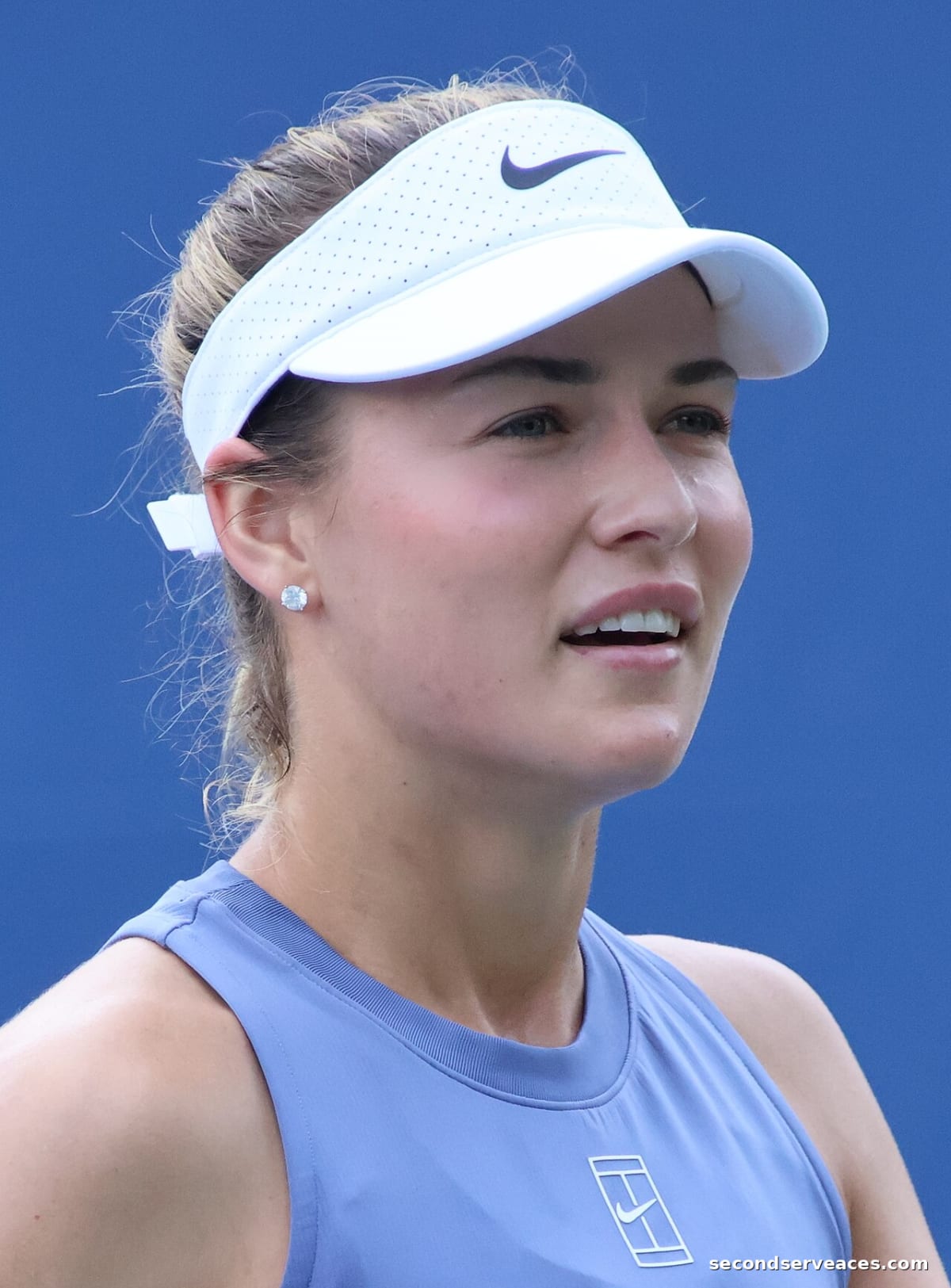
Physical durability remains the ultimate currency on the modern professional tennis tour. At the 2026 Cincinnati Open, the physical toll of high-intensity hard-court tennis was laid bare when Anna Kalinskaya retired during her third-round match against Sorana Cîrstea with the scoreline reading 6-7(4), 6-1, 5-0 ret. The sudden conclusion left fans and analysts dissecting the physical thresholds required to sustain performance at this level.
Listen to the Second Serve Podcast
Get our daily AI-synthesized audio briefings and match reviews on the go.
For Kalinskaya, the match represented a frustrating breakdown of her physical chassis just as the tournament reached its critical business end. Cîrstea, showing remarkable tactical patience, was able to capitalize on her opponent's declining movement before the match was officially called off. The retirement marks another complicated chapter in the Russian's quest for physical consistency on the demanding North American hard courts.
The Cincinnati Physical Breakdown and Mid-Match Retirement
The match began as a highly competitive, baseline-centric affair. In the opening set, Kalinskaya utilized her flat groundstrokes to push Cîrstea deep behind the baseline, eventually forcing a tiebreak. Cîrstea’s defensive resilience ultimately secured the first set 7-6(4), but Kalinskaya responded with immediate tactical adjustments in the second set, leveling the match with a dominant 6-1 performance that showcased her clean ball-striking.
However, the physical demands of the high-temperature hard court quickly began to register. As the third set commenced, Kalinskaya's lateral movement deteriorated rapidly, leading to a quick 5-0 deficit. The structural integrity of her movement was visibly compromised, preventing her from loading on her shots or recovering effectively after wide balls.
Down 0-5 in the deciding set, Kalinskaya called for a medical timeout to receive treatment on her lower back and hip area. Realizing that continuing would risk long-term structural damage to her kinetic chain, she elected to retire. This decision handed Sorana Cîrstea a spot in the fourth round, leaving her just one game shy of a complete statistical victory on court.
Analyzing Kalinskaya's 2026 Durability Metrics
This disappointing exit marks Anna Kalinskaya's second mid-match retirement of the 2026 season. For a player currently positioned at No. 21 in the official WTA rankings, these recurring physical interruptions present a significant barrier to entry for the elite top-10 tier. Consistent performance requires not just high-end skill, but the physical durability to survive consecutive three-set matches.
Standing at 1.75 m (5 ft 9 in), the Russian possesses an aggressive baseline style that relies heavily on explosive hip rotation and lower-back flexibility. When these specific areas suffer from acute fatigue or strain, her ability to generate topspin and maintain depth disappears. Without her signature depth, her defensive limitations are exposed, forcing her to play high-risk tennis from disadvantaged positions.
In contrast, Sorana Cîrstea's ability to absorb pace and extend rallies tested Kalinskaya's physical thresholds to their absolute limit. Cîrstea now advances to the fourth round of the Cincinnati Open, where she is scheduled to face home-favorite Jessica Pegula. We previously analyzed the tactical dynamics of the American's baseline game in our WTA Cincinnati Predictions: Navarro vs. Pegula Odds Analysis.
The Second-Round Triumph Over Caty McNally
Before the physical breakdown in the third round, Kalinskaya demonstrated her immense hard-court capabilities earlier in the tournament. In her second-round match, she secured a convincing 6-3, 6-4 straight-sets victory over American wild card Caty McNally. In that contest, Kalinskaya's movement was fluid, and her lateral recovery times were well within her peak performance metrics.
That victory extended her head-to-head record against McNally to 2-1, proving that when healthy, her aggressive baseline game can dismantle players who rely on variety and net-rushing. Kalinskaya consistently neutralized McNally's slice and serve-and-volley tactics with heavy, dipping passing shots that forced the American into difficult low volleys.
However, the physical load of that high-intensity encounter likely contributed to the subsequent hip and back issues experienced against Cîrstea. The high-friction surface of the Cincinnati hard courts increases the load on a player's joints during sudden deceleration, meaning that even minor mechanical inefficiencies can quickly escalate into acute physical strain.
Future Implications for the Russian's Hard-Court Campaign
At 27 years of age, Anna Kalinskaya is entering her peak athletic window, yet she still seeks her first career singles title on the main WTA Tour. To bridge the gap between being a dangerous top-20 competitor and a genuine title threat, her coaching staff must prioritize physical conditioning and load management over raw technical adjustments.
From a technical gear perspective, managing chronic lower back and hip issues often requires fine-tuning footwear specs to optimize shock absorption without sacrificing traction. The balance between court-grip and slide on hard courts is critical; too much grip increases the torque transmitted to the knees and hips, while too little grip causes micro-slippage that strains the lower back muscles.
As the tour moves closer to the final Grand Slam of the season, Kalinskaya's immediate priority must be rehabilitation. The physical demands of best-of-three-set tennis on hard courts require an uncompromised physical foundation, and her team will need to carefully evaluate her recovery timeline before she takes the court again.
Rivalry Matchup & Player Profiles
To understand the physical and tactical contrast on display, we can examine the player profiles of Anna Kalinskaya and her second-round opponent, Caty McNally, who remains a key yardstick for Kalinskaya's hard-court efficiency.
| Metric | Anna Kalinskaya | Caty McNally |
|---|---|---|
| Rank | 21 | 70 |
| Age | 27 | 24 |
| Country | Russia | United States |
| Height | 1.75 m (5 ft 9 in) | 1.81 m (5 ft 11 in) |
| Handedness | Right-handed | Right-handed |
| Play Style | Aggressive baseliner | All-court player with variety |
| Career Titles | 0 WTA Singles (4 WTA Doubles) | 0 WTA Singles (9 WTA Doubles) |
The head-to-head series between Kalinskaya and McNally currently stands at 2-1 in favor of the Russian. Their matches highlight a fascinating clash of styles: Kalinskaya's linear, aggressive baseline weight of shot against McNally's slice-and-dice variety. While Kalinskaya has historically held the upper hand by dictating from the center of the court, McNally's ability to force low-contact points remains a highly effective counter-strategy on faster surfaces.
Ultimately, Kalinskaya's success against all-court players like McNally is highly dependent on her physical health. When her movement is compromised, she cannot get low enough to handle low slices, which shifts the tactical advantage back to her opponents. Ensuring long-term physical durability remains the primary challenge for the Russian as she navigates the remainder of the hard-court season.
Essential Matchday Add-Ons
Tournament-tested accessories and high-frequency consumables every competitive player keeps in their bag.
Tourna Grip Original Dry Feel Overgrip (10-Pack)
4.8 ★ (12,000+ reviews)
The gold standard for sweaty hands. Proprietary dry feel absorbs moisture better as play intensifies.
Luxilon ALU Power 125 Silver String Set
4.9 ★ (3,500+ reviews)
Unrivaled control and spin potential used by over 50% of the ATP Top 100 players.
Babolat Custom Damp Vibration Dampener (2-Pack)
4.7 ★ (4,200+ reviews)
Customizable dampening with removable central O-ring for fine-tuning court feedback and sound.
Penn Championship Extra Duty Tennis Balls (4-Can Pack)
4.7 ★ (8,900+ reviews)
Official ball of USTA League Tennis with extra-duty felt designed for abrasive hard courts.
Analyze Anna Kalinskaya vs. Caty McNally
Predict tactical adjustments, momentum swings, and serve strategy options for this match-up using our AI simulator.
The Aces Tactical Panel
This report was curated and edited by Bhaskar Goel. Tactical analysis and technical insights were provided by our specialized panel of expert correspondents.
Julian Price
Senior Tactical Correspondent
Stuffy, pedantic British academic and historian specializing in match momentum and historical context.
Elena Cruz
Director of Analytical Research
Data scientist specializing in court surface physics and movement patterns.
Bhaskar
The Editor & Fan
Passionate tennis player and site editor bringing everyday amateur insights and relatable fan commentary.
Arthur Vance
Senior Existential Analyst
Deep, eccentric, and DFW-inspired. Models court metaphysics, kinetic beauty, and player psychology.
Leo Sterling
High-Performance Consultant
Hard-nosed ex-trainer from Melbourne with a no-nonsense view on tour fitness.
Related Reports

Quick Answers
Why did Anna Kalinskaya retire from her Cincinnati Open match against Sorana Cîrstea?+
Anna Kalinskaya retired during the third set while trailing 6-7(4), 6-1, 5-0 due to physical issues, receiving medical treatment on her lower back and hip area before stopping play.
What is the head-to-head record between Anna Kalinskaya and Caty McNally?+
Anna Kalinskaya leads her head-to-head series against Caty McNally 2-1, following her straight-sets victory (6-3, 6-4) in the second round of the 2026 Cincinnati Open.
Who will Sorana Cîrstea play next after Kalinskaya's retirement?+
Following her third-round victory over Kalinskaya, Sorana Cîrstea advanced to the fourth round of the Cincinnati Open to face Jessica Pegula.