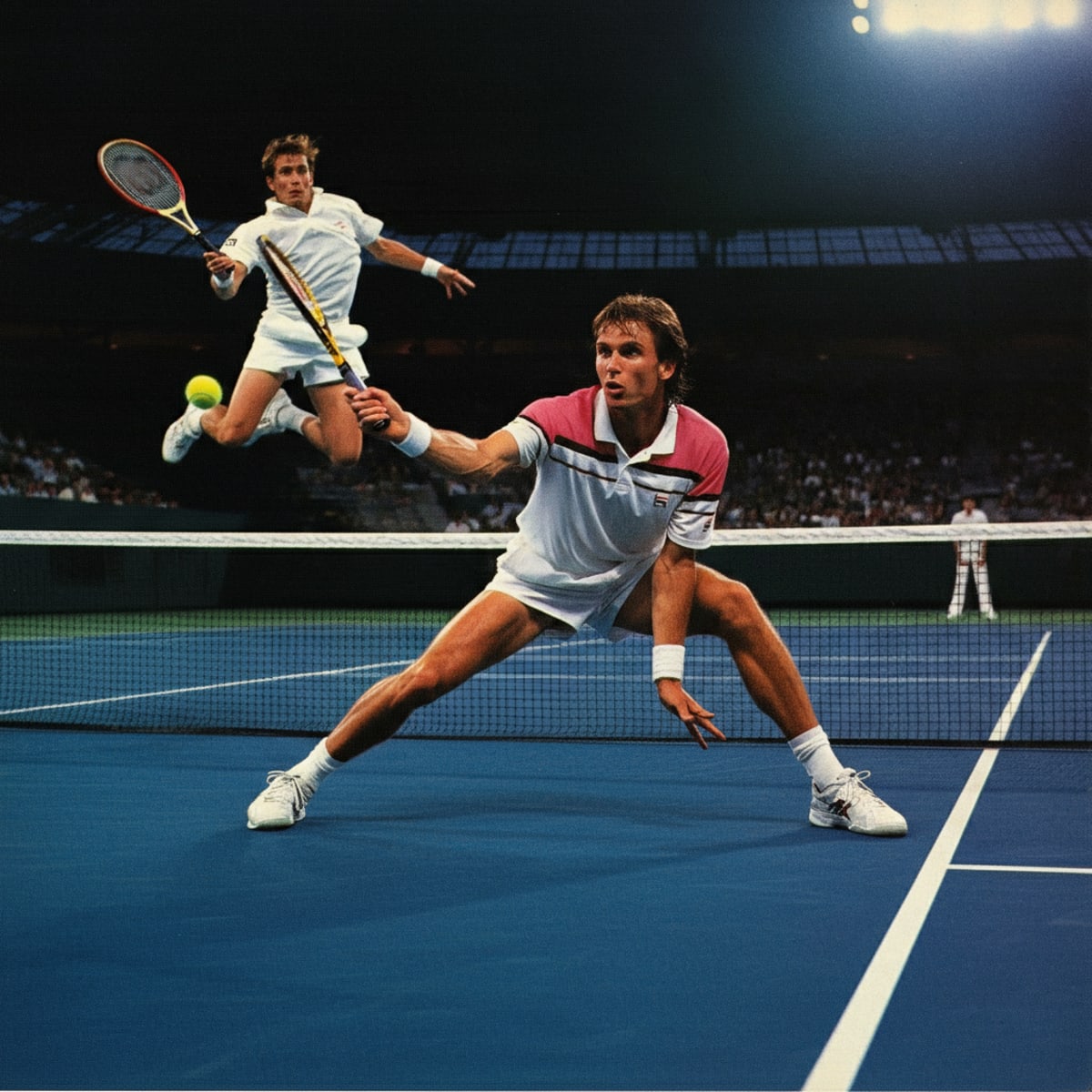
A single, subtle physical tell transformed one of the greatest rivalries of the 1990s.
Greetings, racquet enthusiasts! Julian Price here, dusting off the archives to explore one of the most delightful and downright bizarre tactical quirks in the storied history of the ATP Tour. We often marvel at the thunderous topspin and blistering footwork of the sport's greatest champions, but occasionally, the grandest stages are conquered by the smallest, strangest details.
Case in point: the legendary skirmishes between "The Las Vegas Kid," Andre Agassi, and Germany's "Boom Boom," Boris Becker. For years, a hidden variable lurked within their matchups, a micro-expression that completely flipped the script of their rivalry.
The 0-3 Hole and the Grand Discovery
Before the 1990s commenced, Becker effectively owned the matchup. The German powerhouse had raced to a pristine 0-3 head-to-head advantage over Agassi across the 1988 and 1989 seasons. Becker's serve was a terrifying weapon—a heavy, booming delivery that routinely bullied opponents facing a pivotal Break Point.
Yet, Agassi—blessed with perhaps the sharpest eyes to ever track a fluorescent fuzzball—cracked the code. He discovered that Becker possessed a subconscious physical tell. During his elaborate service motion, Becker's tongue would subtly protrude.
- If the tongue rested in the middle: The serve was hurtling straight down the T or directly into the body.
- If the tongue slid to the side: The serve was destined out wide.
Armed with this bizarre but infallible intelligence, Agassi completely flipped the Match Momentum for a decade. He rattled off an astonishing 10-1 record against Becker from 1990 to 1999.
The Wimbledon Hiccup and the Oktoberfest Confession
Naturally, maintaining a flawless deception against a champion of Becker's caliber is nearly impossible. The singular blemish during Agassi's decade of supremacy arrived on the hallowed lawns of the All England Club. In a fiercely contested 1995 Wimbledon semifinal, Becker finally struck back, snapping an agonizing eight-match losing streak against his rival.
For years, Becker remained entirely in the dark regarding why his American foe was seemingly reading his mind. It wasn't until both men had hung up their racquets that the truth emerged. Agassi eventually confessed his espionage to Becker in the most fitting venue imaginable: over a frosty pint of beer at an Oktoberfest celebration in Germany.
The Tactical Breakdown
Analyzing this rivalry requires us to look beyond mere racquet speed and examine the cognitive mechanics of the return. Agassi built his entire hall-of-fame career on taking the ball exceptionally early. By standing inside the baseline, he robbed servers of their reaction time. However, to execute this aggressive court geometry, anticipating the serve's direction is paramount.
Becker's serve relied on disguise and pure velocity. When a server steps to the line, the returner is scanning for any physiological hints—a slightly different ball toss, a shifted grip, or a varied knee bend. By isolating the tongue placement, Agassi eliminated the guesswork. Knowing a serve was heading down the T allowed Agassi to commit his weight forward a fraction of a second earlier, absorbing the pace rather than lunging defensively. It is a stunning reminder that at the highest echelons of professional tennis, pattern recognition frequently trumps raw athletic power.
The Bigger Picture
This revelation enriches the lore of tennis rivalries. The cat-and-mouse dynamic between Agassi and Becker underscores a timeless truth of the sport: the most crucial battles are fought between the ears.
When we evaluate modern tactical battles—such as the relentless adjustments between Rafael Nadal and Carlos Alcaraz—we see the modern evolution of this same concept. Today's superstars rely on exhaustive video analysis and biometric tracking to uncover similar tells. Yet, there is an enduring, whimsical charm in knowing that one of the fiercest rivalries of the 1990s was profoundly altered not by a revolutionary composite racquet, but by a wandering tongue.
The Aces Tactical Panel
This report was curated and edited by Bhaskar Goel. Tactical analysis and technical insights were provided by our specialized panel of expert correspondents.
Julian Price
Senior Tactical Correspondent
Distinguished British academic and historian specializing in match momentum.
Elena Cruz
Director of Analytical Research
Data scientist specializing in court surface physics and movement patterns.
Marcus Thorne
Global Tour Insider
Veteran reporter with deep ties to the global ATP/WTA locker rooms since '98.
Arthur Vance
Technical Equipment Analyst
Former club player obsessed with technical specs, racket tension, and underdog grit.
Leo Sterling
High-Performance Consultant
Hard-nosed ex-trainer from Melbourne with a no-nonsense view on tour fitness.