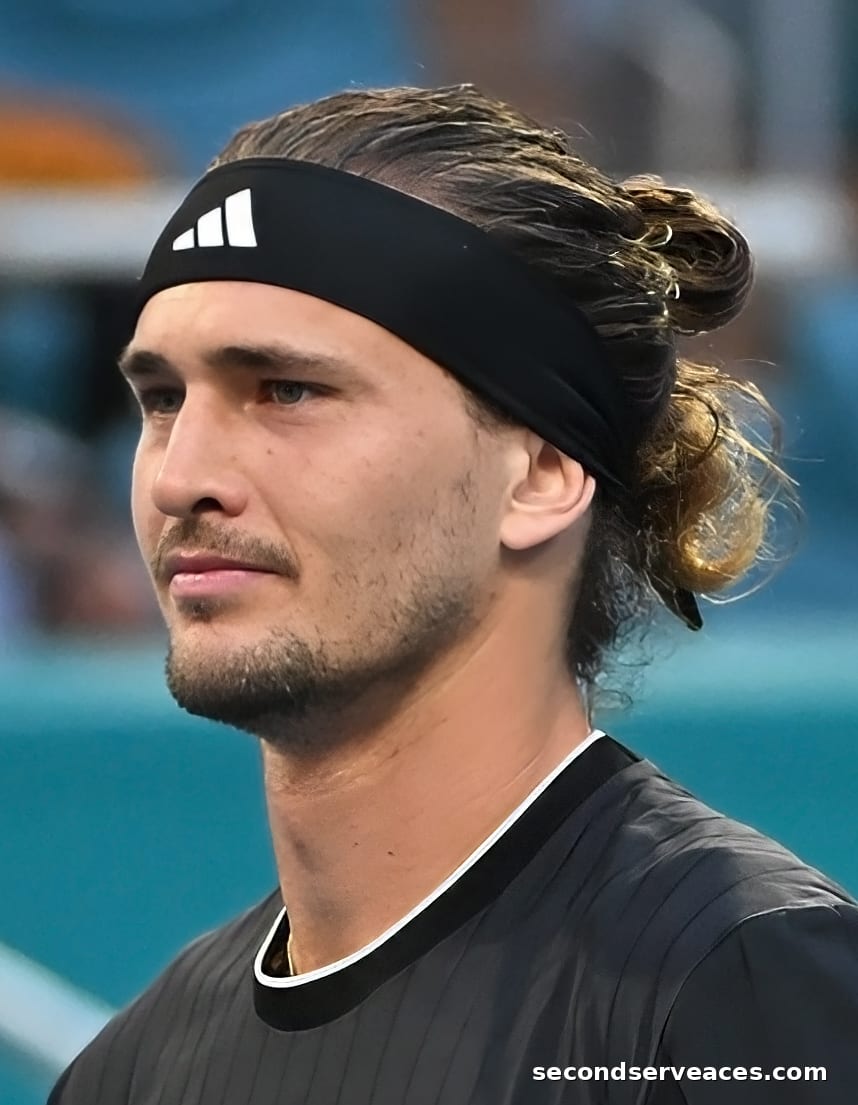
There is a distinct, physical reality to the way Alexander Zverev occupies a tennis court. At 6'6", the German moves with a synchronized fluidity that defies the traditional limitations of his height. His recent triumph at the US Open, where he secured his second Grand Slam title, was a testament to this physical resilience. Yet, the conversation surrounding his achievement has quickly shifted from the court to the press room, ignited by a protective family defense that has polarized the tennis community.
Listen to the Second Serve Podcast
Get our daily AI-synthesized audio briefings and match reviews on the go.
The Flushing Meadows Breakthrough Against Ben Shelton
Alexander Zverev's path to his second Grand Slam title culminated in a physical showcase against the explosive Ben Shelton. To neutralize Shelton's thunderous left-handed serve, Zverev relied on a deeply anchored platform stance, a mechanical choice that allowed him to maintain structural stability on the high-friction hard courts of Arthur Ashe Stadium. By utilizing a highly disciplined continental grip on his backhand volley, Zverev successfully intercepted Shelton's passing shots, turning defensive situations into offensive transitions.
The footwork required for Zverev to defend the baseline is immense. Unlike smaller, more compact players who rely on rapid, short-stepping adjustments, Zverev employs an open-stance recovery slide. This allows him to absorb heavy topspin and recover back to the center mark with minimal energy expenditure. This mechanical efficiency was crucial in wearing down Shelton, whose high-octane game began to fray under the relentless pressure of Zverev's deep-court positioning.
This physical resilience stands in stark contrast to the challenges faced by other top-tier competitors during the grueling North American swing. The demands of the hard-court season frequently force elite athletes to make difficult scheduling decisions to protect their bodies. We saw a similar dynamic recently when Amanda Anisimova withdrew from her Singapore commitments to focus on physical recovery, highlighting the delicate balance players must strike between competitive ambition and physical preservation.
Brotherly Defense and the Durability Debate
The aftermath of Zverev's New York victory has been heavily shaped by his older brother, Mischa Zverev. The former world No. 25 publicly warded off critics of Sascha's schedule and playstyle by turning the focus toward his primary rivals, Jannik Sinner and Carlos Alcaraz. Mischa boldly asserted that Sinner and Alcaraz simply lack the sheer physical robustness required for long-term dominance, pointing to their frequent injury layoffs as evidence of structural vulnerability that detracts from their on-court brilliance.
This claim has ignited a firestorm of backlash among tennis purists, particularly when examining the head-to-head matchups. According to official ATP Tour data, Jannik Sinner holds a commanding 11-4 head-to-head advantage over Alexander Zverev. Sinner’s modern closed-stance sliding and extreme Eastern forehand grip have repeatedly dismantled Zverev's defensive positioning, suggesting that when healthy, the Italian possesses a distinct tactical edge that transcends mere physical durability.
Similarly, the rivalry with Carlos Alcaraz remains highly competitive, with the young Spaniard leading Zverev 7-6 in their head-to-head encounters. Alcaraz’s kinetic court coverage and explosive semi-western forehand present a persistent threat to Zverev's deep-court positioning. Mischa's comments, therefore, attempt to shift the narrative from raw tactical superiority to a question of pure physical endurance and availability, arguing that a player's greatest ability is, ultimately, their availability.
The Bologna Outburst and Davis Cup Frustrations
Beyond personal rivalries, Alexander Zverev has turned his analytical gaze toward the institutional structures governing the sport. The newly crowned US Open champion did not mince words when discussing the current state of international team competition. He directed sharp criticism at the modern format of the Davis Cup, specifically targeting the group stage matches held in Bologna, which have drawn ire from several top professionals.
Zverev characterized the Bologna matches as "absolute rubbish," a blunt assessment that highlights the growing rift between elite players and the International Tennis Federation (ITF). The grueling scheduling demands, which require players to transition rapidly from individual Grand Slam pressure to team-based ties on different continents, have long been a point of contention for players trying to manage their physical workloads.
This outspoken stance reflects Zverev's broader frustration with the tennis calendar. The physical toll of maintaining a peak performance level across multiple surfaces is immense, and Sascha's critique underscores the delicate balance between commercial expansion and player welfare. It is a structural conflict that continues to divide the locker room and shape the scheduling decisions of the world's best players.
From the Citi Open to the Grand Slam Stage
To understand the unique bond and contrasting philosophies of the Zverev brothers, one must look back at their rare professional encounters. The two have met only once on the ATP Tour, a memorable Round of 16 clash at the 2018 Citi Open in Washington. On that day, the younger Alexander defeated Mischa 6-3, 7-5, showcasing a passing of the torch within the family hierarchy and establishing Sascha as the premier force in German tennis.
The match was a fascinating study in contrasting styles. Mischa, a classic left-handed serve-and-volleyer, relied on a delicate continental grip, chip-and-charge tactics, and exquisite net play. Alexander, conversely, represented the evolution of the heavy baseline game: an aggressive baseliner standing 6'6", utilizing a powerful semi-western forehand and a dominant two-handed backhand to dictate play from deep behind the baseline.
This stylistic divergence has shaped their post-playing relationship, with Mischa transitioning into a protective coaching and media role. His recent defense of Sascha’s US Open victory is not merely brotherly loyalty; it is an endorsement of the heavy, baseline-centric physical style that Sascha has perfected, even as the tennis world debates whether durability should eclipse head-to-head records in defining greatness.
Rivalry Matchup & Player Profiles
| Metric | Alexander Zverev | Mischa Zverev |
|---|---|---|
| Rank | No. 2 | Retired (Career-high No. 25) |
| Age | 29 | 39 |
| Country | Germany | Germany |
| Height | 6'6" (1.98 m) | 6'3" (1.91 m) |
| Handedness | Right-handed | Left-handed |
| Play Style | Aggressive baseliner | Classic serve-and-volleyer |
| Career Titles | 26 singles titles (2 Grand Slams) | 1 singles title (4 doubles titles) |
The head-to-head history between the Zverev brothers remains limited to their singular encounter at the 2018 Citi Open, where Alexander secured a straight-sets victory. This match highlighted the tactical shift in tennis, as Mischa's traditional serve-and-volley tactics were systematically dismantled by Alexander's heavy passing shots and superior baseline court coverage.
While Mischa's career was defined by net rushing and tactical variety, Alexander's ascendancy to No. 2 in the world has been built on physical endurance and backhand stability. This contrast in styles explains Mischa's analytical focus on physical durability; having played a style that required explosive forward movement, he understands the physical toll of the tour, framing his brother's robust health as a primary competitive advantage over more fragile rivals like Sinner and Alcaraz.
What Alexander Zverev Plays With
Head Gravity Pro
Head Hawk Touch 1.25
Head Prime Tour (12-Pack)
Analyze Alexander Zverev vs. Mischa Zverev
Predict tactical adjustments, momentum swings, and serve strategy options for this match-up using our AI simulator.
The Aces Tactical Panel
This report was curated and edited by Bhaskar Goel. Tactical analysis and technical insights were provided by our specialized panel of expert correspondents.
Julian Price
Senior Tactical Correspondent
Stuffy, pedantic British academic and historian specializing in match momentum and historical context.
Elena Cruz
Director of Analytical Research
Data scientist specializing in court surface physics and movement patterns.
Bhaskar
The Editor & Fan
Passionate tennis player and site editor bringing everyday amateur insights and relatable fan commentary.
Arthur Vance
Senior Existential Analyst
Deep, eccentric, and DFW-inspired. Models court metaphysics, kinetic beauty, and player psychology.
Leo Sterling
High-Performance Consultant
Hard-nosed ex-trainer from Melbourne with a no-nonsense view on tour fitness.
Related Reports
Quick Answers
Who did Alexander Zverev defeat to win the US Open?+
Alexander Zverev defeated Ben Shelton to secure his first US Open title and second Grand Slam title.
What was Mischa Zverev's defense of his brother Alexander?+
Mischa Zverev argued that rivals Jannik Sinner and Carlos Alcaraz are not strong enough because they frequently suffer from injuries.
What are the head-to-head records between Alexander Zverev and his rivals Jannik Sinner and Carlos Alcaraz?+
Jannik Sinner leads Alexander Zverev 11-4 in their head-to-head matchups, while Carlos Alcaraz holds a 7-6 lead over Zverev.